ثبت نام / ورود
0
ثبت نام / ورود
0
John Hull
#Markets
#Swaps
#Stock
#Financial
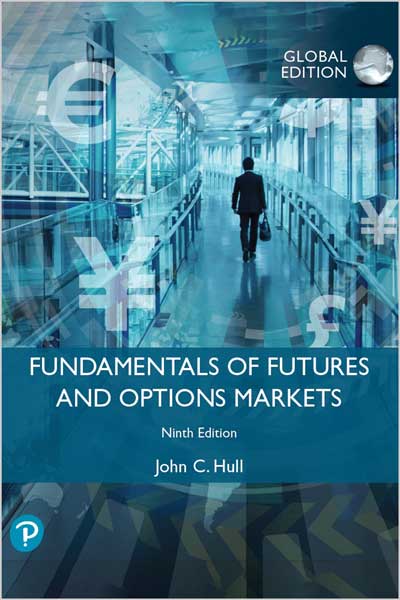
This title is a Pearson Global Edition. The Editorial team at Pearson has worked closely with educators around the world to include content which is especially relevant to students outside the United States. For courses in derivatives, options and futures, financial engineering, financial mathematics, and risk management. An Easily Understandable Introduction to Futures and Options Markets Fundamentals of Futures and Options Markets covers much of the same material as Hull’s acclaimed title, Options, Futures, and Other Derivatives. However, this text simplifies the language for a less mathematically sophisticated audience. Omitting calculus completely, the book is suitable for any graduate or undergraduate course in business, economics, and other faculties. The Ninth Edition, Global Edition, has a flexible structure that can be used for any course length. Instructors can choose to cover only the first 12 chapters, finishing with binomial trees, or to cover chapters 13-25 in a variety of different sequences. Each chapter from 18 onwards can be taught independently as its own unit. No matter how you elect to divide the material, Fundamentals of Futures and Options Markets offers a wide audience a sound and easy-to-grasp introduction into financial mathematics.
Table of Contents
Chapter 1: Introduction
Chapter 2: Futures Markets and Central Counterparties
Chapter 3: Hedging Strategies Using Futures
Chapter 4: Interest Rates
Chapter 5: Determination of Forward and Futures Prices
Chapter 6: Interest Rates Futures
Chapter 7: Swaps
Chapter 8: Securitization and the Credit Crisis of 2007
Chapter 9: Mechanics of Options Markets
Chapter 10: Properties of Stock Options
Chapter 11: Trading Strategies Involving Options
Chapter 12: Introduction to Binomial Trees
Chapter 13: Valuing Stock Options: The Black-Scholes-Merton Model
Chapter 14: Employee Stock Options
Chapter 15: Options on Stock Indices and Currencies
Chapter 16: Futures Options and Black's Model
Chapter 17: The Greek letters
Chapter 18: Binomial Trees in Practice
Chapter 19: Volatility Smiles
Chapter 20: Value at Risk and Expected Shortfall
Chapter 21 : Interest Rate Options
Chapter 22: Exotic Options and Other Nonstandard Products
Chapter 23: Credit Derivatives
Chapter 24: Weather, Energy, and Insurance Derivatives
Chapter 25: Derivatives Mishaps and What We Can l earn from Them
Answers to Quiz Questions
About the Author
John C. Hull is a Professor of Derivatives and Risk Management at the Rotman School of Management at the University of Toronto.
He is a respected researcher in the academic field of quantitative finance (see for example the Hull-White model) and is the author of two books on financial derivatives that are widely used texts for market practitioners: "Options, Futures, and Other Derivatives" and "Fundamentals of Futures and Options Markets".
Hull is an editor of the Journal of Derivatives (since 1993), The Review of Derivatives Research (since 1993), the Journal of Derivatives Use, Trading & Regulation (since 1994), the Canadian Journal of Administrative Studies (since 1996), the Journal of Risk (since 1998), the Journal of Bond Trading and Management (since 2001), the Journal of Derivatives Accounting (since 2002) and the Journal of Credit Risk (since 2004).
He studied Mathematics at Cambridge University (B.A. & M.A.), and holds an M.A. in Operational Research from Lancaster University and a Ph.D. in Finance from Cranfield University. In 1999, he was awarded the Financial Engineer of the Year Award, by the International Association of Financial Engineers. He has twin sons named Peter and David, and a wife named Michelle.