ثبت نام / ورود
0
ثبت نام / ورود
0
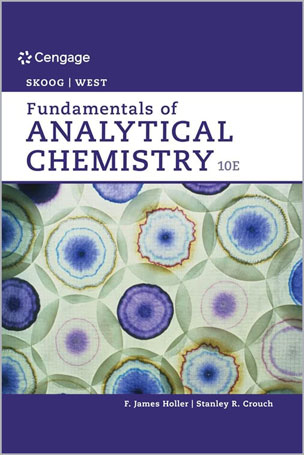
Douglas A. Skoog, Donald M. West, F. James Holler, Stanley R. Crouch
#Chemistry
#Chemical_Equilibria
#Electrochemistry
#Molecular
#Spectroscopy
Discover the principles and practices behind analytical chemistry as you study its applications in medicine, industry and the sciences with Skoog/West/Holler/Crouch's FUNDAMENTALS OF ANALYTICAL CHEMISTRY, 10th Edition. This award-winning author team presents the latest developments in analytical chemistry today using a reader-friendly yet systematic and thorough approach. Each chapter begins with a compelling story and stunning visuals. Dynamic photos from renowned chemistry photographer Charlie Winters capture attention while reinforcing key principles. New features highlight chemistry-related careers. You also learn how to use Excel 2019 as a problem-solving tool in analytical chemistry with new exercises, examples and a no-cost supplement by the text authors. OWLv2 online homework tool is also available to help you master the principles of analytical chemistry today.
Table of Contents
Chapter 1 The Nature of Analytical Chemistry
PART I QUALITY OF ANALYTICAL MEASUREMENTS
Chapter 2 Calculations Used in Analytical Chemistry
Chapter 3 Precision and Accuracy of Chemical Analyses
Chapter 4 Random Errors in Chemical Analysis
Chapter 5 Statistical Data Treatment and Evaluation
Chapter 6 Sampling, Standardization, and Calibration
PART II CHEMICAL EQUILIBRIA
Chapter 7 Aqueous Solutions and Chemical Equilibria
Chapter 8 Effect of Electrolytes on Chemical Equilibria
Chapter 9 Solving Equilibrium Problems for Complex Systems
PART III CLASSICAL METHODS OF ANALYSIS
Chapter 10 Gravimetric Methods of Analysis
Chapter 11 Titrations in Analytical Chemistry
Chapter 12 Principles of Neutralization Titrations
Chapter 13 Complex Acid-Base Systems
Chapter 14 Applications of Neutralization Titrations
Chapter 15 Complexation and Precipitation Reactions and Titrations
PART IV ELECTROCHEMICAL METHODS
Chapter 16 Introduction to Electrochemistry
Chapter 17 Applications of Standard Electrode Potentials
Chapter 18 Applications of Oxidation/Reduction Titrations
Chapter 19 Potentiometry
Chapter 20 Bulk Electrolysis: Electrogravimetry and Coulometry
Chapter 21 Voltammetry
PART V SPECTROCHEMICAL ANALYSIS
Chapter 22 Introduction to Spectrochemical Methods
Chapter 23 Instruments for Optical Spectrometry
Chapter 24 Molecular Absorption Spectrometry
Chapter 25 Molecular Fluorescence Spectroscopy
Chapter 26 Atomic Spectroscopy
Chapter 27 Mass Spectrometry
PART VII PRACTICAL ASPECTS OF CHEMICAL ANALYSIS
Chapter 33 The Analysis of Real Samples
Chapter 34 Preparing Samples for Analysis
Chapter 35 Decomposing and Dissolving the Sample
Chapter 36 Chemicals, Apparatus, and Unit Operations of Analytical Chemistry
Chapter 37 Selected Methods of Analysis
Appendix 1 The Literature of Analytical Chemistry
Appendix 2 Solubility Product Constants at 25°C
Appendix 3 Acid Dissociation Constants at 25°C
Appendix 4 Formation Constants at 25°C
Appendix 5 Standard and Formal Electrode Potentials
Appendix 6 Use of Exponential Numbers and Logarithms
Appendix 7 Volumetric Calculations Using Normality and Equivalent Weight
Appendix 8 Compounds Recommended for the Preparation of Standard Solutions of Some Common Elements
Appendix 9 Derivation of Error Propagation Equations
Answers to Selected Questions and Problems
Douglas A. Skoog (deceased) was a professor of chemistry at Stanford University and the lead author of several best-selling texts during his career. He earned a B.S. in chemistry from Oregon State University and his Ph.D. in analytical chemistry from the University of Illinois. Dr. Skoog was the 1999 recipient of the American Chemical Society award in analytical chemistry, sponsored by the Fisher Scientific Company. The same year, he was named a fellow of the American Association for the Advancement of Science. In 1993, he received the ACS Division of Analytical Chemistry Award for Excellence in Teaching.
Donald M. West (deceased) was a professor of chemistry at San Jose State University.
F. James Holler is professor emeritus of chemistry and is a recipient of the Alumni Association Great Teacher Award at the University of Kentucky. He received his Ph.D. from Michigan State University. In addition to his role as co-author of several bestselling texts, he is co-creator of the world-famous Periodic Table of Comic Books.
Stanley R. Crouch is professor emeritus at Michigan State University. He received his undergraduate and M.S. degrees from Stanford University and his Ph.D. in analytical chemistry from the University of Illinois. He is the recipient of the 2001 American Chemical Society Division of Analytical Chemistry Award in Chemical Instrumentation and the 1996 ACS Division of Analytical Chemistry Award for Excellence in Teaching.