ثبت نام / ورود
0
ثبت نام / ورود
0
John D. Anderson, Jr.
#Aerodynamics
#Airfoils
#Linear_Theory
#physical
#Nonlinear
#Shock_Waves
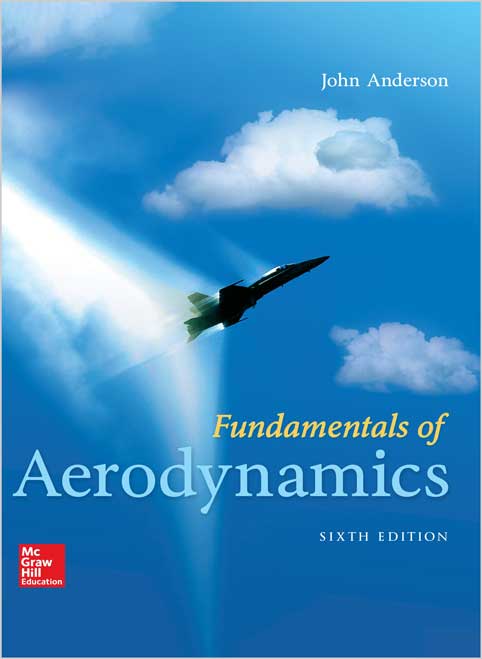
Fundamentals of Aerodynamics is meant to be read. The writing style is intentionally conversational in order to make the book easier to read. The book is designed to talk to the reader; in part to be a self-teaching instrument.
Learning objectives have been added to each chapter to reflect what is believed to be the most important items to learn from that particular chapter. This edition emphasizes the rich theoretical and physical background of aerodynamics, and marbles in many historical notes to provide a background as to where the aerodynamic technology comes from.
Also, new with this edition, are "Integrated Work Challenges" that pertain to the chapter as a whole, and give the reader the opportunity to integrate the material in that chapter, in order to solve a "bigger picture".
McGraw-Hill's Connect, is also available as an optional, add on item. Connect is the only integrated learning system that empowers students by continuously adapting to deliver precisely what they need, when they need it, how they need it, so that class time is more effective. Connect allows the professor to assign homework, quizzes, and tests easily and automatically grades and records the scores of the student's work. Problems are randomized to prevent sharing of answers an may also have a "multi-step solution" which helps move the students' learning along if they experience difficulty.
Chapter
PART 1: Fundamental Principles
Chapter 1: Aerodynamics: Some Introductory Thoughts
Chapter 2: Aerodynamics: Some Fundamental Principles and Equations
PART 2: Inviscid, Incompressible Flow
Chapter 3: Fundamentals of Inviscid, Incompressible Flow
Chapter 4: Incompressible Flow over Airfoils
Chapter 5: Incompressible Flow over Finite Wings
Chapter 6: Three-Dimensional Incompressible Flow
PART 3: Inviscid, Compressible Flow
Chapter 7: Compressible Flow: Some Preliminary Aspects
Chapter 8: Normal Shock Waves and Related Topics
Chapter 9: Oblique Shock and Expansion Waves
Chapter 10: Compressible Flow Through Nozzles, Diffusers, and Wind Tunnels
Chapter 11: Subsonic Compressible Flow over Airfoils: Linear Theory
Chapter 12: Linearized Supersonic Flow
Chapter 13: Introduction to Numerical Techniques for Nonlinear Supersonic Flow
Chapter 14: Elements of Hypersonic Flow
PART 4: Viscous Flow
Chapter 15: Introduction to the Fundamental Principles and Equations of Viscous Flow
Chapter 16: A Special Case: Couette Flow
Chapter 17: Introduction to Boundary Layers
Chapter 18: Laminar Boundary Layers
Chapter 19: Turbulent Boundary Layers
Chapter 20: Navier-Stokes Solutions: Some Examples
Appendix A: isentropic Flow Properties
Appendix B: Normal Shock Properties
Appendix C: Prandtl-Meyer Function and Mach Angle
Appendix D: Standard Atmosphere, SI Units
Appendix E: Standard Atmosphere, English Engineering Units
References
Index
John D. Anderson, Jr., was born in Lancaster, Pennsylvania, on October 1, 1937. He attended the University of Florida, graduating in 1959 with high honors and a Bachelor of Aeronautical Engineering Degree. From 1959 to 1962, he was a Lieutenant and Task Scientist at the Aerospace Research Laboratory at Wright-Patterson Air Force Base. From 1962 to 1966, he attended the Ohio State University under the National Science Foundation and NASA Fellowships, graduating with a PhD in Aeronautical and Astronautical Engineering. In 1966, he joined the U.S. Naval Ordnance Laboratory as Chief of the Hypersonics Group. In 1973, he became Chairman of the Department of Aerospace Engineering at the University of Maryland, and since 1980 has been Professor of Aerospace Engineering at the University of Maryland. In 1982, he was designated a Distinguished Scholar/Teacher by the University. During 1986–1987, while on sabbatical from the University, Dr. Anderson occupied the Charles Lindbergh Chair at the National Air and Space Museum of the Smithsonian Institution. He continued with the Air and Space Museum one day each week as their Special Assistant for Aerodynamics, doing research and writing on the History of Aerodynamics. In addition to his position as Professor of Aerospace Engineering, in 1993, he was made a full faculty member of the Committee for the History and Philosophy of Science and in 1996 an affiliate member of the History Department at the University of Maryland. In 1996, he became the Glenn L. Martin Distinguished Professor for Education in Aerospace Engineering. In 1999, he retired from the University of Maryland and was appointed Professor Emeritus. He is currently the Curator for Aerodynamics at the National Air and Space Museum, Smithsonian Institution.