ثبت نام / ورود
0
ثبت نام / ورود
0
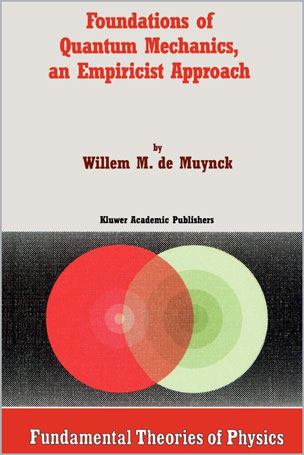
Willem M. de Muynck
#Quantum
#Mechanics
#Empiricist
Taking a new perspective provided by a generalization of the mathematical formalism encompassing positive operator-valued measures, this book views old and new problems of the foundations of quantum mechanics. It demonstrates the crucial role of the generalized formalism in fundamental issues and practical applications.
In this book old and new problems of the foundations of quantum mechanics are viewed from the new perspective provided by a generalization of the mathematical formalism of that theory encompassing so-called positive operator-valued measures. At its inception the standard formalism of quantum mechanics as developed by Dirac and von Neumann seemed to yield the natural mathematical framework for describing the microscopic world of atoms and subatomic objects. In particular, Hermitian operators seemed to be able to replace the phase space functions of classical mechanics as mathematical representations of physical quantities. For a large part of the century axiomatic systems were set up, based on this latter idea. Only in the second half of that century, starting with the pioneering work by Davies and Lewis it was gradually realized that Hermitian operators constitute too narrow a framework to encompass all experiments possible in the atomic domain.
Table of Contents
1 Standard and generalized formalisms of quantum mechanics
2 Empiricist and realist interpretations of quantum mechanics
3 Quantum mechanical description of measurement, and the “measurement problem”
4 The Copenhagen interpretation
5 The Einstein-Podolsky-Rosen problem
6 Individual-particle and ensemble interpretations of quantum mechanics
7 Generalized quantum mechanics
8 Applications of generalized quantum mechanics
9 The Bell inequality in quantum mechanics
10 Subquantum or hidden-variables theories
A Mathematical appendix