ثبت نام / ورود
0
ثبت نام / ورود
0
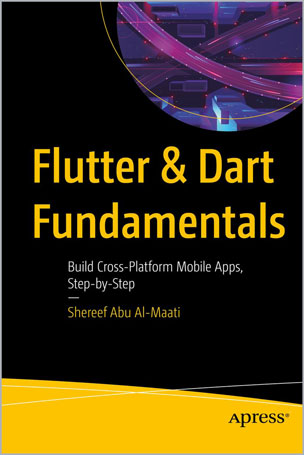
Build Cross-Platform Mobile Apps, Step by Step
Shereef Abu Al-Maati
#Flutter
#Dart
#Mobile_Apps
#JSON
#APls
Google’s Flutter is one of today’s fastest-growing frameworks for cross-platform mobile development, but most resources leave beginners overwhelmed. This book is a comprehensive, classroom-tested guide that teaches students and self-learners to master Flutter, starting from the Dart language and progressing to complete mobile applications.
Unlike the fragmented tutorials scattered across the web, this book follows a single, coherent path that has been refined over two semesters of teaching undergraduates. It takes a deliberate Dart-first approach: Readers build a real command of the language, including variables, control flow, functions, collections, object-oriented programming, and null safety, before writing a single line of Flutter. That foundation is what separates developers who can only copy code from those who can reason about it and build apps that hold up.
From there, the chapters move through Flutter’s widget system, responsive layouts, state management, navigation, user input, dynamic lists, asynchronous programming, and integration with live data and JSON APIs. Every Flutter chapter has readers building a running app around a single concept, reinforced with hands-on exercises, and the final chapters culminate in several complete applications, from a full task manager to apps that pull real data from the web, which readers can add to their portfolio.
Organized into 27 short, focused chapters that each tackle just one or two ideas, the book works equally well for self-study and as an adoption-ready text for a semester-long course or bootcamp. By the end of the book, readers will have moved from knowing some code to building and shipping real cross-platform apps for Android, iOS, web, and desktop, with the confidence to keep building on their own.
What You Will Learn:
Who This Book Is For:
The beginner who knows some code: university students, bootcamp attendees, and self-taught developers who have basic programming knowledge and want to build real mobile apps. Experience with Dart or Flutter is not required as the book moves step by step with one concept at a time through Dart's essentials and into Flutter. Instructors will appreciate the modular design that maps cleanly onto a semester or bootcamp format, and chapters that stand alone or can be adapted to different course paces.
Table of Contents
Chapter 1: Introduction to Flutter and Dart
Chapter 2: Dart Foundations
Chapter 3: Control Flow and Loops
Chapter 4: Working with Lists
Chapter 5: Functions
Chapter 6: Classes and Objects
Chapter 7: Inheritance and Beyond
Chapter 8: From Dart to Flutter
Chapter 9: Understanding MaterialApp
Chapter 10: MaterialApp and Scaffold
Chapter 11: Understanding Stateless Widgets
Chapter 12: Images in Flutter
Chapter 13: Rows, Columns, and Containers
Chapter 14: Using GestureDetector for Interaction
Chapter 15: StatefulWidget: Building a Dynamic UI
Chapter 16: Buttons and Layout Helpers: Expanded and SizedBox
Chapter 17: Working with TextField
Chapter 18: Exploring ListView
Chapter 19: Exploring ListView.builder
Chapter 20: Dialog Boxes and User Input
Chapter 21: Building a To-Do List App
Chapter 22: Flutter Navigator: Navigating Between Screens
Chapter 23: Flutter Navigator: Navigating Between Three Screens
Chapter 24: Full Task List App with Add, Delete, and Detail View
Chapter 25: Asynchronous Programming in Dart and Flutter
Chapter 26: Working with Web APls and JSON
Chapter 27: Using SharedPreferences in Flutter
Shereef Abu Al-Maati is an Associate Professor of Computer Science at the American University of Kuwait (AUK), an institution partnered with Dartmouth College. One of AUK's founding faculty members, he has spent more than 20 years turning beginning programmers into confident developers. The clear, step-by-step approach in this book was refined in his own classrooms, where he teaches mobile development with Flutter and Dart.
Dr. Abu Al-Maati's teaching is backed by substantial industry experience. At the Kuwait Institute for Scientific Research, he worked alongside international partners, including IBM, Martin Marietta Data Systems, and the US Navy, to build mission-critical software that automated the operational readiness of the Kuwait Air Force. As an independent consultant, he designed and developed one of the first web-based asset portfolio management systems for the Kuwait Stock Exchange.
At AUK, Dr. Abu Al-Maati served as founding Division Head of Sciences & Engineering and later as Department Chair of Computer Science & Information Systems, where he substantially modernized the curricula to keep them current and industry-relevant. He was also a founding board member of Kuwait's National Bureau for Academic Accreditation and Quality Assurance, the government agency for the Ministry of Higher Education, and co-authored a chapter in the Springer book, Machine Learning for Real World Applications. With this book on Flutter and Dart fundamentals, he brings that same classroom-tested approach to readers everywhere, guiding them step by step from their first line of Dart to complete cross-platform apps.