ثبت نام / ورود
0
ثبت نام / ورود
0
Patrick Morandi
#Field
#Galois_Theory
#Hilbert_Theorem
#Cohomology
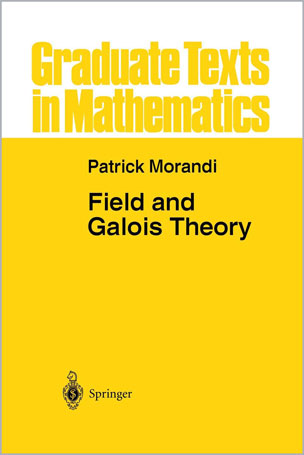
In the fall of 1990, I taught Math 581 at New Mexico State University for the first time. This course on field theory is the first semester of the year-long graduate algebra course here at NMSU. In the back of my mind, I thought it would be nice someday to write a book on field theory, one of my favorite mathematical subjects, and I wrote a crude form of lecture notes that semester. Those notes sat undisturbed for three years until late in 1993 when I finally made the decision to turn the notes into a book. The notes were greatly expanded and rewritten, and they were in a form sufficient to be used as the text for Math 581 when I taught it again in the fall of 1994. Part of my desire to write a textbook was due to the nonstandard format of our graduate algebra sequence. The first semester of our sequence is field theory. Our graduate students generally pick up group and ring theory in a senior-level course prior to taking field theory. Since we start with field theory, we would have tojump into the middle of most graduate algebra textbooks. This can make reading the text difficult by not knowing what the author did before the field theory chapters. Therefore, a book devoted to field theory is desirable for us as a text. While there are a number of field theory books around, most of these were less complete than I wanted.
Table of Contents
I Galois Theory
1 Field Extensions
2 Automorphisms.
3 Normal Extensions
4 Separable and Inseparable Extensions
5 The Fundamental Theorem of Galois Theory
II Some Galois Extensions
6 Finite Fields
7 Cyclotomic Extensions
8 Norms and Traces
9 Cyclic Extensions
10 Hilbert Theorem 90 and Group Cohomology
11 Kummer Extensions
III Applications of Galois Theory
12 Discriminants
13 Polynomials of Degree 3 and 4
14 The Transcendence of 7r and e
15 Ruler and Compass Constructions
16 Solvability by Radicals
IV Infinite Algebraic Extensions
17 Infinite Galois Extensions
18 Some Infinite Galois Extensions
V Transcendental Extensions
19 Transcendence Bases
20 Linear Disjointness
21 Algebraic Varieties
22 Algebraic Function Fields
23 Derivations and Differentials
Appendix A Ring Theory
1 Prime and Maximal Ideals
2 Unique Factorization Domains
3 Polynomials over a Field
4 Factorization in Polynomial Rings
5 Irreducibility Tests
Appendix B Set Theory
1 Zorn's Lemma
2 Cardinality and Cardinal Arithmetic
Appendix C Group Theory
1 Fundamentals of Finite Groups
2 The Sylow Theorems
3 Solvable Groups
4 Pro finite Groups
Appendix D Vector Spaces
1 Bases and Dimension
2 Linear Transformations
3 Systems of Linear Equations and Determinants
4 Tensor Products
Appendix E Topology
1 Topological Spaces
2 Topological Properties
About the Author
Patrick J. Morandi is an algebraist who has spent his career at New Mexico State University (NMSU).
Education: He earned his Ph.D. at the University of California, San Diego in 1988, with a dissertation titled “Valuation Rings in Division Rings and Central Simple Algebras,” under Adrian R. Wadsworth. His early research was in noncommutative algebra, especially valuation theory on division algebras and central simple algebras.
Best-known work: His main book is Field and Galois Theory (Springer Graduate Texts in Mathematics, vol. 167, 1996). He wrote it from lecture notes for Math 581 at NMSU, the first semester of the department’s graduate algebra sequence, which begins with field theory. Because the course starts with fields rather than groups and rings, the book is self-contained. It is widely used as a graduate text on the subject.
Other writing: He has lecture notes on error-correcting codes and algebraic curves (NMSU, 2001) and an expository piece on the classification of wallpaper patterns, which uses group cohomology and connects to Escher’s tessellations.