ثبت نام / ورود
0
ثبت نام / ورود
0
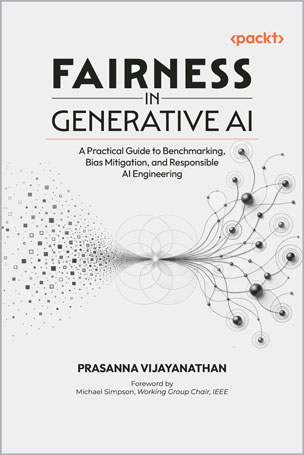
A Practical Guide to Benchmarking, Bias Mitigation, and Responsible AI Engineering
Prasanna Vijayanathan
#Generative_AI
#Benchmarking
#AI_Engineering
#GenAI
#LLMs
Build responsible AI systems with practical fairness benchmarks. Turn fairness principles into measurable requirements using metrics, human review, AI governance, CI gates, and drift monitoring across text, image, and multimodal AI.
A child asks an image model for a picture of a soccer player and gets a boy, every time. Across hiring, lending, education, and healthcare, fairness in generative AI can affect opportunity, dignity, and trust. This practical guide shows you how to measure fairness and build responsible AI practices across LLMs, image models, and multimodal generative AI systems.
Move from AI ethics and fairness principles to engineering artifacts you can test and defend. Define harms and sensitive attributes, decide whose experience is in scope, and translate fairness trade-offs into measurable requirements. Then build a modular benchmarking framework for your ML and MLOps pipelines using versioned scenario and prompt libraries, quantitative metrics, qualitative rubrics, and human review.
Put AI governance into practice by publishing actionable scorecards and dashboards, adding fairness checks to CI and release gates, monitoring drift, and preparing incident-response playbooks. Keep evaluation meaningful as models, data, and expectations change.
A running soccer image-generator case connects the concepts to implementation, showing how responsible AI engineering moves from principles to measurable production controls.
This book is for people who build, ship, evaluate, and govern generative AI. ML and data engineers, application developers shipping LLM features, and responsible AI, trust-and-safety, and security engineers will gain hands-on value. Product managers and engineering leaders will develop a shared language for AI governance, while policymakers, regulators, researchers, standards contributors, and civil-society advocates will find structured ways to scrutinize deployed systems. A working grasp of ML evaluation and Python is all you need.
Table of Contents
Part 1: The Case for Fairness in Generative AI
Chapter 1: The Urgency of Fairness in Generative AI
Chapter 2: From Intuition to Norms: The Foundations of Fairness
Chapter 3: Benchmarks: Forming the Principles of Evaluation
Part 2: A Practical Framework for Fairness Evaluation
Chapter 4: Requirements for a Fairness Evaluation System
Chapter 5: Architecture of a Fairness Benchmarking Platform
Chapter 6: Data, Scenarios, and Prompt Libraries
Chapter 7: Metrics, Scorecards, and Interpretation
Part 3: Building and Operating Your Fairness Benchmark
Chapter 8: Getting Started: Your First End-to-End Benchmark
Chapter 9: Industrial Strength: Integrating with MLOps and Continuous Integration
Chapter 10: AI Observability for Fairness Benchmarking Systems
Chapter 11: Monitoring Drift and Incident Response
Part 4: Sustaining Fairness: Stakeholders, Governance, and the Road Ahead
Chapter 12: Personas: How Different Actors Use Fairness Benchmarks
Chapter 13: Community Contribution and Governance
Chapter 14: The Work Ahead
Chapter 15: Unlock Your Exclusive Benefits
Prasanna Vijayanathan is a senior AI and platforms engineer with more than a decade of experience building large scale, low latency systems at companies such as Netflix and LinkedIn, focused on observability, reliability, and data driven decision making. He is a Senior Member of IEEE and co leads Safety by Design for Generative AI, including model deployment guidance for child safety and abuse prevention. Across standards bodies and nonprofits, he works at the intersection of engineering practice, AI fairness, and policy, translating principles into concrete architectures, metrics, and evaluation pipelines teams can ship.