ثبت نام / ورود
0
ثبت نام / ورود
0
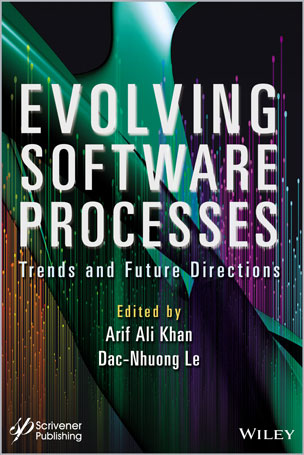
Trends and Future Directions
Arif Ali Khan, Dac-Nhuong Le
#Software_Processes
#DevOps
#GSD
#Software_development
#Software_engineer
#IT
The book provides basic building blocks of evolution in software processes, such as DevOps, scaling agile process in GSD, in order to lay a solid foundation for successful and sustainable future processes.
One might argue that there are already many books that include descriptions of software processes. The answer is “yes, but.” Becoming acquainted with existing software processes is not enough. It is tremendously important to understand the evolution and advancement in software processes so that developers appropriately address the problems, applications, and environments to which they are applied. Providing basic knowledge for these important tasks is the main goal of this book.
Industry is in search of software process management capabilities. The emergence of the COVID-19 pandemic emphasizes the industry’s need for software-specific process management capabilities. Most of today’s products and services are based to a significant degree on software and are the results of largescale development programs. The success of such programs heavily depends on process management capabilities, because they typically require the coordination of hundreds or thousands of developers across different disciplines. Additionally, software and system development are usually distributed across geographical, cultural and temporal boundaries, which make the process management activities more challenging in the current pandemic situation.
This book presents an extremely comprehensive overview of the evolution in software processes and provides a platform for practitioners, researchers and students to discuss the studies used for managing aspects of the software process, including managerial, organizational, economic and technical. It provides an opportunity to present empirical evidence, as well as proposes new techniques, tools, frameworks and approaches to maximize the significance of software process management.
Audience
The book will be used by practitioners, researchers, software engineers, and those in software process management, DevOps, agile and global software development.
Table of Contents
1 ReMo: A Recommendation Development Model for Software Process Improvement Based on Correlation Analysis
2 A Framework for a Sustainable Software Security Program
3 Linking Software Processes to IT Professionalism Frameworks
4 Monitoring and Controlling Software Project Scope Using Agile EVM
5 Modeling Multi-Release Open Source Software Reliability Growth Process with Generalized Modified Weibull Distribution
6 Developing a Reference Model for Open Data Capability Maturity Assessment
7 AHP-Based Prioritization Framework for Software Outsourcing Human Resource Success Factors in Global Software Development
8 A Process Framework for the Classification of Security Bug Reports
9 A Systematic Literature Review of Challenges Factors for Implementing DevOps Practices in Software Development Organizations: A Development and Operation Teams Perspective
10 DevOps' Culture Challenges Model(DC2M): A Systematic Literature Review Protocol
11 Critical Challenges of Designing Software Architecture for Internet of Things (loD Software System
12 Challenges to Project Management in Distributed Software Development: A Systematic Literature Review
13 Cyber Security Challenges Model: SLR Based Protocol and Initial Findings
14 A Process Assessment Model for Human Resource Skill Development Enabling Digital Transformation
Arif Ali Khan is at the University of Jyvȁskylȁ, Finland. He obtained his PhD degree in software engineering from the Department of Computer Science, City University of Hong Kong. He has participated in and managed several empirical software engineering related research projects. He has expertise in software outsourcing, process improvement, 3C’s (communication, coordination, control), requirements change management, agile software development and evidence-based software engineering. Khan has published over 40 articles in peer reviewed conferences and journals.
Dac-Nhuong Le obtained his PhD in computer science from Vietnam National University, Vietnam in 2015. He is Deputy-Head of Faculty of Information Technology, Haiphong University, Vietnam. His area of research includes: evaluation computing and approximate algorithms, network communication, security and vulnerability, network performance analysis and simulation, cloud computing, IoT and image processing in biomedicine. He has more than 50 publications and edited/authored 15 computer science books, many with the Wiley-Scrivener imprint.