ثبت نام / ورود
0
ثبت نام / ورود
0
Opher Etzion, Peter Niblett
#Event
#Processing
#Engineering
Unlike traditional information systems which work by issuing requests and waiting for responses, event-driven systems are designed to process events as they occur, allowing the system to observe, react dynamically, and issue personalized data depending on the recipient and situation.
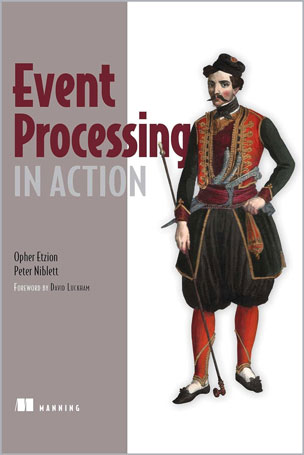
Event Processing in Action introduces the major concepts of event-driven architectures and shows how to use, design, and build event processing systems and applications. Written for working software architects and developers, the book looks at practical examples and provides an in-depth explanation of their architecture and implementation. Since patterns connect the events that occur in any system, the book also presents common event-driven patterns and explains how to detect and implement them. Throughout the book, readers follow a comprehensive use case that incorporates all event processing programming styles in practice today.
Table of Contents
PART 1 THE BASICS
1 Entering the world of event processing
2 Principles of event processing
PART 2 THE BUILDING BLOCKS
3 Defining the events
4 Producing the events
5 Consuming the events
6 The event processing network
7 Putting events in context
8 Filtering and transformation
9 Detecting event patterns
PART 3 PRAGMATICS
10 Engineering and implementation considerations
11 Today’s event processing challenges
12 Emerging directions of event processing
Opher Etzion is the chair of the Event Processing Technical Society (EPTS), and an IBM Senior Technical Staff member who has worked on the WebSphere group and in IBM Research. He has served as a programmer, analyst, and consultant, specializing in rule-driven applications. He is an adjunct professor at the Technion - Israel Institute of Technology, and has authored or co-authored nearly 70 papers for refereed journals and conferences.
Peter Niblett is an IBM Senior Technical Staff Member, working on thearchitecture and design of IBM's messaging and event processing products. He helped to define the Java Message Service (JMS) programming interface, and chaired the OASIS Web Services Notification Technical Committee. He is a member of EPTS, and leads its Interoperability workgroup.