ثبت نام / ورود
0
ثبت نام / ورود
0
Development and History
Marvin Jay Greenberg
#Euclidean
#Geometry
#Euclid
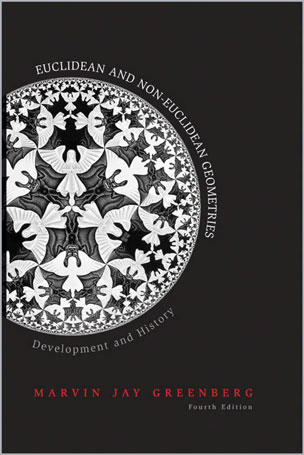
This is the definitive presentation of the history, development and philosophical significance of non-Euclidean geometry as well as of the rigorous foundations for it and for elementary Euclidean geometry, essentially according to Hilbert. Appropriate for liberal arts students, prospective high school teachers, math. majors, and even bright high school students. The first eight chapters are mostly accessible to any educated reader; the last two chapters and the two appendices contain more advanced material, such as the classification of motions, hyperbolic trigonometry, hyperbolic constructions, classification of Hilbert planes and an introduction to Riemannian geometry.
Table of Contents
Chapter 1. Euclid's Geometry
Chapter 2. Logic and Incidence Geometry
Chapter 3. Hilbert's Axioms
Chapter 4. Neutral Geometry
Chapter 5. History of the Parallel Postulate
Chapter 6. The Discovery of Non-Euclidean Geometry
Chapter 7. Independence of the Parallel Postulate
Chapter 8. Philosophical Implications, Fruitful Applications
Chapter 9. Geometric Transformations
Chapter 10. Further Results in Real Hyperbolic Geometry
Appendix A. Elliptic and Other Riemannian Geometries
Appendix B. Hilbert's Geometry Without Real Numbers
About the Author
Marvin Jay Greenberg (1935–2017) was an American mathematician and professor best known for his contributions to algebraic geometry, algebraic topology, and non-Euclidean geometry. He studied at Columbia University, earning his bachelor's degree in 1955, and completed his PhD at Princeton University in 1959 under the supervision of renowned mathematician Serge Lang. He taught at several universities, including the University of California, Berkeley, Northeastern University, and the University of California, Santa Cruz. Greenberg authored influential mathematical books, particularly Euclidean and Non-Euclidean Geometries: Development and History and Lectures on Algebraic Topology. He was admired for his ability to explain complex mathematical ideas clearly and received the Lester R. Ford Prize for his contributions to mathematical writing. His work continues to influence mathematics education and research.