ثبت نام / ورود
0
ثبت نام / ورود
0
Douglas Comer
#Computer_Architecture
#Parallelism
#Performance
#Pipelining
#I/O
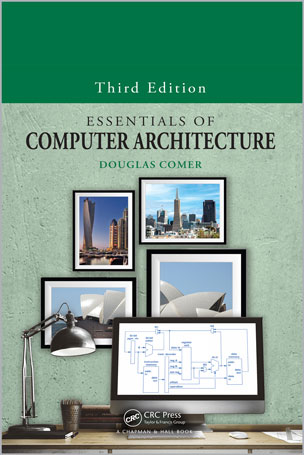
This easy-to-read textbook provides an introduction to computer architecture, focusing on the essential aspects of hardware that programmers need to know. Written from a programmer’s point of view, Essentials of Computer Architecture, Third Edition, covers the three key aspects of architecture: processors, physical and virtual memories, and input-output (I/O) systems.
This third edition is updated in view of advances in the field. Most students only have experience with high-level programming languages, and almost no experience tinkering with electronics and hardware.
As such, this text is revised to follow a top-down approach, moving from discussions on how a compiler transforms a source program into binary code and data, to explanations of how a computer represents data and code in binary.
Additional chapters cover parallelism and data pipelining, assessing the performance of computer systems, and the important topic of power and energy consumption. Exclusive to this third edition, a new chapter explains multicore processors and how coherence hardware provides a consistent view of the values in memory even though each core has its own cache.
Suitable for a one-semester undergraduate course, this clear, concise, and easy-to-read textbook offers an ideal introduction to computer architecture for students studying computer programming.
Table of Contents
Chapter 1: Introduction And Overview
Chapter 2: Program Interpretation And Transformation
Chapter 3: Data And Program Representation
Chapter 4: A High-Level Overview Of Processors
Chapter 5: Instruction Sets And Operands
Chapter 6: Operand Addressing And Operand Types
Chapter 7: Assembly Languages And Programming Paradigm
Chapter 8: Main Memory And Memory Addressing
Chapter 9: Virtual Memory Technologies And Virtual Addressing
Chapter 10: Caches And Caching
Chapter 11: Storage: File Systems, Blocks, And SSDs
Chapter 12: A Programmer's View Of Devices, 1/0, And Buffering
Chapter 13: Buses And Bus Architectures
Chapter 14: Programming Devices And Interrupt-Driven 1/0
Chapter 15: Data Paths And Instruction Execution
Chapter 16: CPUs: Microcode, Protection, And Processor Modes
Chapter 17: Parallelism
Chapter 18: Data Pipelining
Chapter 19: Assessing Performance
Chapter 20: Multicore Processors
Chapter 21: Power And Energy
Chapter 22: Building Blocks: Transistors, Gates, And Clocks
Chapter 23: Hardware Modularity
Appendix 1: Rules For Boolean Algebra Simplification
Appendix 2: A Quick Introduction To x86 Assembly Language
Appendix 3: ARM Register Definitions And Calling Sequence
Appendix 4: Lab Exercises For A Computer Architecture Course
Douglas Comer is a Distinguished Professor of Computer Science at Purdue University. He is an internationally recognized expert on computer networking and the TCP/IP protocols. He has been working with TCP/IP and the Internet since the late 1970s. Comer established his reputation as a principal investigator on several early Internet research projects. He served as chairman of the CSNET technical committee, chairman of the DARPA Distributed Systems Architecture Board, and was a member of the Internet Activities Board (the group of researchers who built the Internet).
Comer has created courses on computer networks, the Internet, TCP/IP protocols, and operating systems for a variety of audiences, including in-depth courses for engineers and less technical courses for others; he continues to teach at various industries and networking conferences around the world. In addition, Comer consults for private industry on the design of networks and networking equipment. Professor Comer is well-known for his series of ground breaking textbooks on computer networks, the Internet, computer operating systems, and computer architecture. His books have been translated into sixteen languages, and are widely used in both industry and academia. His three-volume series Internetworking With TCP/IP is often cited as an authoritative reference for the Internet protocols. More significantly, Comer's texts have been used by fifteen of the top sixteen Computer Science Departments listed in the U.S. News and World Report ranking.