ثبت نام / ورود
0
ثبت نام / ورود
0
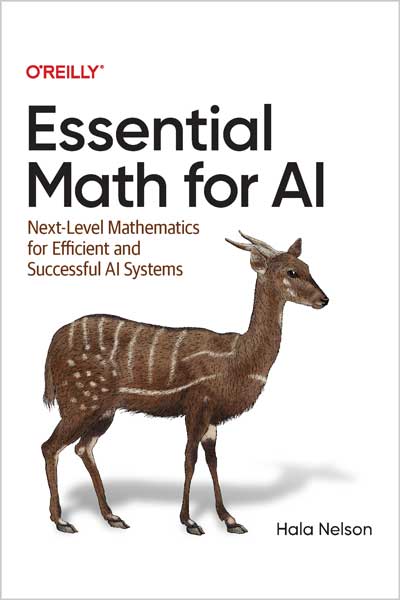
Next-Level Mathematics for Efficient and Successful AI Systems
Hala Nelson
#Math
#Mathematics
#AI
#networks
#data
#scientists
#mathematical
#mathematicians
#scientists
#machine_learning
#data_management
Many industries are eager to integrate AI and data-driven technologies into their systems and operations. But to build truly successful AI systems, you need a firm grasp of the underlying mathematics. This comprehensive guide bridges the gap in presentation between the potential and applications of AI and its relevant mathematical foundations.
In an immersive and conversational style, the book surveys the mathematics necessary to thrive in the AI field, focusing on real-world applications and state-of-the-art models, rather than on dense academic theory. You'll explore topics such as regression, neural networks, convolution, optimization, probability, graphs, random walks, Markov processes, differential equations, and more within an exclusive AI context geared toward computer vision, natural language processing, generative models, reinforcement learning, operations research, and automated systems. With a broad audience in mind, including engineers, data scientists, mathematicians, scientists, and people early in their careers, the book helps build a solid foundation for success in the AI and math fields.
You'll be able to:
Who This Book Is For?
Who This Book Is Not For?
This book is not for a person who likes to sit down and do many exercises to master a particular mathematical technique or method, a person who likes to write and prove theorems, or a person who wants to learn coding and development. This is not a math textbook. There are many excellent textbooks that teach calculus, linear algebra, and probability (but few books relate this math to AI). That said, this book has many in-text pointers to the relevant books and scientific publications for readers who want to dive into technicalities, rigorous statements, and proofs. This is also not a coding book. The emphasis is on concepts, intuition, and general understanding, rather than on implementing and developing the technology.
What Math Background Is Expected from You to Be Able to Read This Book?
This book is self-contained in the sense that we motivate everything that we need to use. I do hope that you have been exposed to calculus and some linear algebra, including vector and matrix operations, such as addition, multiplication, and some matrix decompositions. I also hope that you know what a function is and how it maps an input to an output. Most of what we do mathematically in AI involves constructing a function, evaluating a function, optimizing a function, or composing a bunch of functions. You need to know about derivatives (these measure how fast things change) and the chain rule for derivatives. You do not necessarily need to know how to compute them for each function, as computers, Python, Desmos, and/or Wolfram|Alpha mathematics do a lot for us nowadays, but you need to know their meaning. Some exposure to probabilistic and statistical thinking are helpful as well. If you do not know any of the above, that is totally fine. You might have to sit down and do some examples (from some other books) on your own to familiarize yourself with certain concepts. The trick here is to know when to look up the things that you do not know…only when you need them, meaning only when you encounter a term that you do not understand, and you have a good idea of the context within which it appeared. If you are truly starting from scratch, you are not too far behind. This book tries to avoid technicalities at all costs.
Technology and AI markets are like a river, where some parts are moving faster than others. Successfully applying AI requires the skill of assessing the direction of the flow and complementing it with a strong foundation, which this book enables, in an engaging, delightful, and inclusive way. Hala has made math fun for a spectrum of participants in the AI-enabled future!
—Adri Purkayastha, Group Head, AI Operational Risk and Digital Risk Analytics, BNP Paribas
Texts on artificial intelligence are usually either technical manuscripts written by experts for other experts, or cursory, math-free introductions catered to general audiences. This book takes a refreshing third path by introducing the mathematical foundations for readers in business, data, and similar fields without advanced mathematics degrees. The author weaves elegant equations and pithy observations throughout, all the while asking the reader to consider the very serious implications artificial intelligence has on society. I recommend Essential Math for AI to anyone looking for a rigorous treatment of AI fundamentals viewed through a practical lens.
—George Mount, Data Analyst and Educator
Hala has done a great job in explaining crucial mathematical concepts. This is a must-read for every serious machine learning practitioner. You'd love the field more once you go through the book.
—Umang Sharma, Senior Data Scientist and Author
To understand artificial intelligence, one needs to understand the relationship between math and AI. Dr. Nelson made this easy by giving us the foundation on which the symbiotic relationship between the two disciplines is built.
—Huan Nguyen, Rear Admiral (Ret.), Cyber Engineering, NAVSEA
This manuscript aims at explaining the mathematics behind current state-of-the-art practices in machine learning (ML) / artificial intelligence (AI). It also serves as an introductory exposition to AI/ML, surveying quite broadly the methodology as well as the applications. It is intended for readers with limited to no knowledge in AI/ML and with basic familiarity with mathematics.
The strategy taken in this book and, in my opinion, its distinguishing feature, is that of immediate immersion in both the AI/ML and the mathematics behind it. Terms are explained and background is provided on-the-go and just when they are needed, with the scope of the explanations restricted to the what is essential to quickly understand the topic at hand.
This top-down approach allows the readers to:
This top-down/immersive approach is a very efficient way for quickly learning a subject, at least in a level that allows understanding and conversing about it. Implementing such an approach is a highly non-trivial task, as there is a high risk of making the reader lost by the abundance of information and brevity of context, derivation and motivation. This book stands up to the challenge in a remarkable way. The result is, in my opinion, a one-of-kind invaluable and highly efficient text for quickly getting up-to-speed with AI/ML and the mathematics behind it, for readers with only basic knowledge in math/cs. Very few books take the top-down/immersion approach to explaining AI and usually either require substantially more mathematical/AI background or often highly technical an impenetrable
__ Oren Louidor, Associate Professor, Faculty of Industrial Engineering and Management, Technion
I wrote this book in purely colloquial language, leaving most of the technical details out. It is a math book about AI with very few mathematical formulas and equations, no theorems, no proofs, and no coding. My goal is to not keep this important knowledge in the hands of the very few elite, and to attract more people to technical fields. I believe that many people get turned off by math before they ever get a chance to know that they might love it and be naturally good at it. This also happens in college or in graduate school, where many students switch their majors from math, or start a Ph.D. and never finish it. The reason is not that they do not have the ability, but that they saw no motivation or an end goal for learning torturous methods and techniques that did not seem to transfer to anything useful in their lives. It is like going to a strenuous mental gym every day only for the sake of going there. No one even wants to go to a real gym every day (this is a biased statement, but you get the point). In math, formalizing objects into functions, spaces, measure spaces, and entire mathematical fields comes after motivation, not before. Unfortunately, it gets taught in reverse, with formality first and then, if we are lucky, some motivation.
In this book I will extract the math required for AI in a way that does not deviate at all from the real-life AI application in mind. It is infeasible to go through existing tools in detail and not fall into an encyclopedic and overwhelming treatment. What I do instead is try to teach you how to think about these tools and view them from above, as a means to an end that we can tweak and adjust when we need to. I hope that you will get out of this book a way of seeing how things relate to each other and why we develop or use certain methodsamong others. In a way, this book provides a platform that launches you to whatever area you find interesting or want to specialize in.
Another goal of this book is to democratize mathematics, and to build more confidence to ask about how things work. Common answers such as "It's complicated mathematics," "It's complicated technology," or "It's complex models," are no longer satisfying, especially since the technologies that build on mathematical models cur‐ rently affect every aspect of our lives. We do not need to be experts in every field in mathematics (no one is) in order to understand how things are built and why they operate the way they do.
More info in the preface :).