ثبت نام / ورود
0
ثبت نام / ورود
0
William G. Sullivan, Elin M. Wicks, C. Patrick Koelling
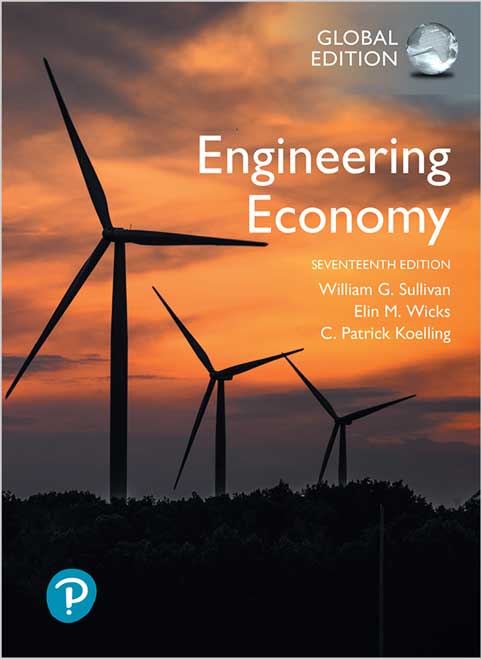
#Engineering_Economy
#Economy
#methodology
نکته: لطفا در انتخاب چاپ رنگی دقت کنید، صفحات رنگی این کتاب در رو رنگ آبی و مشکی می باشد که رنگ آبی فقط برای کادرها و نمودار ها استفاده شده است.
Understand the importance of engineering economics principles and how to make smart economic choices
Used by engineering students worldwide, this bestselling text provides a sound understanding of the principles, basic concepts, and methodology of engineering economy. Explanations and examples that are student-centered and practical in real-life situations help students develop proficiency in the methods and processes for making rational decisions. Built upon the rich and time-tested teaching materials of earlier editions, the text is extensively revised and updated to reflect current trends and issues. The new edition captures the spirit of environmental sustainability with more than 160 “green” problems, as well as new end-of-chapter problems and group exercises, and includes updates to the new 2017 Federal Tax code revisions.
MyLab™ Engineering is not included.
Students, if MyLab Engineering is a recommended/mandatory component of the course, please ask your instructor for the correct ISBN. MyLab Engineering should only be purchased when required by an instructor. Instructors, contact your Pearson representative for more information.
Reach every student by pairing this text with MyLab Engineering
MyLab™ is the teaching and learning platform that empowers you to reach every student. By combining trusted author content with digital tools and a flexible platform, MyLab personalizes the learning experience and improves results for each student.
We live in a sea of economic decisions.
—Anonymous
About Engineering Economy
A succinct job description for an engineer consists of two words: problem solver. Broadly speaking, engineers use knowledge to find new ways of doing things economically. Engineering design solutions do not exist in a vacuum but within the context of a business opportunity. Given that every problem hasmultiple solutions, the issue is, How does one rationally select the design with the most favorable economic result? The answer to this question can also be put forth in two words: engineering economy. Engineering economy provides a systematic framework for evaluating the economic aspects of competing design solutions. Just as engineers model the stress on a support column, or the thermodynamic response of a steam turbine, they must also model the economic impact of their recommendations.
Engineering economy—what is it, and why is it important? The initial reaction of many engineering students to these questions is, “Money matters will be handled by someone else. They are not something I need to worry about.” In reality, any engineering project must be not only physically realizable but also economically affordable. This book is about how to make smart economic choices.
Understanding and applying economic principles to engineering have never been more important. Engineering is more than a problem-solving activity focusing on the development of products, systems, and processes to satisfy a need or demand. Beyond function and performance, solutions must also be viable economically. Design decisions affect limited resources such as time, material, labor, capital, and natural resources, not only initially (during conceptual design) but also through the remaining phases of the life cycle (e.g., detailed design, manufacture and distribution, service, retirement, and disposal). A great solution can die a certain death if it is not profitable.
Chapter 1 Introduction to Engineering Economy
Chapter 2 Cost Concepts and Design Economics
Chapter 3 Cost-Estimation Techniques
Chapter 4 The Time Value of Money
Chapter 5 Evaluating a Single Project
Chapter 6 Comparison and Selection Among Alternatives
Chapter 7 Depreciation and Income Taxes
Chapter 8 Price Changes and Exchange Rates
Chapter 9 Replacement Analysis
Chapter 10 Evaluating Projects with the Benefit-Cost Ratio Method
Chapter 11 Breakeven and Sensitivity Analysis
Chapter 12 Probabilistic Risk Analysis
Chapter 13 The Capital Budgeting Process
Chapter 14 Decision Making Considering Multiattributes
Appendix A Accounting Fundamentals
Appendix B Abbreviations and Notation
Appendix C Interest and Annuity Tables for Discrete Compounding
Appendix D Interest and Annuity Tables for Continuous Compounding
Appendix E Standard Normal Distribution
Appendix F Selected References
Appendix G Solutions to Try Your Skills
Appendix H Answers to Selected Problems