ثبت نام / ورود
0
ثبت نام / ورود
0
William H. Hayt, Jr. , Jack E. Kemmerly, Steven M. Durbin
#Electric
#Engineering
#Circuit_Analysis
#Circuits
#DC
#AC
#RC
#RL
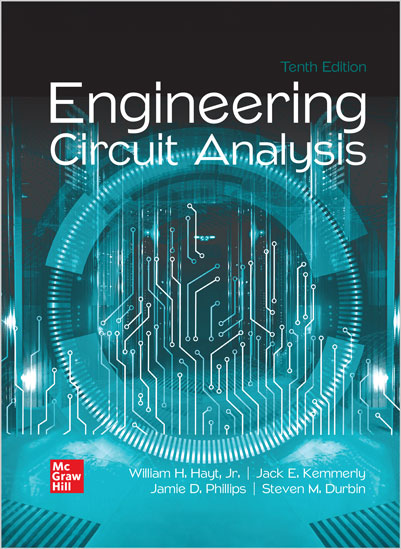
Master the art of circuit analysis with "Engineering Circuit Analysis", a trusted resource for engineering students and professionals alike. This book combines clear explanations, practical examples, and advanced techniques to help you build a solid foundation in electrical engineering. Whether you're tackling basic circuit principles or diving into more complex topics, this comprehensive guide is your key to success.
The hallmark feature of Engineering Circuit Analysis is its focus on the student. This text is written so students may teach the science of circuit analysis to themselves. Terms are clearly defined, basic material appears toward the beginning of each chapter and is explained carefully and in detail, and numerical examples are used to introduce and suggest general results. Simple practice problems appear throughout each chapter, while more difficult problems appear at the end of chapters.
The new edition of Engineering Circuit Analysis is also available in McGraw Hill Connect, featuring: SmartBook 2.0, Adaptive STEM Prep Modules, Application-Based Activities, a curated question bank, Proctorio, and more!
What You'll Learn:
Complete with illustrative examples, detailed diagrams, and practice problems, this book provides the tools you need to excel in your studies and professional career.
Table of Contents
1. Introduction
2. Basic Components and Electric Circuits
3. Voltage and Current Laws
4. Basic Nodal and Mesh Analysis
5. Handy Circuit Analysis Techniques
6. The Operational Amplifier
7. Capacitors and Inductors
8. Basic RC and RL Circuits
9. The RLC Circuit
10. Sinusoidal Steady-State Analysis
11. AC Circuit Power Analysis
12. Polyphase Circuits
13. Magnetically Coupled Circuits
14. Circuit Analysis in the s-Domain
15. Frequency Response
16. Two-Port Networks
17. Fourier Circuit Analysis
Appendix 1. An Introduction to Network Topology
Appendix 2. Solution of Simultaneous Equations
Appendix 3. A Proof of Thévenin's Theorem
Appendix 4. An LTspice® Tutorial
Appendix 5. Complex Numbers
Appendix 6. A Brief MATLAB® Tutorial
Appendix 7. Additional Laplace Transform Theorems
Appendix 8. The Complex Frequency Plane
About the Authors:
WILLIAM H. HAYT, JR., received his B.S. and M.S. at Purdue University and his Ph.D. from the University of Illinois. After spending four years in industry, Professor Hayt joined the faculty of Purdue University, where he served as Professor and Head of the School of Electrical Engineering, and as Professor Emeritus after retiring in 1986. Besides Engineering Circuit Analysis, Professor Hayt authored three other texts, including Engineering Electromagnetics, now in its eighth edition with McGraw Hill. Professor Hayt’s professional society memberships included Eta Kappa Nu, Tau Beta Pi, Sigma Xi, Sigma Delta Chi, Fellow of IEEE, ASEE, and NAEB. While at Purdue, he received numerous teaching awards, including the university’s Best Teacher Award. He is also listed in Purdue’s Book of Great Teachers, a permanent wall display in the Purdue Memorial Union, dedicated on April 23, 1999. The book bears the names of the inaugural group of 225 faculty members, past and present, who have devoted their lives to excellence in teaching and scholarship. They were chosen by their students and their peers as Purdue’s finest educators.
JACK E. KEMMERLY received his B.S. magna cum laude from The Catholic University of America, M.S. from University of Denver, and Ph.D. from Purdue University. Professor Kemmerly first taught at Purdue University and later worked as principal engineer at the Aeronutronic Division of Ford Motor Company. He then joined California State University, Fullerton, where he served as Professor, Chairman of the Faculty of Electrical Engineering, Chairman of the Engineering Division, and Professor Emeritus. Professor Kemmerly’s professional society memberships included Eta Kappa Nu, Tau Beta Pi, Sigma Xi, ASEE, and IEEE (Senior Member). His pursuits outside of academe included being an officer in the Little League and a scoutmaster in the Boy Scouts.
JAMIE PHILLIPS received his B.S., M.S., and Ph.D. degrees in Electrical Engineering from the University of Michigan, Ann Arbor, Michigan. He was a postdoctoral researcher at Sandia National Laboratories in Albuquerque, New Mexico, and a research scientist at the Rockwell Science Center in Thousand Oaks, California, before returning to the University of Michigan as a faculty member in the EECS Department in 2002. At the University of Michigan, Prof. Phillips taught and developed numerous courses in circuits and semiconductor devices spanning from first-year undergraduate courses to advanced graduate courses. There he received several teaching honors including the University Undergraduate Teaching Award and an Arthur F. Thurnau Professorship recognizing faculty for outstanding contributions to undergraduate education. In 2020, he joined the University of Delaware as a Professor and Chair of the Electrical and Computer Engineering Department. His research interests are on semiconductor optoelectronic devices with particular emphasis on infrared detectors and photovoltaics and engineering education. His professional memberships include IEEE (Senior Member), Eta Kappa Nu, Optica, Materials Research Society, Tau Beta Pi, and ASEE.
STEVEN M. DURBIN received the B.S., M.S. and Ph.D. degrees in Electrical Engineering from Purdue University, West Lafayette, Indiana. Subsequently, he was with the Department of Electrical Engineering at Florida State University and Florida A&M University before joining the University of Canterbury, New Zealand, in 2000. In 2010, he moved to the University at Buffalo, The State University of New York, where he held a joint tenured appointment between the Departments of Electrical Engineering and Physics. Since 2013, he has been with the Department of Electrical and Computer Engineering at Western Michigan University, where he is Professor of Electrical and Computer Engineering, and has served in a variety of administrative roles. His teaching interests include circuits, electronics, electromagnetics, solid-state electronics and nanotechnology. His research interests are primarily concerned with the development of novel electronic materials—in particular those based on oxide and nitride compounds—as well as studying disorder in both naturally occurring and synthetic systems as a route to physical understanding and engineering of properties. He is a founding principal investigator of the MacDiarmid Institute for Advanced Materials and Nanotechnology, a New Zealand National Centre of Research Excellence, and coauthor of over 100 technical publications, including several patents and patents pending. He is a senior member of the IEEE, and a member of Eta Kappa Nu, Tau Beta Pi, the Materials Research Society, the AVS (formerly the American Vacuum Society), the Society of Amateur Radio Astronomers, the American Physical Society, and the Royal Society of New Zealand. In his spare time, he enjoys building acoustic and electric guitars, and solid-top ukuleles.