ثبت نام / ورود
0
ثبت نام / ورود
0
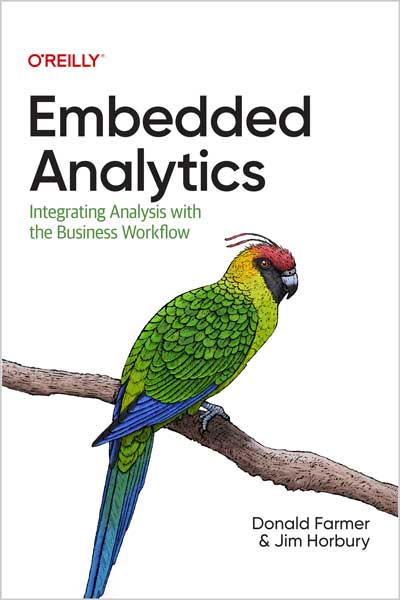
Integrating Analysis with the Business Workflow
Donald Farmer, Jim Horbury
#Analytics
#data
#data_analytics
#i
Over the past 10 years, data analytics and data visualization have become essential components of an enterprise information strategy. And yet, the adoption of data analytics has remained remarkably static, reaching no more than 30% of potential users. This book explores the most important techniques for taking that adoption further: embedding analytics into the workflow of our everyday operations.
Authors Donald Farmer and Jim Horbury show business users how to improve decision making without becoming analytics specialists. You'll explore different techniques for exchanging data, insights, and events between analytics platforms and hosting applications. You'll also examine issues including data governance and regulatory compliance and learn best practices for deploying and managing embedded analytics at scale.
Table of Contents
Chapter 1. Introduction to Embedded Analytics
Chapter 2. Analytics and Decision Making
Chapter 3. Architectures for Embedded Analytics
Chapter 4. Data for Embedded Analytics
Chapter 5. Embedding Analytics Objects
Chapter 6. Administration of Embedded Analytics
Chapter 7. Governance and Compliance
Chapter 8. Beyond the Spreadsheet
Chapter 9. Data Science, Machine Learning, and Embedded Analytics
Chapter 10. Analytics as a line of Business
Data and analytics technologies are not only rapidly developing, but they also seem to be constantly in the news. So it is puzzling that industry analysts often say that the adoption of analytics technologies, such as business intelligence (BI), hovers around 25–30% of the addressable market, even while that addressable market has grown. Why is the percentage so low?
Part of the reason seems to be that analytics as a specialism may only be relevant to about 30% of the market. But analytics as a way of delivering insight and improved decision making has far greater potential. The new question, then, is how to reach those underserved users.
Our answer, in this book, is that we can embed analytics into the applications that business users work with every day, making analytics part of their regular workflow, not a specialized practice. There will still be a role for analytics experts with bespoke applications, but regular users can benefit from embedding analytic features into other apps.
We think embedded analytics is an exciting field that promises to transform the way we design, build, and use software applications. It is a field that brings together the worlds of data analytics and application design, allowing us to integrate powerful analytical tools directly into familiar applications. The result is a much more intuitive and efficient user experience, which enables users to make better decisions and gain deeper insights into their data. By integrating analytics into the application design process, we can create much more intelligent and effective applications that are better suited to the needs of the user.
This book is designed to provide you with the knowledge you need to embed analytics into your applications and create a more powerful user experience.
Who Should Read This Book
We hope this book will work for a wide range of professionals who are involved in designing, building, or managing software applications that feature embedded analytics. These professionals include:
Application designers: If you are responsible for designing the user experience of an application, this book will help you understand how to integrate analytics into the application design process. You will learn how to create more intelligent and effective applications that are better suited to the needs of the user.
Analytics professionals: If you are responsible for developing or managing analytics solutions, this book will help you understand how to integrate your solutions into applications. You will learn how to create more effective analytics solutions that are more closely aligned with the needs of the user.
Developers: If you are responsible for developing software applications, this book will help you understand how to design and build applications with embedded analytics features. You will learn how to create applications that are more intuitive and efficient for the end user, as well as how to integrate analytics into the application development process.
Architects: If you are responsible for the overall design and architecture of software applications, this book will help you understand how to integrate analytics into your overall design strategy. You will learn how to create more intelligent and effective applications that are better suited to the needs of the user.
To get the most out of this book, readers should have a basic understanding of data analytics and software application design. Familiarity with programming languages and application development tools could also be helpful, but is not required. Overall, this book is designed to provide practical, actionable insights and advice to help professionals in a variety of roles create more intelligent and effective software applications that feature embedded analytics.
Donald Farmer is the Principal of TreeHive Strategy, a strategic advisory practice specializing in data, analytics and innovation strategy. His background is very diverse, with over 30 years of deeply practical experience in industries ranging from fish-farming to archaeology to advanced manufacturing. He has worked in award-winning startups in the UK and Iceland, and spent 15 years at Microsoft and at Qlik leading teams designing and developing new enterprise capabilities in data integration, data mining, self-service analytics and visualization.
Donald Farmer is an advisor to investors, venture funds, incubators and startups around the world. He mentors executives and speaks globally at events and private workshops. Donald lives with his wife, Alison, an artist, in a recycled-polystyrene house near Seattle with one of the world’s most beautiful treehouses - the tree hive - in their wild garden.
Jim Horbury is the Solutions Practice Director at InterWorks, currently living and working in Hampshire, UK.
Having spent almost two decades working in technical and creative direction roles in advertising, Jim was an early proponent of data-driven response measurement and drove the development of ad-tech reporting solutions for some of the UK's largest travel and tourism organizations.
After a move into telecoms, big data and machine learning, it was a natural step to put his accumulated knowledge into action as a consultant. Jim now leads a global team of solution architects working with some of the world's best-known brands, designing and leading the development of innovative and scalable analytics solutions.
Outside of work, Jim tries to recapture his youth with mountain-biking, running, and climbing.