ثبت نام / ورود
0
ثبت نام / ورود
0
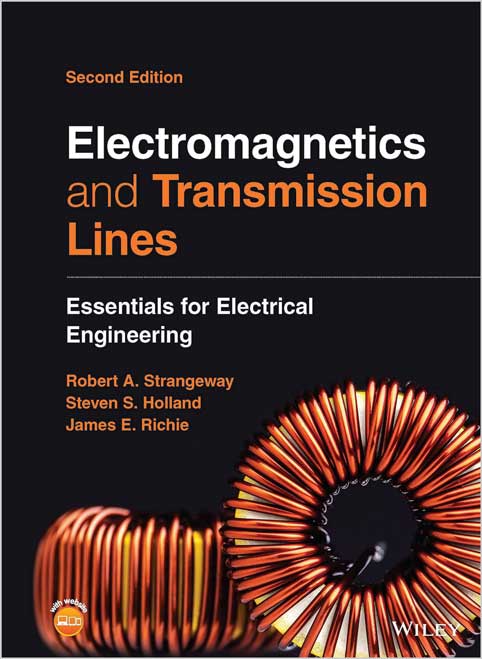
Essentials for Electrical Engineering
Robert A. Strangeway, Steven S. Holland, James E. Richie
#Electromagnetics
#Electrical_Engineering
#VNA
Electromagnetics and Transmission Lines
Textbook resource covering static electric and magnetic fields, dynamic electromagnetic fields, transmission lines, antennas, and signal integrity within a single course
Electromagnetics and Transmission Lines provides coverage of what every electrical engineer (not just the electromagnetic specialist) should know about electromagnetic fields and transmission lines. This work examines several fundamental electrical engineering concepts and components from an electromagnetic fields viewpoint, such as electric circuit laws, resistance, capacitance, and self and mutual inductances. The approach to transmission lines (T-lines), Smith charts, and scattering parameters establishes the underlying concepts of vector network analyzer (VNA) measurements. System-level antenna parameters, basic wireless links, and signal integrity are examined in the final chapters.
As an efficient learning resource, electromagnetics and transmission lines content is strategically modulated in breadth and depth towards a single semester objective. Extraneous, distracting topics are excluded. The wording style is somewhat more conversational than most electromagnetics textbooks in order to enhance student engagement and inclusivity while conveying the rigor that is essential for engineering student development. To aid in information retention, the authors also provide supplementary material, including a homework solutions manual, lecture notes, and VNA experiments.
Sample topics covered in Electromagnetics and Transmission Lines include:
Electromagnetics and Transmission Lines is an authoritative textbook learning resource, suited perfectly for engineering programs at colleges and universities with a single required electromagnetic fields course. Student background assumptions are multivariable calculus, DC and AC electric circuits, physics of electromagnetics, and elementary differential equations.
Table of Contents
Chapter 1 Vectors, Vector Algebra, and Coordinate Systems
Part 1 Static Electric and Magnetic Fields
Chapter 2 The Superposition Laws of Electric and Magnetic Fields
Chapter 3 The Flux Laws of Electric and Magnetic Fields
Chapter 4 The Path Laws and Circuit Principles
Part 2 Time-Changing Electric and Magnetic Fields
Chapter 5 Maxwell's Equations
Chapter 6 Transmission lines: Waves and Reflections
Chapter 7 Transmission lines: Theory and Applications
Chapter 8 Antennas and links
Chapter 9 Signal Integrity
Appendix A Alphabetical Characters, Names, and Units
Appendix B Greek Letters, Names, and Units
Appendix CA Short list of Physical Constants
Appendix D A Short list of Common Material Electrical Properties
Appendix E Summary of Important Equations
Robert A. Strangeway, PhD, is a Professor and Transfer Track Coordinator with the Electrical Engineering and Computer Science (EECS) Department at Milwaukee School of Engineering (MSOE).
Steven S. Holland, PhD, is an Associate Professor and Electrical Engineering Program Director with the EECS Department at Milwaukee School of Engineering (MSOE).
James E. Richie, PhD, is an Associate Professor and Associate Department Chair in the Department of Electrical and Computer Engineering at Marquette University.