ثبت نام / ورود
0
ثبت نام / ورود
0
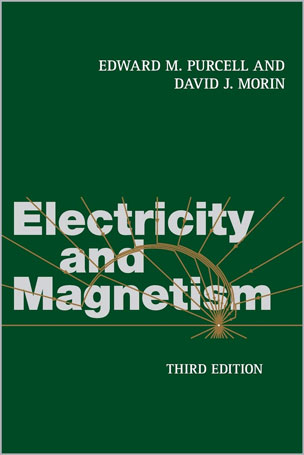
Edward M. Purcell, David J. Morin
#Electricity
#Magnetism
#Electromagnetic
#Circuits
#Electrostatics
For 50 years, Edward M. Purcell's classic textbook has introduced students to the world of electricity and magnetism. The third edition has been brought up to date and is now in SI units. It features hundreds of new examples, problems. figures. contains discussions of real life applications. The textbook covers all the standard introductory topics, such as electrostatics, magnetism, circuits, electromagnetic waves. electric and magnetic fields in matter. Taking a nontraditional approach, magnetism is derived as a relativistic effect. Mathematical concepts are introduced in parallel with the physics topics at hand, making the motivations clear. Macroscopic phenomena are derived rigorously from the underlying microscopic physics. With worked examples, hundreds of illustrations. nearly 600 end of chapter problems and exercises, this textbook is ideal for electricity and magnetism courses. Solutions to the exercises are available for instructors at www.cambridge.org/Purcell Morin.
"Although the basic physics remains largely unchanged, the Purcell and Morin book has many clarifying discussions based on those experimental results, and most chapters end with current applications and a summary. Solutions to the problems represent roughly one-quarter of the text―they are a most welcome addition, particularly for self-study. (Purcell wrote out a solution manual by hand―mainly for instructors.―to accompany his first edition.) "
H. Henry Stroke, New York University for Physics Today
Table of Contents
CHAPTER 1 ELECTROSTATICS: CHARGES AND FIELDS
CHAPTER 2 THE ELECTRIC POTENTIAL
CHAPTER 3 ELECTRIC FIELDS AROUND CONDUCTORS
CHAPTER 4 ELECTRIC CURRENTS
CHAPTER 5 THE FIELDS OF MOVING CHARGES
CHAPTER 6 THE MAGNETIC FIELD
CHAPTER 7 ELECTROMAGNETIC INDUCTION
CHAPTER 8 ALTERNATING-CURRENT CIRCUITS
CHAPTER 9 MAXWELL'S EQUATIONS AND ELECTROMAGNETIC WAVES
CHAPTER 10 ELECTRIC FIELDS IN MATTER
CHAPTER 11 MAGNETIC FIELDS IN MATTER
CHAPTER 12 SOLUTIONS TO THE PROBLEMS
Appendix A: Differences between SI and Gaussian units
Appendix B: SI units of common quantities
Appendix C: Unit conversions
Appendix D: SI and Gaussian formulas
Appendix E: Exact relations among SI and Gaussian units
Appendix F: Curvilinear coordinates
Appendix H: Radiation by an accelerated charge
Appendix I: Superconductivity
Appendix J: Magnetic resonance
Appendix K: Helpful formulas/facts
About the Author
David Morin is a Senior Lecturer in the Physics Department at Harvard University. He received his A.B. in mathematics from Brown University and his Ph.D. in theoretical particle physics from Harvard University. He is the author of eight books, including Introduction to Classical Mechanics (Cambridge University Press, 2008), Electricity and Magnetism (Cambridge University Press, co-author, 2013), and Probability: For the Enthusiastic Beginner (2016). When not writing textbooks, thinking of math and physics limericks, or conjuring up new problems whose answers involve e or the golden ratio, he can be found running along the Charles River or hiking in the White Mountains of New Hampshire. Resources for his books, along with other educational material (including many limericks!), can be found on his Harvard webpage.
His most recent book is "Algebra: For the Enthusiastic Beginner" (split into two volumes), designed for middle-school and high-school students, along with anyone else who is eager to learn some math! It features more than 350 exercises, all with detailed solutions (and in many cases multiple solutions, so that students can learn different ways of approaching problems). Additionally, to lighten things up, there are more than 100 original math limericks! The book is perfect for self-study, home schooling, or as a resource in a standard class. Its detailed explanations emphasize the "why" behind the concepts in algebra, and there are numerous side remarks to help clarify misconceptions. It is both a serious AND a fun book! For more information, including a sampling of the limericks, see the author's Harvard webpage.