ثبت نام / ورود
0
ثبت نام / ورود
0
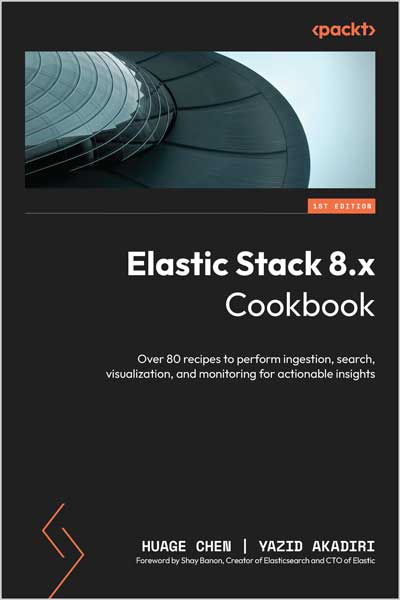
Over 80 recipes to perform ingestion, search, visualization, and monitoring for actionable insights
Huage Chen, Yazid Akadiri
#Elastic
#Elastic_Stack
#ELK
#AI
Unlock the full potential of Elastic Stack for search, analytics, security, and observability and manage substantial data workloads in both on-premise and cloud environments
Key Features:
Book Description:
Learn how to make the most of the Elastic Stack (ELK Stack) products-including Elasticsearch, Kibana, Elastic Agent, and Logstash-to take data reliably and securely from any source, in any format, and then search, analyze, and visualize it in real-time. This cookbook takes a practical approach to unlocking the full potential of Elastic Stack through detailed recipes step by step.
Starting with installing and ingesting data using Elastic Agent and Beats, this book guides you through data transformation and enrichment with various Elastic components and explores the latest advancements in search applications, including semantic search and Generative AI. You'll then visualize and explore your data and create dashboards using Kibana. As you progress, you'll advance your skills with machine learning for data science, get to grips with natural language processing, and discover the power of vector search. The book covers Elastic Observability use cases for log, infrastructure, and synthetics monitoring, along with essential strategies for securing the Elastic Stack. Finally, you'll gain expertise in Elastic Stack operations to effectively monitor and manage your system.
What You Will Learn:
Who this book is for:
This book is for Elastic Stack users, developers, observability practitioners, and data professionals ranging from beginner to expert level. If you're a developer, you'll benefit from the easy-to-follow recipes for using APIs and features to build powerful applications, and if you're an observability practitioner, this book will help you with use cases covering APM, Kubernetes, and cloud monitoring. For data engineers and AI enthusiasts, the book covers dedicated recipes on vector search and machine learning. No prior knowledge of the Elastic Stack is required.
Table of Contents
Chapter 1: Getting Started - Installing the Elastic Stack
Chapter 2: Ingesting General Content Data
Chapter 3: Building Search Applications
Chapter 4: Timestamped Data Ingestion
Chapter 5: Transform Data
Chapter 6: Visualize and Explore Data
Chapter 7: Alerting and Anomaly Detection
Chapter 8: Advanced Data Analysis and Processing
Chapter 9: Vector Search and Generative Al Integration
Chapter 10: Elastic Observability Solution
Chapter 11: Managing Access Control
Chapter 12: Elastic Stack Operation
Chapter 13: Elastic Stack Monitoring
“This book serves as a practical resource for anyone who interacts with data and wants to learn how to exploit the power of the Elastic Stack, including Elasticsearch, Kibana, and various integrations, to make data-driven decisions and gain richer insights from their data environments.
As you turn the pages of this cookbook, you will uncover the innovations introduced in version 8.x. Whether you are taking your initial steps in Elasticsearch and the Elastic Stack or looking to expand your expertise, the cookbook format provides a unique opportunity to build your skills progressively and systematically ”
Shay Banon
Creator of Elasticsearch and CTO of Elastic
About the Author
Huage Chen is a member of Elastic's customer engineering team and has been with Elastic for over five years, helping users throughout Europe to innovate and implement cloud-based solutions for search, data analysis, observability, and security. Before joining Elastic, he worked for 10 years in web content management, web portals, and digital experience platforms.
Yazid Akadiri has been a solutions architect at Elastic for over four years, helping organizations and users solve their data and most critical business issues by harnessing the power of the Elastic Stack. At Elastic, he works with a broad range of customers, with a particular focus on Elastic observability and security solutions. He previously worked in web services-oriented architecture, focusing on API management and helping organizations build modern applications.