نام کتاب
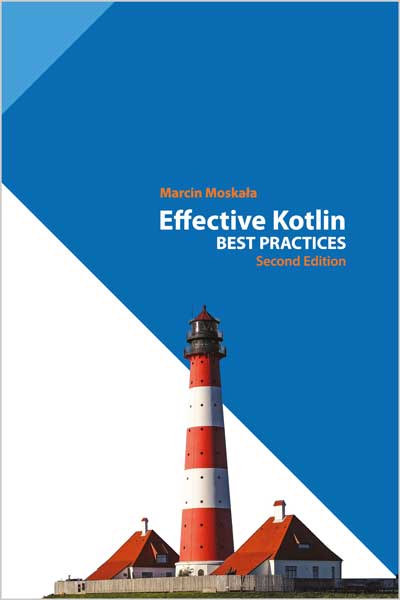
Effective Kotlin

Best Practices

Marcin Moskala

Paperback388 Pages
PublisherLeanpub
Edition2
LanguageEnglish
Year2024
ISBN9788395452833
1K
A2809
انتخاب نوع چاپ:
جلد سخت
647,000ت
0
جلد نرم
587,000ت
0
طلق پاپکو و فنر
597,000ت
0
مجموع:
0تومان
کیفیت متن:اورجینال انتشارات
قطع:B5
رنگ صفحات:دارای متن و کادر رنگی
پشتیبانی در روزهای تعطیل!
ارسال به سراسر کشور

#Kotlin

#Swift

#Scala

توضیحات

Kotlin is a powerful and pragmatic language, but it's not enough to know about its features. We also need to know when they should be used and in what way. This book is a guide for Kotlin developers on how to become excellent Kotlin developers. It presents and explains in-depth the best practices for Kotlin development. Each item is presented as a clear rule of thumb, supported by detailed explanations and practical examples.


Effective Kotlin provides insights into the idiomatic way of Kotlin development, as well as many general programming best practices and details about advanced Kotlin features like DSL creation, generics,platform types or inline functions and classes. All that for experienced Kotlin developers to get more effective when they use this programming language: to make safe, well designed and efficient code.


Main parts of the book

Concepts in the book are grouped into three parts. Each part is divided into chapters, which are subdivided into item. Those parts are:


Good code

More general rules about making good quality code. This part is for every Kotlin developer, no matter how big their project is. It starts from items about safety and later talks about readability. It is not a coincidence that the first chapter is dedicated to safety. I believe that program correctness generally is of the highest priority, and safety is an important component. Readability is another item because the code is not only for a compiler but also for programmers. Even when we work alone, we want code that is readable and self-explanatory.


Code design

This section is for developers creating a project together with other developers, or creating libraries. It is about conventions and setting contracts. It will, in the end, reflect on readability and safety, but all in terms of correct code design. This part is a bit more abstract at the beginning, but thanks to that it can explore topics that are often omitted in books about code quality. This section is also about preparing our code for growth. A lot of items are about being ready for changes in the future. Therefore it is an especially important section for developers creating large projects.


Efficiency

This section is for developers that care about code efficiency. Most of the rules presented here do not come at the cost of development time or readability, so they are suitable for everyone. However, they are particularly important for developers implementing high-performance applications, libraries, or applications for millions.


Table of contents

Introduction: Be pragmatic

Part 1: Good code

Chapter 1: Safety

  • Item 1: Limit mutability
  • Item 2: Eliminate critical sections
  • Item 3: Eliminate platform types as soon as possible
  • Item 4: Minimize the scope of variables
  • Item 5: Specify your expectations for arguments and state
  • Item 6: Prefer standard errors to custom ones
  • Item 7: Prefer a nullable or Result result type when the lack of a result is possible
  • Item 8: Close resources with use
  • Item 9: Write unit tests

Chapter 2: Readability

  • Item 10: Design for readability
  • Item 11: An operator’s meaning should be consistent with its function name
  • Item 12: Use operators to increase readability
  • Item 13: Consider making types explicit
  • Item 14: Consider referencing receivers explicitly
  • Item 15: Properties should represent a state, not a behavior
  • Item 16: Avoid returning or operating on Unit?
  • Item 17: Consider naming arguments
  • Item 18: Respect coding conventions

Part 2: Code design

Chapter 3: Reusability

  • Item 19: Do not repeat knowledge
  • Item 20: Do not repeat common algorithms
  • Item 21: Use generics when implementing common algorithms
  • Item 22: Avoid shadowing type parameters
  • Item 23: Consider using variance modifiers for generic types
  • Item 24: Reuse between different platforms by extracting common modules

Chapter 4: Abstraction design

  • Item 25: Each function should be written in terms of a single level of abstraction
  • Item 26: Use abstraction to protect code against changes
  • Item 27: Specify API stability
  • Item 28: Consider wrapping external APIs
  • Item 29: Minimize elements’ visibility
  • Item 30: Define contracts with documentation
  • Item 31: Respect abstraction contracts

Chapter 5: Object creation

  • Item 32: Consider factory functions instead of secondary constructors
  • Item 33: Consider a primary constructor with named optional arguments
  • Item 34: Consider defining a DSL for complex object creation
  • Item 35: Consider using dependency injection

Chapter 6: Class design

  • Item 36: Prefer composition over inheritance
  • Item 37: Use the data modifier to represent a bundle of data
  • Item 38: Use function types or functional interfaces to pass operations and actions
  • Item 39: Use sealed classes and interfaces to express restricted hierarchies
  • Item 40: Prefer class hierarchies instead of tagged classes
  • Item 41: Use enum to represent a list of values
  • Item 42: Respect the contract of equals
  • Item 43: Respect the contract of hashCode
  • Item 44: Respect the contract of compareTo
  • Item 45: Consider extracting non-essential parts of your API into extensions
  • Item 46: Avoid member extensions

Part 3: Efficiency

Chapter 7: Make it cheap

  • Item 47: Avoid unnecessary object creation
  • Item 48: Consider using object declarations
  • Item 49: Use caching when possible
  • Item 50: Extract objects that can be reused
  • Item 51: Use the inline modifier for functions with parameters of functional types
  • Item 52: Consider using inline value classes
  • Item 53: Eliminate obsolete object references

Chapter 8: Efficient collection processing

  • Item 54: Prefer Sequences for big collections with more than one processing step
  • Item 55: Consider associating elements to a map
  • Item 56: Consider using groupingBy instead of groupBy
  • Item 57: Limit the number of operations
  • Item 58: Consider Arrays with primitives for performance-critical processing
  • Item 59: Consider using mutable collections
  • Item 60: Use appropriate collection types

Dictionary


About the Author

Marcin Moskala is a highly experienced developer and Kotlin instructor as the founder of Kt. Academy, an official JetBrains partner specializing in Kotlin training, is known for his significant contributions to the Kotlin community. Moskala is the author of several widely recognized books, including "Effective Kotlin," "Kotlin Coroutines," "Functional Kotlin," "Advanced Kotlin," "Kotlin Essentials," and "Android Development with Kotlin."


Beyond his literary achievements, Moskala is the author of the largest Medium publication dedicated to Kotlin. As a respected speaker, he has been invited to share his insights at numerous programming conferences, including events such as Droidcon and the prestigious Kotlin Conf, the premier conference dedicated to the Kotlin programming language.


دیدگاه خود را بنویسید
نظرات کاربران (0 دیدگاه)
نظری وجود ندارد.
قیمت
منصفانه
ارسال به
سراسر کشور
تضمین
کیفیت
پشتیبانی در
روزهای تعطیل
خرید امن
و آسان
آرشیو بزرگ
کتاب‌های تخصصی
هـر روز با بهتــرین و جــدیــدتـرین
کتاب های روز دنیا با ما همراه باشید
آدرس
پشتیبانی
مدیریت
ساعات پاسخگویی
درباره اسکای بوک
دسترسی های سریع
  • راهنمای خرید
  • راهنمای ارسال
  • سوالات متداول
  • قوانین و مقررات
  • وبلاگ
  • درباره ما
چاپ دیجیتال اسکای بوک. 2024-2022 ©