ثبت نام / ورود
0
ثبت نام / ورود
0
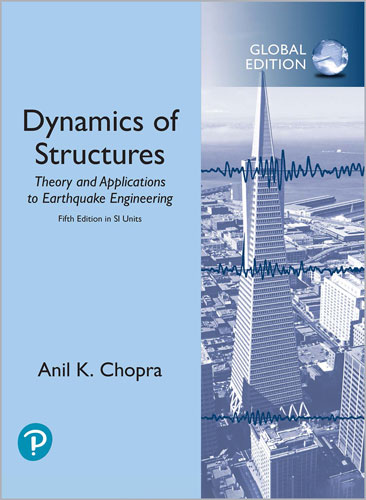
Theory and Applications to Earthquake Engineering
Anil K. Chopra
#Dynamics
#Structures
#SI
#Earthquake_Engineering
For courses in Structural Dynamics. Structural dynamics and earthquake engineering for both students and professional engineers. An expert on structural dynamics and earthquake engineering, Anil K. Chopra fills an important niche, explaining the material in a manner suitable for both students and professional engineers with his Fifth Edition of Dynamics of Structures: Theory and Applications to Earthquake Engineering. No prior knowledge of structural dynamics is assumed, and the presentation is detailed and integrated enough to make the text suitable for self-study. As a textbook on vibrations and structural dynamics, this book has no competition. The material includes many topics in the theory of structural dynamics, along with applications of this theory to earthquake analysis, response, design, and evaluation of structures, with an emphasis on presenting this often difficult subject in as simple a manner as possible through numerous worked-out illustrative examples. The Fifth Edition includes new sections, figures, and examples, along with relevant updates and revisions.
Table of Contents
PART I SINGLE-DEGREE-OF-FREEDOM SYSTEMS
1 Equations of Motion, Problem Statement, and Solution Methods
2 Free Vibration
3 Response to Harmonic and Periodic Excitations
4 Response to Arbitrary, Step, and Pulse Excitations
5 Numerical Evaluation of Dynamic Response
6 Earthquake Response of Linear Systems
7 Earthquake Response of Inelastic Systems
8 Generalized Single-Degree-of-Freedom Systems
PART II MULTI-DEGREE-OF-FREEDOM SYSTEMS
9 Equations of Motion, Problem Statement, and Solution Methods
10 Free Vibration
11 Damping in Structures
12 Dynamic Analysis and Response of Linear Systems
13 Earthquake Analysis of Linear Systems
14 Analysis of Nonclassically Damped Linear Systems
15 Reduction of Degrees of Freedom
16 Numerical Evaluation of Dynamic Response
17 Systems with Distributed Mass and Elasticity
18 Introduction to the Finite Element Method
PART III EARTHQUAKE RESPONSE, DESIGN, AND EVALUATION OF
MULTISTORY BUILDINGS
19 Earthquake Response of Linearly Elastic Buildings
20 Earthquake Analysis and Response of Inelastic Buildings
21 Earthquake Dynamics of Base-Isolated Buildings
22 Structural Dynamics in Building Codes
23 Structural Dynamics in Building Evaluation Guidelines
APPENDIX A FREQUENCY-DOMAIN METHOD OF RESPONSE ANALYSIS
APPENDIX B NOTATION
APPENDIX C ANSWERS TO SELECTED PROBLEMS