ثبت نام / ورود
0
ثبت نام / ورود
0
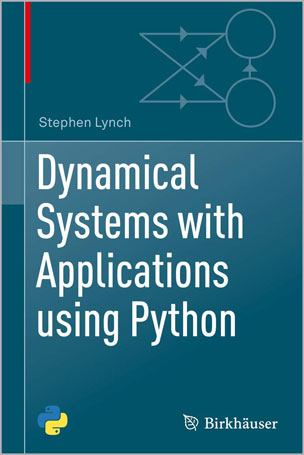
Stephen Lynch
#Python
#Dynamical_Systems
#Computing
#Numerical_algorithms
This textbook provides a broad introduction to continuous and discrete dynamical systems. With its hands-on approach, the text leads the reader from basic theory to recently published research material in nonlinear ordinary differential equations, nonlinear optics, multifractals, neural networks, and binary oscillator computing. Dynamical Systems with Applications Using Python takes advantage of Python’s extensive visualization, simulation, and algorithmic tools to study those topics in nonlinear dynamical systems through numerical algorithms and generated diagrams.
After a tutorial introduction to Python, the first part of the book deals with continuous systems using differential equations, including both ordinary and delay differential equations. The second part of the book deals with discrete dynamical systems and progresses to the study of both continuous and discrete systems in contexts like chaos control and synchronization, neural networks, and binary oscillator computing. These later sections are useful reference material for undergraduate student projects. The book is rounded off with example coursework to challenge students’ programming abilities and Python-based exam questions.
This book will appeal to advanced undergraduate and graduate students, applied mathematicians, engineers, and researchers in a range of disciplines, such as biology, chemistry, computing, economics, and physics. Since it provides a survey of dynamical systems, a familiarity with linear algebra, real and complex analysis, calculus, and ordinary differential equations is necessary, and knowledge of a programming language like C or Java is beneficial but not essential.
Table of Contents
1 A Tutorial Introduction to Python
2 Differential Equations
3 Planar Systems
4 Interacting Species
5 Limit Cycles
6 Hamiltonian Systems, Lyapunov Functions, and Stability
7 Bifurcation Theory
8 Three-Dimensional Autonomous Systems and Chaos
9 Poincare Maps and Nonautonomous Systems in the Plane
10 Local and Global Bifurcations
11 The Second Part of Hilbert's Sixteenth Problem
12 Delay Differential Equations
13 Linear Discrete Dynamical Systems
14 Nonlinear Discrete Dynamical Systems
15 Complex Iterative Maps
16 Electromagnetic Waves and Optical Resonators
17 Fractals and Multifractals
18 Image Processing with Python
19 Chaos Control and Synchronization
20 Neural Networks
21 Binary Oscillator Computing
22 Coursework and Examination-Type Questions
23 Solutions to Exercises
Appendix A Index of Python Programs
About the author
Stephen Lynch is a National Teaching Fellow (NTF), a Fellow of the Institute of Mathematics and Its Applications (FIMA) and a Senior Fellow of the Higher Education Academy (SFHEA). He is an Associate Professor with Manchester Metropolitan University and was concurrently an Associate Lecturer with the Open University (2008-2012). In 2000, he was instrumental in establishing a Schools Liaison forum in the North West of England. In 2010, Stephen volunteered as a STEM Ambassador, in 2012, he won an award as a Public Engagement Champion and in 2014, he became a Speaker for Schools. His research area is in Dynamical Systems and he is a world leader in the use of Maths packages in teaching, learning, assessment, research and employability having written Python, MATLAB, Maple and Mathematica books. Note that all books have accompanying working programs that can be downloaded from the web. Stephen is the co-inventor of binary oscillator computing. He runs national workshops with the Institute of Maths and its Applications: Python for A-Level Maths and Beyond. He also runs international workshops on: Python for Scientific Computing and TensorFlow for Artificial Intelligence.