ثبت نام / ورود
0
ثبت نام / ورود
0
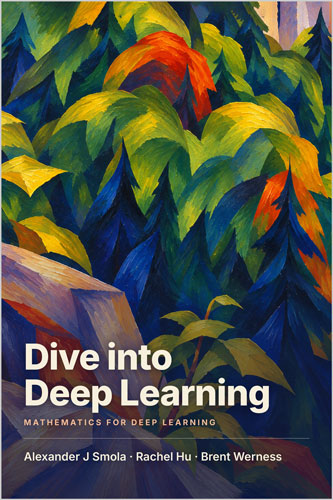
Dive into Deep Learning, version 2026.11.26.
Alexander J Smola, Rachel Hu, Brent Werness
#Deep_Learning
#Mathematics
#PyTorch
#Linear_Algebra
#SVD
#MAP
#ODE
#ELBO
#MCMC
#KKT
📐 با مبانی ریاضی یادگیری عمیق مدرن، از جبر خطی و نظریهٔ یادگیری آماری گرفته تا بهینهسازی، نظریهٔ اطلاعات، معادلات دیفرانسیل و مدلهای مولد با PyTorch آشنا بشید.
📘 کتاب Dive into Deep Learning: Mathematics for Deep Learning (ورود به دنیای یادگیری عمیق؛ ریاضیات یادگیری عمیق) اصول ریاضی زیربنای هوش مصنوعی مدرن و شبکههای عصبی رو بهطور جامع بررسی میکنه. کتاب با ترکیب استنتاجهای دقیق ریاضی، درک شهودی هندسی، کدهای قابلاجرا و آزمایشهای محاسباتی، فاصلهٔ بین نظریههای انتزاعی ریاضی و کاربردهای عملی یادگیری عمیق رو پر میکنه.
🔢 کتاب با جبر خطی شروع میشه و خواننده با فضاهای برداری (Vector Spaces)، تبدیلهای ماتریسی، مقادیر ویژه (Eigenvalues)، تجزیههای طیفی (Spectral Decompositions)، تجزیهٔ مقادیر منفرد (SVD) و تقریبهای کمرتبه (Low-Rank Approximations) آشنا میشه. در ادامه، کتاب به حساب دیفرانسیل و انتگرال تکمتغیره و چندمتغیره، حساب ماتریسی (Matrix Calculus)، ماتریسهای ژاکوبین و هسین (Jacobians and Hessians)، گرافهای محاسباتی، مشتقگیری خودکار (Automatic Differentiation) و مبانی ریاضی پسانتشار خطا (Backpropagation) میپردازه.
⚙️ بخش گستردهای از کتاب به بهینهسازی (Optimization) اختصاص داره و موضوعاتی مثل گرادیان کاهشی (Gradient Descent)، Momentum، روشهای نیوتن و شبهنیوتن، بهینهسازی محدب (Convex Optimization)، بهینهسازی تصادفی و تطبیقی، بهینهسازی مقید (Constrained Optimization)، دوگانگی (Duality) و پایداری عددی (Numerical Stability) رو بررسی میکنه.
📊 کتاب همچنین نظریهٔ احتمال، استنباط آماری (Statistical Inference)، محاسبات بیزی (Bayesian Computation)، برآورد بیشینهٔ درستنمایی (Maximum Likelihood Estimation)، استنباط تغییراتی (Variational Inference)، نامساویهای تمرکز (Concentration Inequalities) و مبانی نظری تعمیمپذیری در یادگیری ماشین رو بهصورت عمیق پوشش میده.
🧠 در ادامه، خواننده با نظریهٔ اطلاعات (Information Theory)، آنتروپی، آنتروپی متقاطع (Cross-Entropy)، واگرایی KL، اطلاعات متقابل (Mutual Information)، انتقال بهینه (Optimal Transport)، فاصلههای واسرشتاین (Wasserstein Distances) و اصول ریاضی زیربنای یادگیری تقابلی (Contrastive Learning) و مدلسازی مولد آشنا میشه.
🌊 فصل پایانی کتاب به ریاضیات زمان پیوسته (Continuous-Time Mathematics) در هوش مصنوعی مولد مدرن میپردازه و معادلات دیفرانسیل معمولی و تصادفی، حلگرهای عددی، Neural ODEs، جریانهای نرمالساز پیوسته (Continuous Normalizing Flows)، حرکت براونی (Brownian Motion)، حساب ایتو (Itô Calculus)، تطبیق امتیاز (Score Matching)، مدلهای انتشار (Diffusion Models) و تطبیق جریان (Flow Matching) رو پوشش میده.
📚 این کتاب هم بهعنوان یک کتاب درسی مستقل در زمینهٔ ریاضیات و هم بهعنوان مکمل سایر جلدهای مجموعهٔ Dive into Deep Learning طراحی شده. کتاب به خواننده کمک میکنه از بهکارگیری الگوریتمهای موجود فراتر بره، مبانی نظری اونها رو درک کنه و روشهای جدیدی برای یادگیری ماشین توسعه بده.
🎯 چیزهایی که خواننده یاد میگیره
📐 درک فضاهای برداری، تبدیلهای ماتریسی، مقادیر ویژه و تجزیههای طیفی
🔢 استفاده از تجزیهٔ مقادیر منفرد (SVD) و تقریبهای کمرتبه در یادگیری عمیق
🧮 تسلط بر حساب دیفرانسیل و انتگرال چندمتغیره، ماتریسهای ژاکوبین و هسین و مشتقگیری خودکار
🧠 درک مبانی ریاضی Backpropagation و گرافهای محاسباتی (Computational Graphs)
⚙️ بررسی بهینهسازی محدب، روشهای گرادیان تصادفی و بهینهسازهای تطبیقی (Adaptive Optimizers)
📏 استفاده از ضرایب لاگرانژ (Lagrange Multipliers)، شرایط KKT و دوگانگی در بهینهسازی
📊 ایجاد پایهای محکم در احتمال، آمار و استنباط بیزی (Bayesian Inference)
🔍 درک برآورد بیشینهٔ درستنمایی (MLE)، MAP، EM، ELBO و MCMC
📈 بررسی نظریهٔ یادگیری آماری، تعمیمپذیری و پدیدهٔ نزول دوگانه (Double Descent)
🧩 بررسی آنتروپی، واگرایی KL، اطلاعات متقابل و انتقال بهینه
🌊 درک معادلات دیفرانسیل معمولی و تصادفی و روشهای انتگرالگیری عددی
🤖 آشنایی با ریاضیات پشت Neural ODEs، مدلهای انتشار، Score Matching و Flow Matching
💻 ایجاد ارتباط بین نظریههای ریاضی و آزمایشهای محاسباتی عملی با استفاده از PyTorch
👥 این کتاب برای چه کسانیه؟
📚 این کتاب برای مهندسان یادگیری ماشین، پژوهشگران هوش مصنوعی، ریاضیدانان، دانشمندان داده، توسعهدهندههای نرمافزار و دانشجویان دانشگاهی طراحی شده که به دنبال درک دقیق و اصولی مبانی ریاضی یادگیری عمیق هستن.
🔬 کتاب بهخصوص برای خوانندگانی ارزشمنده که میخوان مشکلات پیچیدهٔ آموزش مدلها رو تحلیل کنن، مقالات پژوهشی پیشرفته رو درک کنن و الگوریتمهای جدید هوش مصنوعی توسعه بدن.
📖 فهرست مطالب
۳۳. جبر خطی (Linear Algebra)
۳۴. حساب دیفرانسیل و انتگرال و مشتقگیری خودکار (Calculus and Automatic Differentiation)
۳۵. بهینهسازی (Optimization)
۳۶. احتمال و یادگیری آماری (Probability and Statistical Learning)
۳۷. نظریهٔ اطلاعات و واگراییها (Information Theory and Divergences)
۳۸. دینامیک؛ معادلات دیفرانسیل و جریانهای مولد (Differential Equations and Generative Flows)
👥 درباره نویسندگان
👤 الکساندر جی. اسمولا (Alexander J. Smola)
🧠 الکساندر جی. اسمولا پژوهشگر، مدرس و کارآفرین شناختهشدهای در سطح بینالمللیه که در زمینهٔ یادگیری ماشین، یادگیری عمیق و هوش مصنوعی تخصص داره. او مدرک کارشناسی ارشد فیزیک رو از دانشگاه فنی مونیخ (Technical University of Munich) و مدرک دکتری علوم کامپیوتر رو از دانشگاه فنی برلین (Technical University of Berlin) دریافت کرده.
💻 او بهعنوان استاد در دانشگاه کارنگی ملون (Carnegie Mellon University) فعالیت داشته و در Yahoo Research، Google Research و Amazon Web Services (AWS) سمتهای پژوهشی و مدیریتی مختلفی رو بر عهده داشته.
📚 او در سال ۲۰۲۳ شرکت Boson AI رو با همکاری دیگران تأسیس کرده و مقالات علمی متعدد و کتابهای تأثیرگذاری، از جمله Learning with Kernels و Dive into Deep Learning رو نوشته.
👤 ریچل هو (Rachel Hu)
🤖 ریچل هو پژوهشگر علوم کاربردی (Applied Scientist) و مدرس هوش مصنوعیه که در زمینهٔ یادگیری ماشین، یادگیری عمیق و پردازش زبان طبیعی (NLP) تجربه داره.
🎓 او در Amazon Web Services فعالیت داشته و مباحث بینایی کامپیوتر (Computer Vision)، پردازش زبان طبیعی و MLOps رو در Machine Learning University شرکت Amazon تدریس کرده.
📘 او با Energent.ai همکاری داره و در توسعهٔ مبانی ریاضی و محتوای آموزشی کتاب Dive into Deep Learning مشارکت کرده.
👤 برنت ورنس (Brent Werness)
📐 برنت ورنس ریاضیدان، پژوهشگر علمی و مدرس یادگیری ماشینه که مدرک دکتری ریاضیات داره. او در Amazon Web Services فعالیت داشته و نقش مهمی در توسعهٔ برنامههای آموزشی Machine Learning University شرکت Amazon ایفا کرده.
📚 او از مشارکتکنندگان در تدوین مبانی ریاضی کتاب Dive into Deep Learning است و مفاهیم دقیق و اصولی ریاضی رو با آموزش کاربردی یادگیری ماشین پیوند میده.
Discover the mathematical foundations of modern deep learning, from linear algebra and statistical learning theory to optimization, information theory, differential equations, and generative models with PyTorch.
Dive into Deep Learning: Mathematics for Deep Learning provides a comprehensive exploration of the mathematical principles underlying modern artificial intelligence and neural networks. Combining rigorous mathematical derivations, geometric intuition, executable code, and computational experiments, the book bridges the gap between abstract mathematical theory and practical deep learning.
Beginning with linear algebra, readers explore vector spaces, matrix transformations, eigenvalues, spectral decompositions, singular value decomposition (SVD), and low-rank approximations. The book then develops single-variable and multivariable calculus, matrix calculus, Jacobians, Hessians, computational graphs, automatic differentiation, and the mathematical foundations of backpropagation.
An extensive section on optimization examines gradient descent, momentum, Newton and quasi-Newton methods, convex optimization, stochastic and adaptive optimization, constrained optimization, duality, and numerical stability.
The book also provides in-depth coverage of probability theory, statistical inference, Bayesian computation, maximum likelihood estimation, variational inference, concentration inequalities, and the theoretical foundations of machine learning generalization.
Readers then explore information theory, entropy, cross-entropy, KL divergence, mutual information, optimal transport, Wasserstein distances, and the mathematical principles behind contrastive learning and generative modeling.
The final chapter develops the continuous-time mathematics behind modern generative AI, covering ordinary and stochastic differential equations, numerical solvers, Neural ODEs, continuous normalizing flows, Brownian motion, Itô calculus, score matching, diffusion models, and flow matching.
Designed as both a standalone mathematical textbook and a companion to the other volumes of Dive into Deep Learning, this book helps readers move beyond applying existing algorithms to understanding their theoretical foundations and developing new machine learning methods.
What You Will Learn
Who This Book Is For
This book is designed for machine learning engineers, AI researchers, mathematicians, data scientists, software developers, and university students seeking a rigorous understanding of the mathematical foundations of deep learning. It is particularly valuable for readers who want to analyze complex training problems, understand advanced research papers, and develop new artificial intelligence algorithms.
Table of Contents
33. Linear Algebra
34. Calculus and Automatic Differentiation
35. Optimization
36. Probability and Statistical Learning
37. Information Theory and Divergences
38. Dynamics: Differential Equations and Generative Flows
About the Authors
Alexander J. Smola is an internationally recognized researcher, educator, and entrepreneur specializing in machine learning, deep learning, and artificial intelligence. He earned his master's degree in physics from the Technical University of Munich and his Ph.D. in computer science from the Technical University of Berlin. He served as a professor at Carnegie Mellon University and held research and leadership positions at Yahoo Research, Google Research, and Amazon Web Services (AWS). He co-founded Boson AI in 2023 and has authored numerous scientific publications and influential books, including Learning with Kernels and Dive into Deep Learning.
Alex Smola+1
Rachel Hu is an applied scientist and artificial intelligence educator with experience in machine learning, deep learning, and natural language processing. She has worked at Amazon Web Services and taught computer vision, NLP, and MLOps at Amazon's Machine Learning University. She is affiliated with Energent.ai and has contributed to the mathematical foundations and educational content of Dive into Deep Learning.
goldmermaid.github.io+1
Brent Werness is a mathematician, research scientist, and machine learning educator with a Ph.D. in mathematics. He has worked at Amazon Web Services and played an important role in developing educational programs at Amazon's Machine Learning University. He is a contributor to the mathematical foundations of Dive into Deep Learning, connecting rigorous mathematical concepts with practical machine learning education.