ثبت نام / ورود
0
ثبت نام / ورود
0
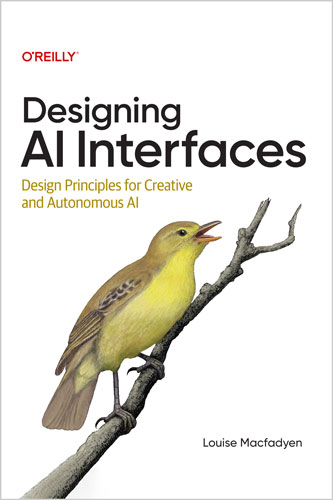
Design Principles for Creative and Autonomous AI
Louise Macfadyen
#AI
#UX
#LLM
Designing AI Interfaces is a practical, design-first guide for product teams building with large language models and autonomous systems.
As artificial intelligence becomes central to modern product design, UX professionals must adapt their toolkits to meet new demands. In Designing AI Interfaces, senior product designer Louise Macfadyen offers a timely, practice-oriented guide for building intuitive, ethical, and effective user experiences with large language models (LLMs) and autonomous AI systems. From content moderation to interruptibility, this book presents actionable design patterns for today’s most advanced AI interactions—with clear technical insights to help designers understand how AI systems process inputs, generate outputs, and make decisions on users’ behalf.
Written specifically for navigating the AI transition, this book provides concrete strategies for managing risk, enabling transparency, and fostering user trust in increasingly agentic systems. Readers will learn how to enable users to steer and shape AI responses in real time, incorporate ethical and UX principles into actionable design strategies, and navigate trade-offs in autonomy and control—all while gaining fluency in key AI concepts to collaborate more effectively with engineering teams.
• Gain an applicable mental model for how AI systems reason, process and act, and how they’re experienced by users
• Design effective and ethical interfaces for LLMs and AI agents
• Apply best-practice patterns for content warnings, permissions, and oversight
• Collaborate confidently with engineering and product teams
• Evaluate your org’s AI maturity and advocate for responsible implementation
“Louise Macfadyen has written a practical guide for designers who will need to not just design but also co-engineer AI systems for the highest reliability. They will need to speak both human and machine. This book teaches them how.”
—John Maeda, VP engineering, Microsoft AI, and author of How To Speak Machine
Table of Contents
Chapter 1. Understanding Large Language Models and Systems
Chapter 2. Capability, Discovery, and Orchestration
Chapter 3. Designing for AI Inputs
Chapter 4. Computation: Designing for the Processing and Generation Phase
Chapter 5. Output: Designing the Delivery and Presentation of LLM Responses
Chapter 6. Agentic AI: Designing for Systems That Plan, Act, and Adapt
About the Author
Louise Macfadyen is a product designer, writer, and creative technologist who specializes in AI interface patterns. Over the past decade, she has worked with organizations including Google, Microsoft, Pinterest, Nike, Gap Sustainability, and the Environmental Working Group and has spoken internationally at events and institutions including Google I/O, Women Who Code, Rhizome, and the Museum of Contemporary Digital Art. She lives in New York City.