ثبت نام / ورود
0
ثبت نام / ورود
0
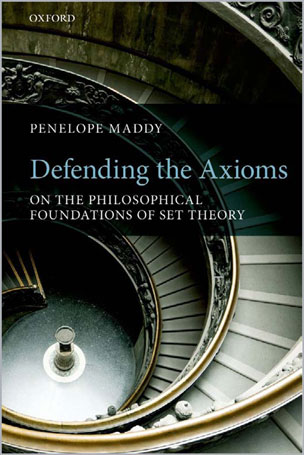
On the Philosophical Foundations of Set Theory
Penelope Maddy
#Axioms
#Mathematics
#Thin_Realism
#Set-theoretic
Mathematics depends on proofs, and proofs must begin somewhere, from some fundamental assumptions. For nearly a century, the axioms of set theory have played this role, so the question of how these axioms are properly judged takes on a central importance. Approaching the question from a broadly naturalistic or second-philosophical point of view, Defending the Axioms isolates the appropriate methods for such evaluations and investigates the ontological and epistemological backdrop that makes them appropriate. In the end, a new account of the objectivity of mathematics emerges, one refreshingly free of metaphysical commitments.
Table of Contents
I. The Problem
1. An historical reversal
2. How applied mathematics became pure
3. Where we are now
II. Proper Method
1. The meta-philosophy
2. Some examples from set-theoretic practice
3. Proper set-theoretic method
4. The challenge
III. Thin Realism
1. Introducing Thin Realism
2. What Thin Realism is not
3. Thin epistemology
4. The objective ground of Thin Realism
5. Retracing our steps
IV. Arealism
1. Introducing Arealism
2. Mathematics in application
3. What Arealism is not
4. Comparison with Thin Realism
5. Thin Realism/Arealism
V. Morals
1. Objectivity in mathematics
2. Robust Realism revisited
3. More examples from set-theoretic practice
4. Intrinsic versus extrinsic
Penelope Maddy is Distinguished Professor of Logic and Philosophy of Science at the University of California, Irvine. She is the author of Naturalism in Mathematics (OUP, 1997), Realism in Mathematics (OUP, 1992), and Second Philosophy (OUP, 2007).