ثبت نام / ورود
0
ثبت نام / ورود
0
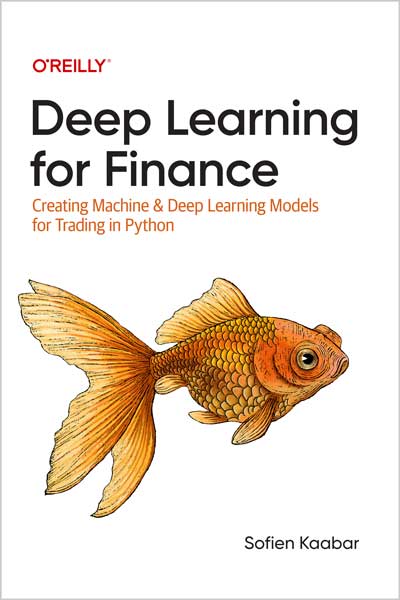
Creating Machine and Deep Learning Models for Trading in Python
Sofien Kaabar
#Deep_Learning
#Finance
#ML
#Python
#algorithms
#Risk_Management
#data_science
#Machine_Learning
Deep learning is rapidly gaining momentum in the world of finance and trading. But for many professional traders, this sophisticated field has a reputation for being complex and difficult. This hands-on guide teaches you how to develop a deep learning trading model from scratch using Python, and it also helps you create, trade, and back-test trading algorithms based on machine learning and reinforcement learning.
Sofien Kaabar—financial author, trading consultant, and institutional market strategist—introduces deep learning strategies that combine technical and quantitative analyses. By fusing deep learning concepts with technical analysis, this unique book presents out-of-the-box ideas in the world of financial trading. This A-Z guide also includes a full introduction to technical analysis, evaluating machine learning algorithms, and algorithm optimization.
Machine learning and deep learning have completely changed the finance industry in recent years. The different learning models are well suited to a world where data is abundant and continuous. Data is the new gold, and its value keeps rising as proper analyses lead to key business decisions, which are the driver of economic shifts.
The rise of quantitative funds is living proof that the world of data science has much to offer to the trading world. After fundamental and technical traders, a new breed of leaders of the universe is emerging. These are the quantitative traders who rely on machine-based algorithms with extremely complex operations that seek to forecast and outperform the markets.
This book covers in detail the subject of deep learning for finance.
Table of Contents
Chapter 1. Introducing Data Science and Trading
Chapter 2. Essential Probabilistic Methods for Deep Learning Chapter 3. Descriptive Statistics and Data Analysis
Chapter 4. Linear Algebra and Calculus for Deep Learning
Chapter 5. Introducing Technical Analysis
Chapter 6. Introductory Python for Data Science
Chapter 7. Machine Learning Models for Time Series Prediction
Chapter 8. Deep Learning for Time Series Prediction I
Chapter 9. Deep Learning for Time Series Prediction II
Chapter 10. Deep Reinforcement Learning for Time Series Prediction
Chapter 11. Advanced Techniques and Strategies
Chapter 12. Market Drivers and Risk Management
Why This Book?
I have spent my career researching trading strategies, techniques, and all things related to the financial world. Through the years, I have become familiar with a few algorithmic models that have the potential of adding value to the trading framework. In this book, I discuss different learning models and their applications in the trading world, with a focus on deep learning and neural networks. My main aim is to cover them in such a way that everyone understands how they function.
Machines can perform operations and detection better than humans for many reasons, one of which is their objectivity. This means that one of the key skills you will learn is how to use Python to create the algorithms required to do such operations.
As mentioned, my objective is to provide a comprehensive introduction to the use of deep learning in finance. I do this by discussing a wide range of topics, including data science, trading, machine and deep learning models, and reinforcement learning applications for trading.
The book begins with an overview of the field of data science and its role in the finance world. It then delves into the knowledge requirements, such as statistics, math, and Python, before focusing on how to use machine and deep learning in trading strategies.
Who Should Read It?
This book is intended for a wide audience, including professionals and academics in finance, data scientists, quantitative traders, and students of finance of any level. It provides a thorough introduction to the use of machine and deep learning in time series prediction, and it is an essential resource for anyone who wants to understand and apply these powerful techniques.
The book assumes you have basic background knowledge in both Python programming (professional Python users will find the code very straightforward) and financial trading. I take a clear and simple approach that focuses on the key concepts so that you understand the purpose of every idea.
Sofien Kaabar is a financial author, trading consultant, and institutional market strategist specializing in the currencies market with a focus on Technical & Quantitative topics. Sofien's goal is to make Technical Analysis objective by incorporating clear conditions that can be analyzed and created with the use of technical indicators that rival existing ones.
Having elaborated many successful trading algorithms, Sofien is now sharing back the knowledge he has acquired over the years to make it accessible to everyone.