ثبت نام / ورود
0
ثبت نام / ورود
0
John K. Thompson
#Data
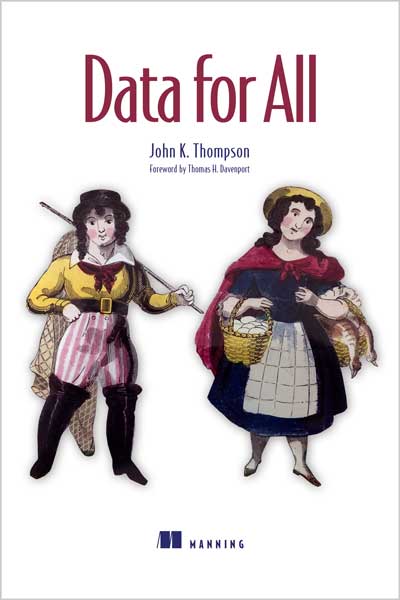
Take control of your personal data. Learn how companies manipulate and exploit your data and what you can do to access, delete, and monetize it yourself.
Both a handbook and a manifesto, Data for All is a must-read for anyone who wants to take control of their personal data. The book lays out how businesses collect, use, and exploit your data, and clearly explains the legislation that will overturn the existing system. Follow John Thompson's direct and accessible guidance and you'll completely change your relationship with your data.
In this fascinating book, you will learn how to oversee who accesses your data, how much different types of data are worth, and how to keep private details private. You'll soon stop being a passive source of free data, and start earning a "data dividend"—hundreds or thousands of dollars paid out simply for your daily online activities.
John Thompson and I have been discussing, debating, and collaborating on data and analytics projects for over 25 years. Data for All concisely summarizes and accurately outlines the coming data revolution and, at the same time, provides guidance as to how each individual and company can prepare themselves to own, manage, protect, and profit from their data. The world of data is changing rapidly. All of us should be ready to benefit from it, this book is a practical guide to doing just that.
Larry Smarr, Distinguished Prof. Emeritus Computer Science & Engineering at UC San Diego
John Thompson is distinctively qualified by experience and insight to explain how the data economy works and why you need to know how it works. Like it or not, the data we generate critically conditions the terms on which we live and work and deal with each other and with the institutions - especially the private corporations - who capture and take advantage of that data. Data for All delivers an accessible yet comprehensive education about the world that we and our computers have created.
William Janeway, University of Cambridge, and Warburg Pincus
John Thompson's book, Data for All, is one of the more interesting ones I have read recently. It is one of the most honest, direct, pull-no-punches sources on one of the most important personal issues of our time. That issue is, "Should I undertake extraordinary efforts to prevent companies—tech and otherwise—from getting access to my personal data?" I think the answer is yes. I've already changed some of my own behaviors after reading the book, and I suggest you do so as well. You have more to lose than you may think.
Thomas H. Davenport, Distinguished Professor, Babson College and Fellow, MIT Initiative on the Digital Economy, Author of Competing on Analytics and The AI Advantage
John provides a cogent and concise treatment of the problem of "digital exhaust" and what to do about the nearly infinite traces of ourselves that we create in the course of everyday activity. His voice is of someone who has lived with and thought about data from before it was trendy to do so. While John is appropriately blunt about the challenges ordinary people face in controlling their data, he is neither cynical or pessimistic, and therefore provides an actionable path toward greater agency around the data we generate.
Thomas A. Finholt, Dean, School of Information, University of Michigan
How much time do you spend thinking deeply about the data you create, who is using that data, and how? It's hard to know where to even start. John Thompson's Data for All provides a wide-ranging non-technical overview of the past present, and future of data, of topics including data privacy, open data, and data analytics, And for those looking to take control of their own data futures, this book is the best version of a "People's Data Manifesto" I've seen to date.
David Steier - Distinguished Service Professor, Carnegie Mellon University
Table of Contents
Chapter 1: A history of data
1.1 Aconcerning situation
1.2 An example: Genetic testing and reporting
1.3 The beginnings of modern data
1.4 Modern data in the present day
1.5 The new and current view and value of data
1.6 Wrapping up
Chapter 2: How data works today
2.1 Where does data originate?
2.2 The life cycle of data
2.3 1he past is the past. but the future has not been written yet
2.4 On my way for the day A Grand Day Out
2.5 Whose interests are being served by leveraging your data?
2.6 Who are you aligned with?
2.7 Final thoughts
Chapter 3: You and your data
3.1 Origins of the internet and World Wide Web
3.2 Current views and attitudes toward data
3.3 Some people don't have the luxury of thinking about data
3.4 How the general population thinks about data today
3.5 How do you think about data today?
3.6 Green shoots and new beginnings
3.7 Final thoughts
Chapter 4: Trust
4.1 Forces that are working against our best interests
4.2 Trust
4.3 Trust in government
4,4 Tust in business and business leaders
4.5 Trust is lost; time for a change
4.6 Technology and media companies are making bank from your data
4.7 Governmental regulations
4.8 Effect of data laws around the globe
4.9 Final thoughts
Chapter 5: Privacy
5.1 Privacy defined
5.2 Privacy throughout history
5.3 Psychology and privacy
5.4 We need privacy like we need sleep
5.5 Privacy and secrecy
5.6 Two sides of privacy
5.7 Privacy and human behavior
5.8 Privacy precepts
5.9 Poor privacy policies
5.10 Enlightened privacy policies and related data protection
5.11 Privacy laws and regulations
5.12 Privacy and data ownership
5.13 Privacy and technology
5.14 Privacy and trust
5.15 Final thoughts
Chapter 6: Moving from Open Data to Our Data
6.1 Data from many sources drives value
6.2 Data and analytics at dinner parties
6.3 Data can be used as a weapon
6.4 The horse is out of the barn, let's go riding
6.5 New and modern approaches to data
6.6 Data exchanges
6.7 Data intermediaries, data pools, and data unions
6.8 Data commons
6.9 Final thoughts
Chapter 7: Derived data, synthetic data, and analytics
7.1 Data lineage
7.2 Forms of data
7.3 Analytics and data
7.4 Augmented intelligence
7.5 Data scientists and statisticians
7.6 Final thoughts
Chapter 8: Looking for ward: What's next for our data?
8.1 Where do we go from here?
8.2 A day in the life of your data well, actually two days
8.3 What's different in 20252
8.4 Data intermediaries (Dls)
8.5 Dimensions of data access
8.6 What Dls will do for you
8.7 Dimensions of data monetization
8.8 So what do we do today
8.9 Final thoughts
Thank you for interest in - Data for All.
Data for All is a thought leadership book that provides an overview of the world of data as it relates to all people. You do not need to have or maintain technical or programming skills to understand the content.
Data for All is written to be an accessible book that is easy to read for the general population. The early feedback is that you can read the book quickly and then revisit sections where you want to gain a deeper understanding of the specific aspect(s) of the data ecosystem that you are interested in.
The book is constructed in 3 parts:
The book is meant to be an educational treatment and explanation of the world of data today and tomorrow.
The scope and scale of change that is underway us significant, and I want to help drive that change across the world. I want to empower people to benefit from their data. I want people to understand that they own their data.
Thank you again for your interest in Data for All. I look forward to our discussions related to how you can take control of your data.
Best,
John
John K. Thompson is an international technology executive with over 37 years of experience in the fields of data, advanced analytics, and artificial intelligence (AI). John is the Gloal Head of AI for EY. He was an executive partner at Gartner, and he was responsible for the advanced analytics business unit of the Dell Software Group. John is the author of Analytics Teams: Harnessing analytics and artificial intelligence for business improvement and co-author of Analytics: How to win with Intelligence. He holds a bachelor of science degree in computer science from Ferris State University and an MBA in marketing from DePaul University.