ثبت نام / ورود
0
ثبت نام / ورود
0
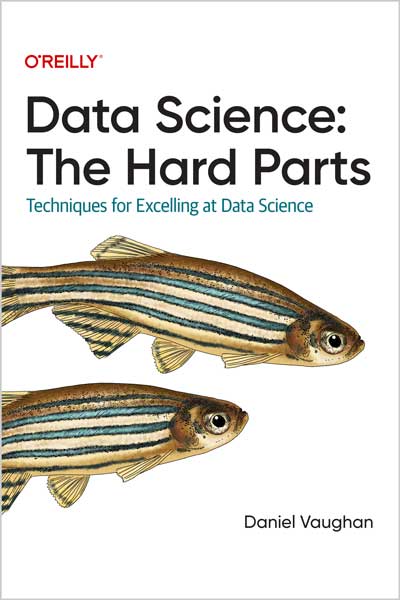
Techniques for Excelling at Data Science
Daniel Vaughan
#Data_Science
#Data
#ML
#Data_Leakage
This practical guide provides a collection of techniques and best practices that are generally overlooked in most data engineering and data science pedagogy. A common misconception is that great data scientists are experts in the "big themes" of the discipline—machine learning and programming. But most of the time, these tools can only take us so far. In practice, the smaller tools and skills really separate a great data scientist from a not-so-great one.
Taken as a whole, the lessons in this book make the difference between an average data scientist candidate and a qualified data scientist working in the field. Author Daniel Vaughan has collected, extended, and used these skills to create value and train data scientists from different companies and industries.
With this book, you will:
Table of Contents
Part I. Data Analytics Techniques
Chapter 1. So What? Creating Value with Data Science
Chapter 2. Metrics Design
Chapter 3. Growth Decompositions: Understanding Tailwinds and Headwinds
Chapter 4. 2×2 Designs
Chapter 5. Building Business Cases
Chapter 6. What's in a Lift?
Chapter 7. Narratives
Chapter 8. Datavis: Choosing the Right Plot to Deliver a Message
Part II. Machine Learning
Chapter 9. Simulation and Bootstrapping
Chapter 10. Linear Regression: Going Back to Basics
Chapter 11. Data Leakage
Chapter 12. Productionizing Models
Chapter 13. Storytelling in Machine Learning
Chapter 14. From Prediction to Decisions
Chapter 15. lncrementality: The Holy Grail of Data Science?
Chapter 16. A/B Tests
Chapter 17. Large Language Models and the
Practice of Data Science
I’ll posit that learning and practicing data science is hard. It is hard because you are expected to be a great programmer who not only knows the intricacies of data structures and their computational complexity but is also well versed in Python and SQL. Statistics and the latest machine learning predictive techniques ought to be a second language to you, and naturally you need to be able to apply all of these to solve actual business problems that may arise. But the job is also hard because you have to be a great communicator who tells compelling stories to nontechnical stakeholders who may not be used to making decisions in a data-driven way.
So let’s be honest: it’s almost self-evident that the theory and practice of data science is hard. And any book that aims at covering the hard parts of data science is either encyclopedic and exhaustive, or must go through a preselection process that filters out some topics.
I must acknowledge at the outset that this is a selection of topics that I consider the hard parts to learn in data science, and that this label is subjective by nature. To make it less so, I’ll pose that it’s not that they’re harder to learn because of their complexity, but rather that at this point in time, the profession has put a low enough weight on these as entry topics to have a career in data science. So in practice, they are harder to learn because it’s hard to find material on them.
The data science curriculum usually emphasizes learning programming and machine learning, what I call the big themes in data science. Almost everything else is expected to be learned on the job, and unfortunately, it really matters if you’re lucky enough to find a mentor where you land your first or second job. Large tech companies are great because they have an equally large talent density, so many of these somewhat underground topics become part of local company subcultures, unavailable to many practitioners.
This book is about techniques that will help you become a more productive data scientist. I’ve divided it into two parts: Part I treats topics in data analytics and on the softer side of data science, and Part II is all about machine learning (ML).
While it can be read in any order without creating major friction, there are instances of chapters that make references to previous chapters; most of the time you can skip the reference, and the material will remain clear and self-explanatory. References are mostly used to provide a sense of unity across seemingly independent topics.
This book is intended for data scientists of all levels and seniority. To make the most of the book, it’s better if you have some medium-to-advanced knowledge of machine learning algorithms, as I don’t spend any time introducing linear regression, classification and regression trees, or ensemble learners, such as random forests or gradient boosting machines.
Daniel Vaughan is currently the Head of Data at Clip, the leading paytech company in Mexico. He is the author of Analytical Skills for AI and Data Science (O'Reilly, 2020). With more than 15 years of experience developing machine learning and more than eight years leading data science teams, he is passionate about finding ways to create value through data and data science and in developing young talent. He holds a PhD in economics from NYU (2011). In his free time he enjoys running, walking his dogs around Mexico City, reading, and playing music.