ثبت نام / ورود
0
ثبت نام / ورود
0
Combining First Principles and Machine Learning
Miguel A. Mendez, Andrea Ianiro, Bernd R. Noack, Steven L. Brunton
#Data_Driven
#Fluid_Mechanics
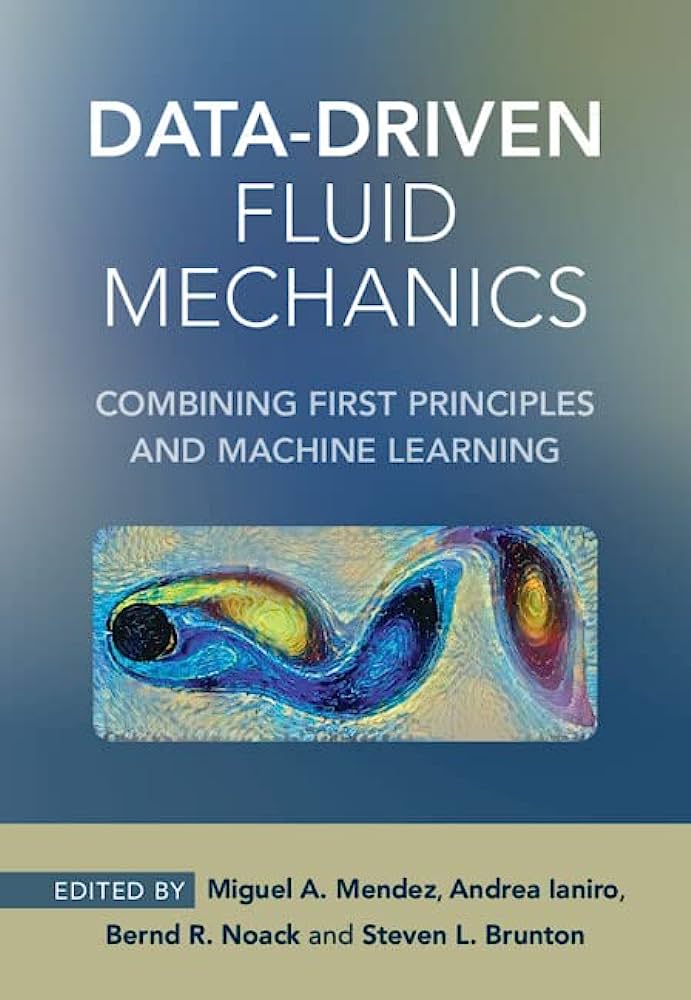
Data-driven methods have become an essential part of the methodological portfolio of fluid dynamicists, motivating students and practitioners to gather practical knowledge from a diverse range of disciplines. These fields include computer science, statistics, optimization, signal processing, pattern recognition, nonlinear dynamics, and control. Fluid mechanics is historically a big data field and offers a fertile ground for developing and applying data-driven methods, while also providing valuable shortcuts, constraints, and interpretations based on its powerful connections to basic physics. Thus, hybrid approaches that leverage both methods based on data as well as fundamental principles are the focus of active and exciting research. Originating from a one-week lecture series course by the von Karman Institute for Fluid Dynamics, this book presents an overview and a pedagogical treatment of some of the data-driven and machine learning tools that are leading research advancements in model-order reduction, system identification, flow control, and data-driven turbulence closures.
Table of Content
Part I Motivation
1 Analysis, Modeling, and Control of the Cylinder Wake
2 Coherent Structures in Turbulence: A Data Science Perspective
3 Machine Learning in Fluids: Pairing Methods with Problems
Part II Methods from Signal Processing
4 Continuous and Discrete LTI Systems
5 Time{Frequency Analysis and Wavelets
Part III Data-Driven Decompositions
6 The Proper Orthogonal Decomposition
7 The Dynamic Mode Decomposition: From Koopman Theory
8 Generalized and Multiscale Modal Analysis
9 Good Practice and Applications of Data-Driven Modal Analysis
Part IV Dynamical Systems
11 Nonlinear Dynamical Systems
12 Methods for System Identi cation
13 Modern Tools for the Stability Analysis of Fluid Flows
Part V Applications
15 Advancing Reacting Flow Simulations with Data-Driven Models
16 Reduced-Order Modeling for Aerodynamic Applications and
17 Machine Learning for Turbulence Control
18 Deep Reinforcement Learning Applied to Active Flow Control
Part VI Perspectives
19 The Computer as Scientist
About the Authors
Miguel A. Mendez is Assistant Professor at the von Karman Institute for Fluid Dynamics, Belgium. He has extensively used data-driven methods for post-processing numerical and experimental data in fluid dynamics. He developed a novel multi-resolution extension of POD which has been extensively used in various flow configurations of industrial interest. His current interests include data-driven modeling and reinforcement learning.
Andrea Ianiro is Associate Professor at Universidad Carlos III de Madrid, Spain. He is a well-known expert in the field of experimental thermo-fluids. He has pioneered the use of data-driven modal analysis in heat transfer studies for impinging jets and wall-bounded flows with heat transfer. He extensively applies these techniques in combination with advanced measurement techniques such as 3D PIV and IR thermography.
Bernd R. Noack is National Talent Professor at the Harbin Institute of Technology, China. He has pioneered the automated learning of control laws and reduced-order models for real-world experiments as well as nonlinear model-based control from first principles. He is Fellow of the American Physical Society and Mendeley/Web-of-Science Highly Cited Researcher with about 300 publications including 5 books, 2 US patents and over 100 journal publications.
Steven L. Brunton is Professor at the University of Washington, USA. He has pioneered the use of machine learning to fluid mechanics in areas ranging from system identification to flow control. He has an international reputation for his excellent teaching and communication skills, which have contributed to the dissemination of his research through textbooks and online lectures.