ثبت نام / ورود
0
ثبت نام / ورود
0
Stephen J. Blundell, Katherine M. Blundell
#Thermal
#Physics
#Thermodynamics
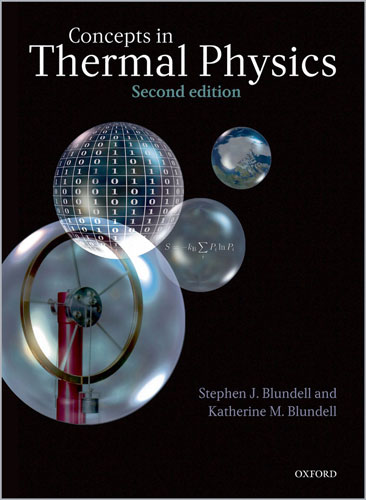
An understanding of thermal physics is crucial to much of modern physics, chemistry and engineering. This book provides a modern introduction to the main principles that are foundational to thermal physics, thermodynamics and statistical mechanics. The key concepts are carefully presented in a clear way, and new ideas are illustrated with copious worked examples as well as a description of the historical background to their discovery. Applications are presented to subjects as diverse as stellar astrophysics, information and communication theory, condensed matter physics and climate change. Each chapter concludes with detailed exercises.
The second edition of this popular textbook maintains the structure and lively style of the first edition but extends its coverage of thermodynamics and statistical mechanics to include several new topics, including osmosis, diffusion problems, Bayes theorem, radiative transfer, the Ising model and Monte Carlo methods. New examples and exercises have been added throughout.
Table of Contents
I: Preliminaries
1 Introduction
2 Heat
3 Probability
4 Temperature and the Boltzmann factor
II: Kinetic theory of gases
5 The Maxwell- Boltzmann distribution
6 Pressure
7 Molecular effusion
8 The mean free path and collisions
Ill: Transport and thermal diffusion
9 Transport properties in gases
10 The thermal diffusion equation
IV: The first law
11 Energy
12 Isothermal and adiabatic processes
V: The second law
13 Heat engines and the second law
14 Entropy
15 Information theory
VI: Thermodynamics in action
16 Thermodynamic potentials
17 Rods, bubbles, and magnets
18 The third law
VII: Statistical mechanics
19 Equipartition of energy
20 The partition function
21 Statistical mechanics of an ideal gas
22 The chemical potential
23 Photons
24 Phonons
VIII: Beyond the ideal gas
25 Relativistic gases
26 Real gases
27 Cooling real gases
28 Phase transitions
29 Bose-Einstein and Fermi- Dirac distributions
30 Quantum gases and condensates
IX: Special topics
31 Sound waves
32 Shock waves
33 Brownian motion and fluctuations
34 Non-equilibrium thermodynamics
35 Stars
36 Compact objects
37 Earth's atmosphere
A: Fundamental constants
B: Useful formulae
C: Useful mathematics
D: The electromagnetic spectrum
E: Some thermodynamical definitions
F: Thermodynamic expansion formulae
G: Reduced mass
H: Glossary of main symbols
Stephen Blundell did his undergraduate degree in Physics and Theoretical Physics at Peterhouse, Cambridge and his Ph. D. in the Cavendish Laboratory at Cambridge. He moved to the Clarendon Laboratory at Oxford to take up an SERC research fellowship, followed by a Junior Research Fellowship at Merton College, where he began research in organic magnets and superconductors using muon-spin rotation. In 1997 he was appointed to a University Lectureship in the Physics Department and a Tutorial Fellowship at Mansfield College, Oxford, and was subsequently promoted to Reader and then Professor. He was a joint winner of the Daiwa-Adrian Prize in 1999 for his work on organic magnets.
Katherine Blundell did her undergraduate degree in Physics and Theoretical Physics at New Hall College, Cambridge and her Ph. D. in the Cavendish Laboratory at Cambridge. She moved to Oxford University Astrophysics department, holding a Junior Research Fellowship at Balliol College, an 1851 Research Fellowship, before taking up a Royal Society University Research Fellowship. Her research concentrates on radio galaxies and quasars. In 2005 she won a Leverhulme prize for her research, and became a Professor of Astrophysics in 2008.