ثبت نام / ورود
0
ثبت نام / ورود
0
John C. Mitchell
#Programming_Languages
#ML
#C++
#Java
#Object_oriented
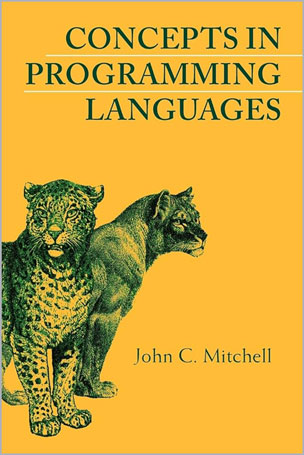
For undergraduate and beginning graduate students, this textbook explains and examines the central concepts used in modern programming languages, such as functions, types, memory management, and control. The book is unique in its comprehensive presentation and comparison of major object-oriented programming languages. Separate chapters examine the history of objects, Simula and Smalltalk, and the prominent languages C++ and Java. The author presents foundational topics, such as lambda calculus and denotational semantics, in an easy-to-read, informal style, focusing on the main insights provided by these theories. Advanced topics include concurrency, concurrent object-oriented programming, program components, and inter-language interoperability. A chapter on logic programming illustrates the importance of specialized programming methods for certain kinds of problems. This book will give the reader a better understanding of the issues and tradeoffs that arise in programming language design, and a better appreciation of the advantages and pitfalls of the programming languages they use.
Table of Contents
Part 1 Functions and Foundations
1 Introduction
2 Computability
3 Lisp: Functions, Recursion, and Lists
4 Fundamentals
Part 2 Procedures, Types, Memory Management, and Control
5 The Algol Family and ML
6 Type Systems and Type Inference
7 Scope, Functions, and Storage Management
8 Control in Sequential Languages
Part 3 Modularity, Abstraction, and Object-Oriented Programming
9 Data Abstraction and Modularity
10 Concepts in Object-Oriented Languages
11 History of Objects: Simula and Smalltalk
12 Objects and Run-Time Efficiency: C++
13 Portability and Safety: Java
Part 4 Concurrency and Logic Programming
14 Concurrent and Distributed Programming
15 The Logic Programming Paradigm and Prolog
Appendix A Additional Program Examples
About the author
John C. Mitchell is Professor of Computer Science at Stanford University, where he has been a popular teacher for more than a decade.Many of his former students are successful in research and private industry. He received his Ph.D. from MIT in 1984 and was a Member of Technical Staff at AT&T Bell Laboratories before joining the faculty at Stanford.