ثبت نام / ورود
0
ثبت نام / ورود
0
Designing Toolkits, Workflows, Industry
Pierpaolo Ruttico
#Coding
#Automated
#Architectural
#3D-Printed
#ECO2
#AEC
#CO2
#Artificial_Intelligence
#Metaverse
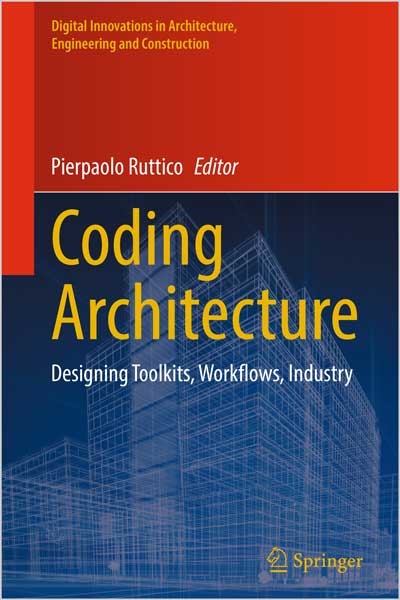
This book provides a clear picture of how computational processes are gradually permeating and innovating the Architecture, Engineering, and Construction sector, contributing to sustainability and aesthetic evolution. It achieves that by gathering a collection of accounts shared by pioneering professionals involved in this innovation, drawing from recent academic studies, ongoing experimental processes conducted in cutting-edge architectural and engineering offices, as well as innovative industrial applications.
The covered subjects span a wide range, including artificial intelligence and robotic manufacturing, the metaverse and 3D printing, strategies to counter CO2 consumption through plug-ins, as well as emerging materials and construction techniques.
The chapters feature authors who are pioneers and embrace roles like software developers, architects, process engineers, academics, and forward-thinking entrepreneurs. They represent authoritative references within a broader interconnected cultural and technological system; an eclectic system that finds in computational processes the key to addressing the new challenges of contemporary architecture.
Table of Contents
Part I Effective Toolkits
1 Ambrosinus-Toolkit Plugin: Artificial Intelligence Text-to-Image Generative Models Through Grasshopper
2 EOC ECO2 Plugin: Automated Embodied Carbon Calculations Within Autodesk Revit
3 Interoperability Challenges. Exploring Trends, Patterns, Practices and Possible Futures for Enhanced Collaboration and Efficiency in the AEC Industry
4 HAL Robotics: From Automated Architectural Design for Fabrication, to Architecting Automated Manufacturing Systems
5 Resilience and the Metaverse: A Toolkit Approach
Part II Virtuous Workflows
6 Towards a Rhizomatic Design Model
7 Enhancing Sustainability: Concept Design Optimization Workflow for Human-Centered Low Carbon Solutions
8 Testing Digital Workflows on Building Renovations: The Case Study of F10 New Law Building for the University of Sydney
9 Computational artwork to transform places
10 Timber Structures Through Advanced Design Tools. The Reciprocalshell Project
Part III Innovative Construction Industry
11 Enhancing Efficiency in Industrial Digital Design and Fabrication of Complex Prefabricated Elements
12 Transforming the Construction Industry Through Wire Arc Additive Manufacturing
13 Custom-Made Printheads Empowering 3d Printed Concrete: Innovations in Digital Design and Fabrication of Complex Prefabricated Elements
14 Architects as Innovators: Harnessing the Power of Digital Design and Construction
15 Superframe: A Novel Construction System that Combines Planar Panels with 3D-Printed Frames Made from Recycled Thermoplastic Materials
Pierpaolo Ruttico is an architect-engineer and researcher at Politecnico di Milano, Italy, who focuses on complex constructions and advanced production processes. He previously worked in New York City for Pelli Clarke & Partners, and subsequently earned a Ph.D. in Building Engineering, with a specialization in non-standard geometries. He is the founder and director of INDEXLAB, a multidisciplinary research group established in 2010. INDEXLAB is dedicated to exploring new paradigms for contemporary design and architecture, introducing innovative processes in digital fabrication, artificial intelligence, and robotics.