ثبت نام / ورود
0
ثبت نام / ورود
0
Michael Hausenblas
#Cloud
#Observability
#Prometheus
#Loki
#Jaeger
#Grafana
#SREs
#AWS
AboutThis Book
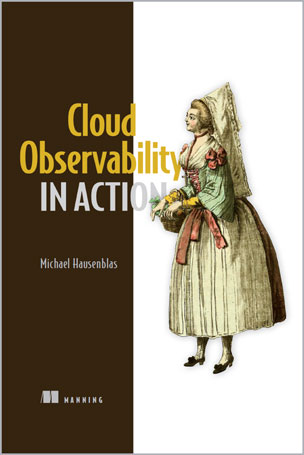
Observability is the capability to continuously generate and discover actionable insights based on signals from the (cloud-native) system under observation, with the goal of influencing the system. We approach the topic from a return-on-investment perspective: we look at costs and benefits, from the sources to telemetry (including agents) to the signal destinations (backends), including time series data stores, such as Prometheus, and frontends, such as Grafana.
Throughout the book, I use open source tooling, including, but not limited to, OpenTelemetry (collector), Prometheus, Loki, Jaeger, and Grafana to demonstrate the different concepts and enable you to experiment with them without any costs, other than your time.
Who Should Read This Book
The book focuses primarily on developers, DevOps/site reliability engineers (SREs), who are working with cloud-native applications. It is meant for anyone interested in running cloud-native applications, be that in Kubernetes or using function-as-a-service offerings, such as AWS Lambda.
Also, I believe that if you are a release manager, an IT architect, a security and network engineer, a tech lead, or a product manager in the cloud-native space, you can benefit from the book. The book can be used with any public cloud (I use AWS for several demonstrations, purely for the sake of familiarity) as well as with any cloudnative setup on-prem (e.g., Kubernetes in the data center).
Table of Contents
1 End-to-end observability
2 Signal types
3 Sources
4 Agents and instrumentation
5 Backend destinations
6 Frontend destinations
7 Cloud operations
8 Distributed tracing
9 Developer observability
10 Service level objectives
11 Signal correlation
Appendix- A Kubernetes end-to-end example
About the Author
Michael Hausenblas works in the Amazon Web Services (AWS) open source observability service team, where he leads the OpenTelemetry activities. He has more than 20 years of experience in data engineering and cloud-native systems. Before AWS, Michael worked at Red Hat on Kubernetes, Mesosphere (now D2iQ) on Mesos and Kubernetes, MapR (now part of HPE) as chief data engineer, and spent more than a decade in applied research in the symbolic AI space.