ثبت نام / ورود
0
ثبت نام / ورود
0
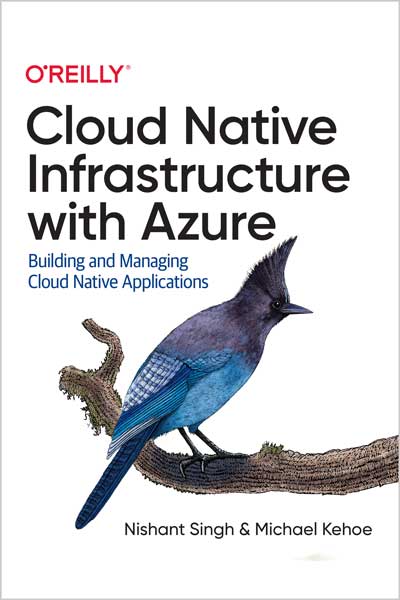
Building and Managing Cloud Native Applications
Nishant Singh, Michael Kehoe
#Cloud
#Cloud_Native
#Azure
#Kubernetes
#Microsoft
#DevOps
The cloud is becoming the de facto home for companies ranging from enterprises to startups. Moving to the cloud means moving your applications from monolith to microservices. But once you do, running and maintaining these services brings its own level of complexity. The answer? Modularity, deployability, observability, and self-healing capacity through cloud native development.
With this practical book, Nishant Singh and Michael Kehoe show you how to build a true cloud native infrastructure using Microsoft Azure or another cloud computing solution by following guidelines from the Cloud Native Computing Foundation (CNCF). DevOps and site reliability engineers will learn how adapting applications to cloud native early in the design phase helps you fully utilize the elasticity and distributed nature of the cloud.
This book helps you explore:
Table of Contents
Chapter 1. Introduction: Why Cloud Native?
Chapter 2. Infrastructure as Code: Setting Up the Gateway
Chapter 3. Containerizing Your Application: More Than Boxes
Chapter 4. Kubernetes: The Grand Orchestrator
Chapter 5. Creating a Kubernetes Cluster in Azure
Chapter 6. Observability: Following the Breadcrumbs
Chapter 7. Service Discovery and Service Mesh: Finding New Territories and Crossing Borders
Chapter 8. Networking and Policy Management: Behold the Gatekeepers
Chapter 9. Distributed Databases and Storage: The Central Bank
Chapter 10. Getting the Message
Chapter 11. Serverless
Chapter 12. Conclusion
Cloud computing has been widely adopted as a model of next-generation digital business transformation that drives growth and innovation. Nowadays, customers look for an ecosystem and experience that is fast and that seamlessly integrates with their existing services. From an enterprise perspective, the cloud delivers services for consumers and businesses in a way that is scalable, highly reliable, and available. From an end-user perspective, the cloud provides a simple model for acquiring computing services without needing to fully understand the underlying infrastructure and technology.
To take full advantage of the speed and agility of cloud services, many existing applications have been transformed into cloud native applications, and new solutions are being built for the cloud first. Cloud native applications are built from the ground up to embrace rapid change, large scale, and resilience. By default, the underlying infrastructure for cloud native applications plays a critical role in efficiently serving a business’s needs. If the underlying infrastructure is not architected with the correct practices, even the best cloud native applications will fail in production environments.
This book explores how modern cloud native infrastructures on Azure can be built and managed in a production environment, along with various requirements and design considerations of cloud native applications.
Who Should Read This Book
This book provides a simple yet comprehensive introduction to the cloud native landscape and all the major technologies that engineers use to build such reliable environments. The book is for site reliability engineers (SREs), DevOps engineers, Solution architects, Azure enthusiasts, and anyone who is involved in building, migrating, deploying, and managing the day-to-day operations of a cloud native workload.
The book assumes that you possess basic knowledge of the cloud and DevOps culture in general. But even if you don’t, and you want to better understand the buzz around cloud native and other fancy technologies, this book is still the right place for you to get started.
Goals of This Book
By the end of this book, you will be able to follow and build your own infrastructure on Microsoft Azure. We present a sequential introduction to the major components of the cloud native world and how to use, deploy, and maintain them over Azure. Additionally, you will be introduced to the need for cloud native technologies in today’s brave new world, the problems they solve, and hands-on best practices.
In this book, you will:
Nishant Singh is a senior site reliability engineer at LinkedIn, where he works to improve the reliability of the site with a focus on reducing the mean time to detect (MTTD) and mean time to respond (MTTR) to incidents. Prior to joining LinkedIn, he worked at Paytm and Gemalto as a DevOps engineer, spending his time building custom solutions for clients and managing and maintaining services over the public cloud. Nishant has a keen interest in site reliability engineering and in building distributed systems.
Michael Kehoe is a senior staff security engineer at Confluent. Prior to this, he worked on incident response, disaster recovery, visibility engineering, and reliability principles as a senior staff site reliability engineer at LinkedIn. During his time at LinkedIn, he led the company's efforts to automate the migration to Microsoft Azure. Michael specializes in maintaining large system infrastructure as demonstrated by his work at LinkedIn (applications, automation, and infrastructure) and at the University of Queensland (networks). He has also spent time building small satellites at NASA and writing thermal environments software at Rio Tinto.