ثبت نام / ورود
0
ثبت نام / ورود
0
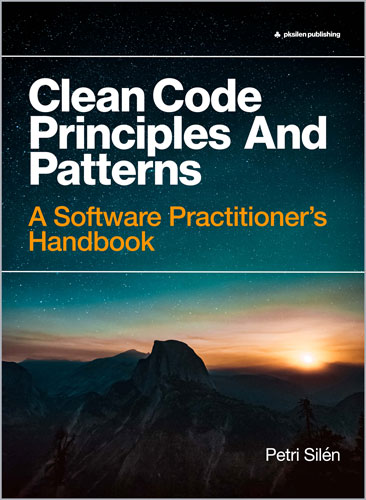
A Software Practitioner's Handbook
Petri Silen
#Clean_Code
#CQRS
#MVC
#GraphQL
#gRPC
#DevSecOps
Clean Code Principles and Patterns is one of the most comprehensive no-fluff guides for software developers to help them write clean code every day. The author Petri Silen has almost 30 years of industry experience in designing and implementing software, and now he puts all his knowledge gained during the years into this book. The book is packed with principles and patterns that help developers, from novices and juniors to seniors and experts, to write cleaner code. The principles and patterns presented in the book are accompanied by realistic yet straightforward examples to help the reader to understand them better. Examples are written in Java, JavaScript/TypeScript, and C++. Most of the examples are directly applicable to other programming languages, too. The reader should have basic knowledge of one object-oriented programming language to get the full benefit from this book. The source code for all major examples presented in the book is available in a public GitHub repository.
After reading this book, you will know the following and much more:
Table of Contents
1: About the Author
2: Introduction
3: Architectural Principles and Patterns
4: Object-Oriented Design Principles
5: Coding Principles
6: Testing Principles
7: Security Principles
8: API Design Principles
9: Databases And Database Principles
10: Concurrent Programming Principles
11: Agile and Teamwork Principles
12: DevSecOps
13: Conclusion
14: Appendix A
About the Author
Petri Silen is a seasoned software developer working at Nokia Networks in Finland with industry experience of almost 30 years. He has done both frontend and backend development with a solid competence in multiple programming languages, including C++, Java, and JavaScript/TypeScript. He started his career at Nokia Telecommunications in 1995. During his first years, he developed a real-time mobile networks analytics product called "Traffica" in C++ for major telecom customers worldwide, including companies like T-Mobile, Orange, Vodafone, and Claro. The initial product was for monitoring a 2G circuit-switched core network and GPRS packet-switched core network. Later, functionality to Traffica was added to cover new network technologies, like 3G circuit-switched and packet core networks, 3G radio networks, and 4G/LTE. He later developed new functionality for Traffica using Java and web technologies, including jQuery and React. During the last few years, he has developed cloud-native containerized microservices with Java and C++ for the next-generation Customer and Networks Insights (CNI) product used by major communications service providers like Verizon, AT&T, USCC, and KDDI. The main application areas he has contributed during the last years include KPI-based real-time alerting, anomaly detection for KPIs, and configurable real-time data exporting.
During his free time, he has developed a data visualization application using React, Redux, TypeScript, and Jakarta EE. He has also developed a security-first cloud-native microservice framework for Node.js in TypeScript. He likes to take care of his Kaapo cat, take walks, play tennis and badminton, ski in the winter, and watch soccer and ice hockey on TV.