ثبت نام / ورود
0
ثبت نام / ورود
0
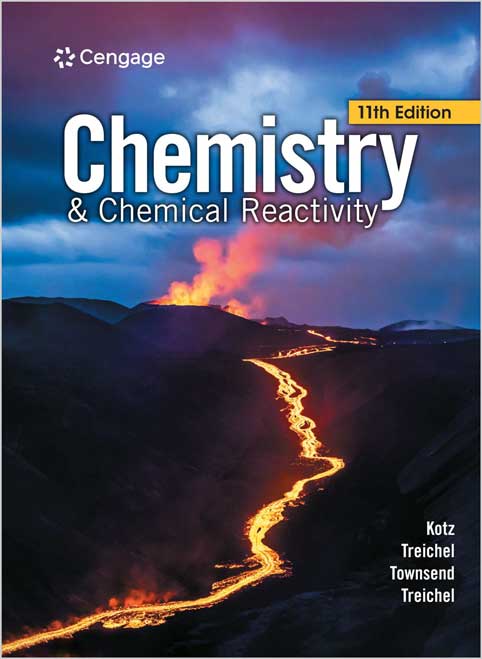
John C. Kotz, Paul M. Treichel, John R. Townsend, David A. Treichel
#Chemistry
#Chemical
#Nuclear
#Acids
#Atoms
#Molecular
The first edition of this book was conceived over 40 years ago. Since that time, there have been ten editions, and over one million students worldwide have used the book to begin their study of chemistry. Although the details of the book and its organization have changed over the years, our fundamental goal has remained the same: to provide a broad overview of the principles of chemistry, the reactivity of the chemical elements and their compounds, and the applications of chemistry. To reach this goal, we have tried to show the close relationship between the observations of chemical and physical changes made by chemists in the laboratory and in nature and the way these changes are viewed at the atomic and molecular levels. We have also tried to convey the sense that chemistry not only has a lively history but is also interesting and dynamic, with important new developments occurring every year. Furthermore, we wanted to provide some insight into the chemical aspects of the world around us.
The authors of this text have collectively taught chemistry for over 100 years, and we have engaged in years of fundamental research. Like countless other scientists, our goals in our research and in writing this textbook have been to satisfy our curiosity about areas of chemistry, to document what we found, and to convey that to students and other scientists. Our results, and many others, may be used, perhaps only years later, to make a better material or better pharmaceutical. Every person eventually benefits from the work of the worldwide community of scientists.
In recent years, when people around the world have experienced various epidemics and increasing evidence of climate change has been published, science has come under attack. Some distrust the scientific community and dismiss the results of carefully done research. Therefore, a key objective of this book, and of a course in general chemistry, is to describe basic chemical “facts”—chemical processes and principles; how chemists came to understand those principles and new ideas; how they can be applied in industry, medicine, and the environment; and how to think about problems as a scientist. We have tried to provide the tools to help you become a chemically and scientifically literate citizen
About This Product
Help your students succeed in chemistry with the clear explanations, problem-solving strategies and dynamic study tools of CHEMISTRY & CHEMICAL REACTIVITY, Eleventh Edition. This progressive and engaging general chemistry text helps students develop a deeper understanding of fundamental chemistry concepts. The text emphasizes the visual nature of chemistry, illustrating the close interrelationship of the macroscopic, symbolic and particulate levels of chemistry with an art program that brings each of these levels to life in engaging detail. In addition, the text showcases the practical applications of chemistry and presents recent advances to make content both interesting and relevant for today's students. The Eleventh Edition also features online learning activities in OWLv2 that can deliver personalized learning experiences for students.
Table of Contents
Part 1: The Basic Tools of Chemistry
Chapter 1: Basic Concepts of Chemistry
Chapter 1R: Let's Review: The Tools of Quantitative Chemistry
Chapter 2: Atoms, Molecules, and lons
Chapter 3: Chemical Reactions
Chapter 4: Stoichiometry: Quantitative Information about Chemical Reactions
Chapter 5: Principles of Chemical Reactivity: Energy and Chemical Reactions
Part 2: Atoms and Molecules
Chapter 6: The Structure of Atoms
Chapter 7: The Structure of Atoms and Periodic Trends
Chapter 8: Bonding and Molecular Structure
Chapter 9: Bonding and Molecular Structure: Orbital Hybridization and Molecular Orbitals
Part 3: States of Matter
Chapter 10: Gases and Their Properties
Chapter 11: Intermolecular Forces and Liquids
Chapter 12: The Solid State
Chapter 13: Solutions and Their Behavior
Part 4: The Control of Chemical Reactions
Chapter 14: Chemical Kinetics: The Rates of Chemical Reactions
Chapter 15: Principles of Chemical Reactivity: Equilibria
Chapter 16: Principles of Chemical Reactivity: The Chemistry of Acids and Bases
Chapter 17: Principles of Chemical Reactivity: Other Aspects of Aqueous Equilibria
Chapter 18: Principles of Chemical Reactivity: Entropy and Free Energy
Chapter 19: Principles of Chemical Reactivity: Electron Transfer Reactions
Part 5: The Chemistry of the Elements
Chapter 20: Nuclear Chemistry
Chapter 21: The Chemistry of the Main Group Elements
Chapter 22: The Chemistry of the Transition Elements
Chapter 23: Carbon: Not Just Another Element
Chapter 24: Biochemistry
Chapter 25: Environmental Chemistry - Earth's Environment, Energy, and Sustainability
List of Appendices
Appendix A: Using Logarithms and Solving Quadratic Equations
Appendix B: Some Important Physical Concepts
Appendix C: Abbreviations and Useful Conversion Factors
Appendix D: Physical Constants
Appendix E: A Brief Guide to Naming Organic Compounds
Appendix F: Values for the lonization Energies and Electron Attachment Enthalpies of the Elements
Appendix G: Vapor Pressure of Water at Various Temperatures
Appendix H: Ionization Constants for Aqueous Weak Acids at 25 Degrees Celsius
Appendix I: Ionization Constants for Aqueous Weak Bases at 25 Degrees Celsius
Appendix J: Solubility Product Constants for Some Inorganic Compounds at 25 Degrees Celsius
Appendix K: Formation Constants for Some Complex lons in Aqueous Solution at 25 Degrees Celsius
Appendix L: Selected Thermodynamic Values
Appendix M: Standard Reduction Potentials in Aqueous Solution at 25 Degrees Celsius
Appendix N: Answers to Study Questions, Check Your Understanding, and Applying Chemical Principles Questions
About the Authors
John (Jack) Kotz graduated from Washington and Lee University in 1959 and earned a Ph.D. in chemistry at Cornell University in 1963. He was a National Institutes of Health postdoctoral fellow at the University of Manchester in England and at Indiana University. He was an Assistant Professor of Chemistry at Kansas State University before moving to the State University of New York at Oneonta in 1970. He taught general chemistry and inorganic chemistry, and in 1986 was appointed a State University of New York Distinguished Teaching Professor of Chemistry. He retired from active teaching in 2005. He is the author or coauthor of sixteen chemistry textbooks, among them two in advanced inorganic chemistry, two introductory general chemistry books in numerous editions, and various manuals and study guides. The general chemistry book has been published as an interactive CD-ROM, as an interactive ebook, and has been translated into five languages. He has also published research papers in organometallic chemistry, and among his awards are the SUNY Award for Research and Scholarship and the Catalyst Award in Education from the Chemical Manufacturers Association. He was a Fulbright Senior Lecturer in Portugal and a mentor for the U.S. National Chemistry Olympiad team. He has served on the boards of trustees for the College at Oneonta Foundation, the Kiawah Island Nature Conservancy, and Camp Dudley. He is also an avid photographer, primarily of wildlife (www.greensward.smugmug.com). His email address is johnkotz@mac.com.
Paul M. Treichel received his B.S. degree from the University of Wisconsin in 1958 and a Ph.D. from Harvard University in 1962. After a year of postdoctoral study in London, he assumed a faculty position at the University of Wisconsin–Madison. He served as department chair from 1986 through 1995 and was awarded a Helfaer Professorship in 1996. He has held visiting faculty positions in South Africa (1975) and in Japan (1995). Retiring after 44 years as a faculty member in 2007, he is currently Emeritus Professor of Chemistry. During his faculty career he taught courses in general chemistry, inorganic chemistry, organometallic chemistry, and scientific ethics. Professor Treichel’s research in organometallic and metal-cluster chemistry and in mass spectrometry, aided by 75 graduate and undergraduate students, has led to more than 170 papers in scientific journals. He may be contacted by email at treichelpaul@me.com.
John R. Townsend completed his B.A. in Chemistry as well as the Approved Program for Teacher Certification in Chemistry at the University of Delaware. After a career teaching high school science and mathematics, he earned his M.S. and Ph.D. in biophysical chemistry at Cornell University, where he also received the DuPont Teaching Award for his work as a teaching assistant. After teaching at Bloomsburg University of Pennsylvania, he joined the faculty at West Chester University of Pennsylvania where he coordinated the chemistry education program for prospective high school teachers and the general chemistry lecture programs, taught undergraduate courses in general chemistry and biochemistry, and was the university supervisor for 78 prospective high school chemistry teachers during their student teaching semester. In 2021, he was the recipient of the Award for Excellence in Undergraduate Teaching in Chemical Science from the Philadelphia (Pennsylvania) Section of the American Chemical Society. Retiring in 2021, he is an Emeritus Professor of Chemistry at West Chester University. He may be contacted by email at jtownsend@wcupa.edu.
David A. Treichel, Professor of Chemistry at Nebraska Wesleyan University, received a B.A. degree from Carleton College. He earned a M.S. and a Ph.D. in analytical chemistry at Northwestern University. After postdoctoral research at the University of Texas in Austin, he joined the faculty at Nebraska Wesleyan University. His research interests are in the fields of electrochemistry and surface laser spectroscopy. He may be contacted by email at dat@nebrwesleyan.edu.