ثبت نام / ورود
0
ثبت نام / ورود
0
Lisa A. Urry, Michael L. Cain, Steven A. Wasserman, Peter V. Minorsky, Rebecca B. Orr
#Biology
#Campbell_Biology
#Ecology
#Animal
#Evolution
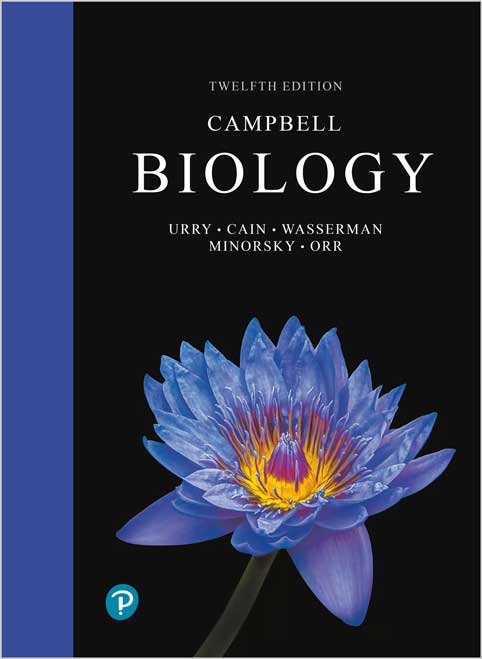
Campbell Biology, 12th Edition, delivers an authoritative, accurate, current, and pedagogically innovative experience that helps students make connections so they learn and understand biology. This edition presents new, engaging visual and digital resources that meet demonstrated student needs.
We are honored to present the Twelfth Edition of Campbell Biology. For the last three decades, Campbell Biology has been the leading college text in the biological sciences. It has been translated into 19 languages and has provided millions of students with a solid foundation in college-level biology.
This success is a testament not only to Neil Campbell’s original vision but also to the dedication of hundreds of reviewers (listed on pages xxviii–xxxi), who, together with editors, artists, and contributors, have shaped and inspired this work. Our goals for the Twelfth Edition include:
■ supporting students with new visual presentations of content and new study tools
■ supporting instructors by providing new teaching modules with tools and materials for introducing, teaching, and assessing important and often challenging topics
■ integrating text and media to engage, guide, and inform students in an active process of inquiry and learning Our starting point, as always, is our commitment to crafting text and visuals that are accurate, are current, and reflect our passion for teaching biology.
Table of Contents
1 Evolution, the Themes of Biology, and Scientific Inquiry
Unit 1 The Chemistry of Life
Interview: Kenneth Olden
2 The Chemical Context of Life
3 Water and Life
4 Carbon and the Molecular Diversity of Life
5 The Structure and Function of Large Biological Molecules
Unit 2 The Cell
6 A Tour of the Cell
7 Membrane Structure and Function
8 An Introduction to Metabolism
9 Cellular Respiration and Fermentation
10 Photosynthesis
11 Cell Communication
12 The Cell Cycle
Unit 3 Genetics
Interview: Francisco Moj ica
13 Meiosis and Sexual Life Cycles
14 Mendel and the Gene Idea
15 The Chromosomal Basis of Inheritance
16 The Molecular Basis of Inheritance
17 Gene Expression: From Geneto Protein
18 Regulation of Gene Expression
19 Viruses
20 DNA Tools and Biotechnology
21 Genomes and Their Evolution
Unit 4 Mechanisms of Evolution
22 Descent with Modification: A Darwinian View of Life
23 The Evolution of Populations
24 The Origin of Species
25 The History of Life on Earth
Unit 5 The Evolutionary History of Biological Diversity
Interview: Penny Chisholm
26 Phylogeny and the Tree of Life
27 Bacteria and Archaea
28 Protists
29.1 Plant Diversity I: How Plants Colonized Land
30 Plant Diversity II: The Evolution of Seed Plants
31 Fungi
32 An Overview of Animal Diversity
33 An Introduction to Invertebrates
34 The Origin and Evolution of Vertebrates
Unit 6 Plant Form and Function
35 Vascular Plant Structure, Growth, and Development
36 Resource Acquisition and Transport in Vascular Plants
37 Soil and Plant Nutrition
38 Angiosperm Reproduction and Biotechnology
39 Plant Responses to Internal and External Signals
Unit 7 Animal Form and Function
40 Basic Principles of Animal Form and Function
41 Animal Nutrition
42 Circulation and Gas Exchange
43 The Immune System
44 Osmoregulation and Excretion
45 Hormones and the Endocrine System
46 Animal Reproduction
47 Animal Development
48 Neurons, Synapses,and Signaling
49 Nervous Systems
50 Sensory and Motor Mechanisms
51 Animal Behavior
Unit 8 Ecology
52 An Introduction to Ecology and the Biosphere
53 Population Ecology
54 Community Ecology
55 Ecosystems and Restoration Ecology
56 Conservation Biology and Global Change
About the Authors
Lisa A. Urry (Chapter 1 and Units 1–3) is Professor of Biology at Mills College. After earning a B.A. at Tufts University, she completed her Ph.D. at the Massachusetts Institute of Technology (MIT). Lisa has conducted research on gene expression during embryonic and larval development in sea urchins. Deeply committed to promoting opportunities in science for women and underrepresented minorities, she has taught courses ranging from introductory and developmental biology to an immersive course on the U.S./Mexico border.
Michael L. Cain (Units 4, 5, and 8) is an ecologist and evolutionary biologist who is now writing full-time. Michael earned an A.B. from Bowdoin College, an M.Sc. from Brown University, and a Ph.D. from Cornell University. As a faculty member at New Mexico State University, he taught introductory biology, ecology, evolution, botany, and conservation biology. Michael is the author of dozens of scientific papers on topics that include foraging behavior in insects and plants, long-distance seed dispersal, and speciation in crickets. He is also a coauthor of an ecology textbook.
Steven A. Wasserman (Unit 7) is Professor of Biology at the University of California, San Diego (UCSD). He earned an A.B. from Harvard University and a Ph.D. from MIT. Working on the fruit fly Drosophila, Steve has done research on developmental biology, reproduction, and immunity. Having taught genetics, development, and physiology to undergraduate, graduate, and medical students, he now focuses on introductory biology, for which he has been honored with UCSD’s Distinguished Teaching Award.
Peter V. Minorsky (Unit 6) is Professor of Biology at Mercy College in New York, where he teaches introductory biology, ecology, and botany. He received his A.B. from Vassar College and his Ph.D. from Cornell University. Peter taught at Kenyon College, Union College, Western Connecticut State University, and Vassar College; he is also the science writer for the journal Plant Physiology. His research interests concern how plants sense environmental change. Peter received the 2008 Award for Teaching Excellence at Mercy College.
Rebecca B. Orr (Ready-to-Go Teaching Modules, Interactive Visual Activities, eText Media Integration) is Professor of Biology at Collin College in Plano, Texas, where she teaches introductory biology. She earned her B.S. from Texas A&M University and her Ph.D. from University of Texas Southwestern Medical Center at Dallas. Rebecca has a passion for investigating strategies that result in more effective learning and retention, and she is a certified Team-Based Learning Collaborative Trainer Consultant. She enjoys focusing on the creation of learning opportunities that both engage and challenge students.
Neil A. Campbell (1946–2004) earned his M.A. from the University of California, Los Angeles, and his Ph.D. from the University of California, Riverside. His research focused on desert and coastal plants. Neil’s 30 years of teaching included introductory biology courses at Cornell University, Pomona College, and San Bernardino Valley College, where he received the college’s first Outstanding Professor Award in 1986. For many years he was also a visiting scholar at UC Riverside. Neil was the founding author of Campbell Biology.