ثبت نام / ورود
0
ثبت نام / ورود
0
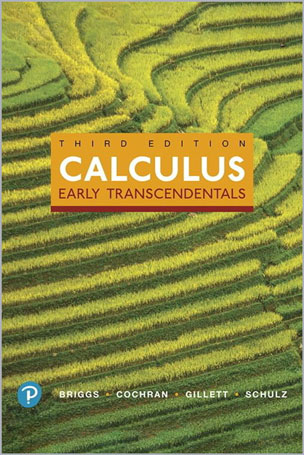
Early Transcendentals
William Briggs, Lyle Cochran, Bernard Gillett, Eric Schulz
#Calculus
#Transcendentals
#Integration
#Differential_Equations
اثری از بریگز، کاکران، گیلت، و شولتز
🔹 درباره کتاب: این کتاب که موفقترین متن جدید حسابان در دو دهه اخیر شناخته میشود، برای دورههای ۳ تا ۴ ترمه حسابان (شامل حسابان تکمتغیره و چندمتغیره) طراحی شده و مورد استفاده دانشجویان ریاضی، مهندسی، علوم طبیعی و اقتصاد قرار میگیرد.
ویرایش سوم مورد انتظار سری کتابهای حسابان بریگز، ویژگیهای برجسته خود را حفظ کرده و در عین حال پیشرفتها و اصلاحات مهمی را معرفی میکند:
برای ویرایش سوم، نویسندگان بازخوردهای بیش از ۱۴۰ استاد و یک پنل تخصصی مهندسی را جمعآوری کردهاند. این فرآیند بررسی گسترده، در کنار تجربه تدریس خود نویسندگان، منجر به خلق متنی شده که بهطور ویژه برای مدرسان و دانشجویان حسابان امروز طراحی شده است.
بخش اول: حسابان تکمتغیره
فصل ۱: توابع (Functions)
فصل ۲: حد (Limits)
فصل ۳: مشتقها (Derivatives)
فصل ۴: کاربردهای مشتق
فصل ۵: انتگرالگیری (Integration)
فصل ۶: کاربردهای انتگرال
فصل ۷: توابع لگاریتمی و نمایی
فصل ۸: تکنیکهای انتگرالگیری
فصل ۹: معادلات دیفرانسیل
فصل ۱۰: دنبالهها و سریهای نامتناهی
فصل ۱۱: سریهای توانی (Power Series)
فصل ۱۲: منحنیهای پارامتری و قطبی
بخش دوم: حسابان چندمتغیره
فصل ۱۳: بردارها و هندسه فضا (Geometry of Space)
فصل ۱۴: توابع برداری (Vector-Valued Functions)
فصل ۱۵: توابع چندمتغیره (Functions of Several Variables)
فصل ۱۶: انتگرالگیری چندگانه (Multiple Integration)
فصل ۱۷: حسابان برداری (Vector Calculus)
فصل D2: معادلات دیفرانسیل مرتبه دوم (Second-Order Differential Equations)
ویلیام بریگز (William Briggs):
لایل کاکران (Lyle Cochran):
برنارد گیلت (Bernard Gillett):
اریک شولتز (Eric Schulz):
For 3- to 4-semester courses covering single-variable and multivariable calculus, taken by students of mathematics, engineering, natural sciences, or economics.
The most successful new calculus text in the last two decades
The much-anticipated 3rd Edition of Briggs’ Calculus Series retains its hallmark features while introducing important advances and refinements. Briggs, Cochran, Gillett, and Schulz build from a foundation of meticulously crafted exercise sets, then draw students into the narrative through writing that reflects the voice of the instructor. Examples are stepped out and thoughtfully annotated, and figures are designed to teach rather than simply supplement the narrative. The groundbreaking eBook contains approximately 700 Interactive Figures that can be manipulated to shed light on key concepts.
For the 3rd Edition, the authors synthesized feedback on the text and MyLab™ Math content from over 140 instructors and an Engineering Review Panel. This thorough and extensive review process, paired with the authors’ own teaching experiences, helped create a text that was designed for today’s calculus instructors and students.
Table of Contents
Chapter 1 Functions
Chapter 2 Limits
Chapter 3 Derivatives
Chapter 4 Applications of the Derivative
Chapter 5 Integration
Chapter 6 Applications of Integration
Chapter 7 Logarithmic and Exponential Functions
Chapter 8 Integration Techniques
Chapter 9 Differential Equations
Chapter 10 Sequences and Infinite Series
Chapter 11 Power Series
Chapter 12 Parametric and Polar Curves
Chapter 13 Vectors and the Geometry of Space
Chapter 14 Vector-Valued Functions
Chapter 15 Functions of Several Variables
Chapter 16 Multiple Integration
Chapter 17 Vector Calculus
Chapter D2 Second-Order Differential Equations
William Briggs has been on the mathematics faculty at the University of Colorado at Denver for 23 years. He received his BA in mathematics from the University of Colorado and his MS and PhD in applied mathematics from Harvard University. He teaches undergraduate and graduate courses throughout the mathematics curriculum, with a special interest in mathematical modeling and differential equations as it applies to problems in the biosciences. He has written a quantitative reasoning textbook, Using and Understanding Mathematics; an undergraduate problem solving book, Ants, Bikes, and Clocks; and two tutorial monographs, The Multigrid Tutorial and The DFT: An Owner's Manual for the Discrete Fourier Transform. He is the Society for Industrial and Applied Mathematics (SIAM) Vice President for Education, a University of Colorado President's Teaching Scholar, a recipient of the Outstanding Teacher Award of the Rocky Mountain Section of the Mathematical Association of America (MAA), and the recipient of a Fulbright Fellowship to Ireland.
Lyle Cochran is a professor of mathematics at Whitworth University in Spokane, Washington. He holds BS degrees in mathematics and mathematics education from Oregon State University and a MS and PhD in mathematics from Washington State University. He has taught a wide variety of undergraduate mathematics courses at Washington State University, Fresno Pacific University, and since 1995 at Whitworth University. His expertise is in mathematical analysis, and he has a special interest in the integration of technology and mathematics education. He has written technology materials for leading calculus and linear algebra textbooks including the Instructor's Mathematica Manual for Linear Algebra and Its Applications by David C. Lay and the Mathematica Technology Resource Manual for Thomas' Calculus. He is a member of the MAA and a former chair of the Department of Mathematics and Computer Science at Whitworth University.
Bernard Gillett is a Senior Instructor at the University of Colorado at Boulder; his primary focus is undergraduate education. He has taught a wide variety of mathematics courses over a 20-year career, receiving 5 teaching awards in that time. Bernard authored a software package for algebra, trigonometry, and precalculus; the Student's Guide and Solutions Manual and the Instructor's Guide and Solutions Manual for Using and Understanding Mathematics by Briggs and Bennett; and the Instructor's Resource Guide and Test Bank for Calculus and Calculus: Early Transcendentals by Briggs, Cochran and Gillett. Bernard is also an avid rock climber and has published 4 climbing guides for the mountains in and surrounding Rocky Mountain National Park.
Eric Schulz has been teaching mathematics at Walla Walla Community College since 1989 and began his work with Mathematica in 1992. He has an undergraduate degree in mathematics from Seattle Pacific University and a graduate degree in mathematics from the University of Washington. Eric loves working with students and is passionate about their success. His interest in innovative and effective uses of technology in teaching mathematics has remained strong throughout his career. He is the developer of the Basic Math Assistant, Classroom Assistant, and Writing Assistant palettes that ship in Mathematica worldwide. He is an author on multiple textbooks: Calculus and Calculus: Early Transcendentals with Briggs, Cochran and Gillett, and Precalculus with Sachs and Briggs, where he writes, codes and creates dynamic eTexts combining narrative, videos and Interactive Figures using Mathematica and CDF technology.