ثبت نام / ورود
0
ثبت نام / ورود
0
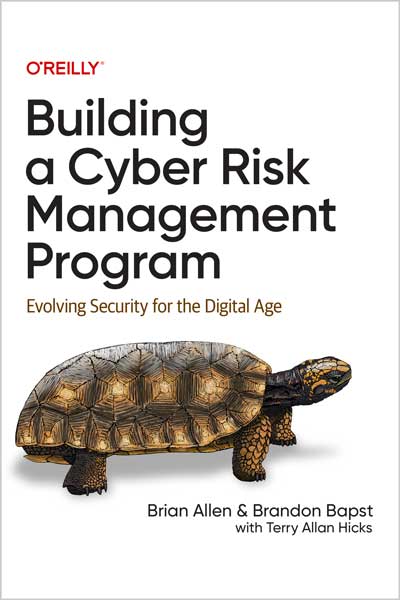
Evolving Security for the Digital Age
Brian Allen, Brandon Bapst
#Cyber_Risk
#Risk_Management
#CRMP
#Security
Cyber risk management is one of the most urgent issues facing enterprises today. This book presents a detailed framework for designing, developing, and implementing a cyber risk management program that addresses your company's specific needs. Ideal for corporate directors, senior executives, security risk practitioners, and auditors at many levels, this guide offers both the strategic insight and tactical guidance you're looking for.
You'll learn how to define and establish a sustainable, defendable, cyber risk management program, and the benefits associated with proper implementation. Cyber risk management experts Brian Allen and Brandon Bapst, working with writer Terry Allan Hicks, also provide advice that goes beyond risk management. You'll discover ways to address your company's oversight obligations as defined by international standards, case law, regulation, and board-level guidance.
This book helps you:
Table of Contents
Chapter 1. Cybersecurity in the Age of Digital Transformation
Chapter 2. The Cyber Risk Management Program
Chapter 3. Agile Governance
Chapter 4. Risk-Informed System
Chapter 5. Risk-Based Strategy and Execution
Chapter 6. Risk Escalation and Disclosure
Chapter 7. Implementing the Cyber Risk Management Program
Chapter 8. The CRMP Applied to Operational Risk and Resilience
Chapter 9. Al and Beyond-the Future of Risk Management in a Digitalized World
Appendix A. The Cyber Risk Management Program Framework v1.0
Who Should Read This Book
We’ve designed this book to deliver real-world value to the broadest possible range of readers, while at the same time making it clear at every stage which readers will be most impacted by which content. The key roles we see benefiting from the book are:
Security practitioners at every level - Risk management is a highly mature practice, one that’s been developed, practiced, and refined for decades, but not usually as a comprehensive, formalized program for security. Developing a program will help to drive the maturity, intent, and purpose of the practice.
Security practitioners in every function - As much as this book is focused on cybersecurity, if you take the word “cyber” out, you have the fundamental elements that could be applied to programmatically managing risks in physical security, fraud management, business continuity management, and operational resilience.
Boards of directors - This book is designed to provide directors with a comprehensive understanding of their vital role and responsibilities in overseeing a cyber risk management program. It offers insights into the expectations for management’s role in the program’s establishment. The underlying principles highlight the importance of viewing cybersecurity as a business risk, providing a perspective that empowers directors to ask more relevant questions and provide better guidance to management. By moving the focus from the technical details of cybersecurity tactics and operations to a wider strategic risk oversight role, directors can improve their cyber risk management program’s effectiveness while strengthening defenses against increasing legal and regulatory liabilities.
CxOs and line-of-business leaders - These high-level decision makers will gain a clear understanding of the need for security to mature as a risk practice; this will help them understand and protect themselves against increased liability. These decision makers will also learn how to set security expectations, so they can make appropriate and informed security risk decisions that align with their overall strategies.
Regulators - Regulatory bodies can use the guidance in this book to help develop well-defined regulations based on reasonable, consistent, and repeatable expectations. A common taxonomy and shared expectations will make their efforts more efficient, effective, and synergistic.
Auditors - Audit professionals typically focus on best practices, evaluating the effectiveness of an enterprise’s or an organization’s security controls and processes against established policies, standards, frameworks, and regulations. This book provides a comprehensive structure for auditors to use in evaluating a cybersecurity risk management program, because it focuses on security execution in relation to the business’s expected risk appetite and tolerance.
Business leaders and professionals whose work may be impacted by the risks introduced by digitalization - The impacts of digital transformation are far-reaching, complex, and unpredictable. As a result, professionals in many different disciplines—most business leaders and decision makers across most enterprise functions—will find real value in learning about how to identify digitalization’s risks and make informed decisions about balancing risk and reward.
"As a cyber practitioner who has spent the last decade building and evolving the cyber risk program at the world's largest Fintech, I thoroughly enjoyed reading Building a Cyber Risk Management Program by Brian Allen and Brandon Bapst. Their program roadmap and insights will benefit cyber risk leaders working in any industry, companies of all sizes, and programs at all levels of maturity." - Greg Montana, Independent Board Member and former CRO, FIS Global
"Building a Cyber Risk Management Program applies practical solutions to the ever evolving, complex, and technical cyber environment. It's well thought-out and provides a structured risk-based governance approach with easy-to-follow concepts. This book is a must read for anyone with cyber risk management responsibilities." John E. Turey, Chief Risk Officer - TE Connectivity
Brian Allen was the Chief Security Officer for Time Warner Cable, a critical infrastructure, Fortune 130 enterprise. He worked for EY as the sub-competency lead for their cyber risk management program efforts, presenting to dozens of boards and c-suite executives at some of the largest global organizations. Today, Brian works at The Bank Policy institute as the SVP, Cybersecurity and Technology Risk Management, working with bank executives (CEO, GC, CRO, CISO), advocating for the industry in front of regulators, legislators, law enforcement agencies, and the intelligence communities. Mr. Allen has worked on several industry and government coordinated critical infrastructure groups including the executive committees of the Comm-ISAC and Comm-Sector Coordinating Council. He was appointed by the FCC Chairman to represent the communication industry in working with NIST on the development of the Cybersecurity Framework. Mr. Allen is an author of two enterprise security risk management books, an Adjunct Professor at the University of Connecticut's MBA Financial Risk Management program, teaching cybersecurity risk and enterprise risk management concepts, and has spoken globally on the topic, including multiple keynote addresses. He holds multiple industry certifications and is a member of the New York State Bar Association.
Brandon Bapst is a Cyber Risk Advisor in EY's Cybersecurity practice. He works closely with executives, CSOs and CISOs on developing mature cyber risk programs. He has worked with Global Fortune 500 companies to transform tactical security programs into holistic enterprise security risk management practices enabled through data driven insights and technology. Brandon is a Certified Information Systems Security Professional (CISSP), Certified Information Security Manager (CISM), and Certified Information Systems Auditor (CISA).