ثبت نام / ورود
0
ثبت نام / ورود
0
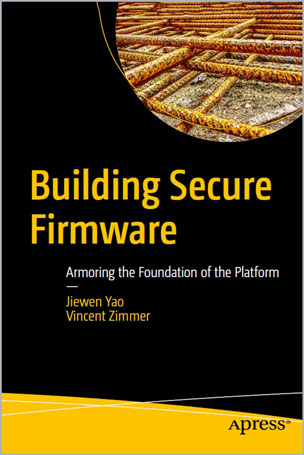
Armoring the Foundation of the Platform
Jiewen Yao, Vincent Zimmer
#Security
#Firmware
#Threat
#Protection
#OS
Use this book to build secure firmware.
As operating systems and hypervisors have become successively more hardened, malware has moved further down the stack and into firmware. Firmware represents the boundary between hardware and software, and given its persistence, mutability, and opaqueness to today’s antivirus scanning technology, it represents an interesting target for attackers.
As platforms are universally network-connected and can contain multiple devices with firmware, and a global supply chain feeds into platform firmware, assurance is critical for consumers, IT enterprises, and governments. This importance is highlighted by emergent requirements such as NIST SP800-193 for firmware resilience and NIST SP800-155 for firmware measurement.
This book covers the secure implementation of various aspects of firmware, including standards-based firmware―such as support of the Trusted Computing Group (TCG), Desktop Management Task Force (DMTF), and Unified Extensible Firmware Interface (UEFI) specifications―and also provides code samples and use cases. Beyond the standards, alternate firmware implementations such as ARM Trusted Firmware and other device firmware implementations (such as platform roots of trust), are covered.
What You Will Learn
Who This Book Is For
Given the complexity of modern platform boot requirements and the threat landscape, this book is relevant for readers spanning from IT decision makers to developers building firmware.
Table of Contents
Part I: Overview
Chapter 1: Introduction to Firmware
Chapter 2: Proactive Firmware Security Development
Part II: Security Architecture
Chapter 3: Firmware Resiliency: Protection
Chapter 4: Firmware Resiliency: Detection
Chapter 5: Firmware Resiliency: Recovery
Chapter 6: OS Resiliency
Chapter 7: Trusted Boot
Chapter 8: Device Security
Chapter 9: S3 Resume
Chapter 10: Access Control
Chapter 11: Configuration
Chapter 12: Security Model
Chapter 13: Virtual Firmware
Part Ill: Security Development
Chapter 14: Firmware Secure Coding Practice
Chapter 15: Compiler Defensive Technology
Chapter 16: The Kernel
Chapter 17: Trusted Execution Environment
Chapter 18: Silicon Secure Configuration
Chapter 19: Cryptography
Chapter 20: Programming Language
Part IV: Security Test
Chapter 21: Security Unit Test
Chapter 22: Security Validation and Penetration Test
Chapter 23: Maintenance
Jiewen Yao is a principal engineer in the Intel Architecture, Graphics, and Software Group. He has been engaged as a firmware developer for over 15 years. He is a member of the UEFI Security sub team, and the TCG PC Client sub working group. He has presented at industry events such as the Intel Developer Forum, UEFI Plugfest, and RSA conference. He worked with co-author Vincent Zimmer to publish 30 “A Tour Beyond BIOS” technical papers for tianocore.org and firmware.intel.com. He holds 40 US patents.
Vincent Zimmer is a senior principal engineer in the Intel Architecture, Graphics, and Software Group. He has been engaged as a firmware developer for over 25 years and leads the UEFI Security sub team. He has presented at industry events such as the Open Source Firmware Conference, Linux Fest Northwest, Intel Developer Forum, UEFI Plugfest, Open Compute Project Summit, BlackHat Las Vegas, BSides Seattle, Toorcon, and Cansecwest. In addition to collaborating with Jiewen Yao on many white papers, he has co-authored several books on firmware, papers, and over 400 issued US patents.