ثبت نام / ورود
0
ثبت نام / ورود
0
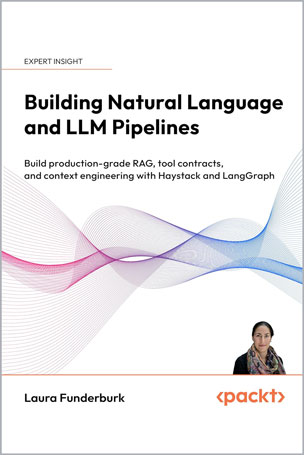
Build production-grade RAG, tool contracts, and context engineering with Haystack and LangGraph
Laura Funderburk
#Natural_Language
#LLM
#Pipelines
#RAG
#LangGraph
#Haystack
#AI
Stop LLM applications from breaking in production. Build deterministic pipelines, enforce strict tool contracts, engineer high-signal context for RAG, and orchestrate resilient multi-agent workflows using two foundational frameworks: Haystack for pipelines and LangGraph for low-level agent orchestration.
*
Modern LLM applications often break in production due to brittle pipelines, loose tool definitions, and noisy context. This book shows you how to build production-ready, context-aware systems using Haystack and LangGraph. You’ll learn to design deterministic pipelines with strict tool contracts and deploy them as microservices. Through structured context engineering, you’ll orchestrate reliable agent workflows and move beyond simple prompt-based interactions.
You'll start by understanding LLM behavior—tokens, embeddings, and transformer models—and see how prompt engineering has evolved into a full context engineering discipline. Then, you'll build retrieval-augmented generation (RAG) pipelines with retrievers, rankers, and custom components using Haystack’s graph-based architecture. You’ll also create knowledge graphs, synthesize unstructured data, and evaluate system behavior using Ragas and Weights & Biases. In LangGraph, you’ll orchestrate agents with supervisor-worker patterns, typed state machines, retries, fallbacks, and safety guardrails.
By the end of the book, you’ll have the skills to design scalable, testable LLM pipelines and multi-agent systems that remain robust as the AI ecosystem evolves.
11. Unlock Your Exclusive Benefits
LLM engineers, NLP developers, and data scientists looking to build production-grade pipelines, agentic workflows, or RAG systems. Ideal for tech leads looking to move beyond prototypes to scalable, testable solutions, as well as teams modernizing legacy NLP pipelines into orchestration-ready microservices. Proficiency in Python and familiarity with core NLP concepts are recommended.
Laura Funderburk is a leading figure in AI and data science, specializing in LLM applications, RAG systems, and agentic workflows. She serves as the developer relations and community lead at AI Makerspace, where she empowers engineers to build production-ready AI through open-source initiatives. With a background as a data scientist and DevOps engineer, Laura brings her skills as a Python developer into her work as an author. She holds a Bachelor of Mathematics from Simon Fraser University, where she was awarded the Terry Fox Gold Medal for courage in adversity. A dedicated mentor, Laura remains committed to teaching and outreach, helping the next generation of engineers master machine learning and AI operations.