ثبت نام / ورود
0
ثبت نام / ورود
0
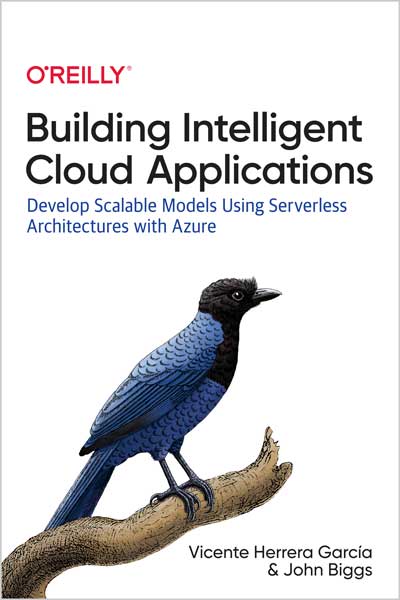
Develop Scalable Models Using Serverless Architectures with Azure
Vicente Herrera García, John Biggs
#Cloud
#Microsoft
#Azure
#Python
Serverless computing is radically changing the way we build and deploy applications. With cloud providers running servers and managing machine resources, companies now can focus solely on the application’s business logic and functionality. This hands-on book shows experienced programmers how to build and deploy scalable machine learning and deep learning models using serverless architectures with Microsoft Azure.
You’ll learn step-by-step how to code machine learning into your projects using Python and pretrained models that include tools such as image recognition, speech recognition, and classification. You’ll also examine issues around deployment and continuous delivery, including scaling, security, and monitoring.
This book is divided into three parts with application examples woven throughout:
Table of Contents
Part I. Cloud-Based Development
Chapter 1. Machine Learning and Deep Learning Models in the Cloud
Chapter 2. Funct ions-as-a-Service and Event- Driven Programming
Chapter 3. Serverless Application Programming Interfaces in Microsoft Azure
Part II. Adding Intelligence
Chapter 4. Getting Started with Microsoft Azure Funct ions
Chapter 5. Using Machine Learning and Deep Learning Models
Part Ill. Deployment and Continuous Delivery
Chapter 6. Deployment and Scaling
Chapter 7. Security
Chapter 8. Monitoring
The past few years have brought massive changes to the way we think about applications. As products scaled to a global level, developers worked hard to keep up, creating new paradigms that left behind the complex client–server systems that were then in place. The resulting systems are called serverless applications, and they will be the primary focus of this book.
Most applications require computing resources, databases, and hardware. The assumption behind a program in Django, for example, is that it will be deployed in an environment that is similar or superior to the environment in which it was coded. It’s also assumed that the program will be on all the time, using resources and running up a bill.
A serverless program is, in essence, a system that requires no infrastructure management, allowing the programmer to focus primarily on the business logic or functionality of the program. It is a bold change in the world of program design, and it’s becoming more and more popular.
To understand the implications of this model, you need to have an understanding of the basic ideas that underlie functional programming.
Intelligent Serverless Applications
There are many different meanings, often overlapping, attributed to the terms “artificial intelligence” and “machine learning.”
In this book, we concern ourselves with the ways in which we can use algorithms to find patterns hidden in large datasets—patterns that would be difficult or impossible for humans to detect without the help of computers. There are various ways in which we can set algorithms to adjust themselves to improve their performance upon each iteration. This is called machine learning.
Serverless applications and functional programming lend themselves perfectly to the exploration of these systems, and in this book you will learn how to build machine learning applications using a serverless architecture.
How This Book Is Organized
First, we should note that this book focuses on Azure, Microsoft’s cloud platform. The concepts we discuss here are universal, but our examples describe how to implement them in Azure.
Who This Book Is For
This book is for experienced programmers who would like to familiarize themselves with functional programming through the lens of machine learning. As we said, the book uses Microsoft’s Azure platform to build these systems, and it uses Python as the primary programming language.
Goals for the Book
When you are done with this book, we hope that you will be proficient in serverless programming in Azure as it relates to machine learning.
A seasoned Software Engineer, with solid experience in all facets of software and web development projects. Possess a Master’s Degree in Computer Science by University of Seville. Highly skilled in collaborating with all members of the organization and clients to achieve technical, business and financial objectives. Adept in streamlining processes, enhancing productivity levels, and introducing new emerging methodologies that enrich product development. Certified Scrum Master "Expert Level", he is a certification teacher and examiner at Scrum Manager, and also teaches software and web development, and project management subjects at Sevilla University and other private institutions.
John Biggs is an entrepreneur, consultant, writer, and maker. He spent fifteen years as an editor for Gizmodo, CrunchGear, and TechCrunch and has a deep background in hardware startups, 3D printing, and blockchain. His work has appeared in Men’s Health, Wired, and the New York Times. He runs the Technotopia podcast about a better future.
He has written five books including the best book on blogging, Bloggers Boot Camp, and a book about the most expensive timepiece ever made, Marie Antoinette’s Watch. He lives in Brooklyn, New York.