ثبت نام / ورود
0
ثبت نام / ورود
0
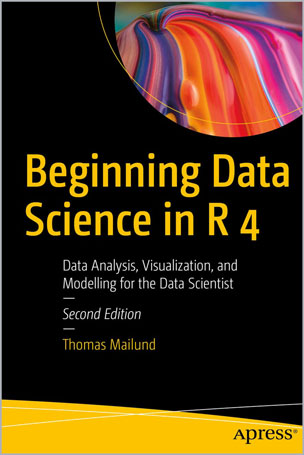
Data Analysis, Visualization, and Modelling for the Data Scientist
Thomas Mailund
#Data_Science
#R4
#Object-Oriented_Programming
#Data
Discover best practices for data analysis and software development in R and start on the path to becoming a fully-fledged data scientist. Updated for the R 4.0 release, this book teaches you techniques for both data manipulation and visualization and shows you the best way for developing new software packages for R.
Beginning Data Science in R 4, Second Edition details how data science is a combination of statistics, computational science, and machine learning. You’ll see how to efficiently structure and mine data to extract useful patterns and build mathematical models. This requires computational methods and programming, and R is an ideal programming language for this.
Modern data analysis requires computational skills and usually a minimum of programming. After reading and using this book, you'll have what you need to get started with R programming with data science applications. Source code will be available to support your next projects as well.
Source code is available at github.com/Apress/beg-data-science-r4.
What You Will Learn
Who This Book Is For
Those with some data science or analytics background, but not necessarily experience with the R programming language.
Table of Contents
Chapter 1: Introduction to R Programming
Chapter 2: Reproducible Analysis
Chapter 3: Data Manipulation
Chapter 4: Visualizing Data
Chapter 5: Working with Large Data Sets
Chapter 6: Supervised Learning
Chapter 7: Unsupervised Learning
Chapter 8: Project 1: Hitting the Bottle
Chapter 9: Deeper into R Programming
Chapter 10: Working with Vectors and Lists
Chapter 11: Functional Programming
Chapter 12: Object-Oriented Programming
Chapter 13: Building an R Package
Chapter 14: Testing and Package Checking
Chapter 15: Version Control
Chapter 16: Profiling and Optimizing
Chapter 17: Project 2: Bayesian Linear Regression
Thomas Mailund is an associate professor in bioinformatics at Aarhus University, Denmark. His background is in math and computer science but for the last decade his main focus has been on genetics and evolutionary studies, particularly comparative genomics, speciation, and gene flow between emerging species.