ثبت نام / ورود
0
ثبت نام / ورود
0
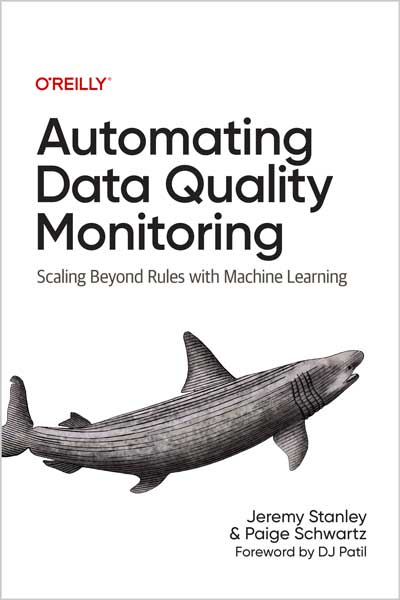
Scaling Beyond Rules with Machine Learning
Jeremy Stanley, Paige Schwartz
#Data
#Monitoring
#BI
#ML
The world's businesses ingest a combined 2.5 quintillion bytes of data every day. But how much of this vast amount of data--used to build products, power AI systems, and drive business decisions--is poor quality or just plain bad? This practical book shows you how to ensure that the data your organization relies on contains only high-quality records.
Most data engineers, data analysts, and data scientists genuinely care about data quality, but they often don't have the time, resources, or understanding to create a data quality monitoring solution that succeeds at scale. In this book, Jeremy Stanley and Paige Schwartz from Anomalo explain how you can use automated data quality monitoring to cover all your tables efficiently, proactively alert on every category of issue, and resolve problems immediately.
This book will help you:
Table of Contents
Chapter 1. The Data Quality Imperative
Chapter 2. Data Quality Monitoring Strategies and the Role of Automation
Chapter 3. Assessing the Business Impact of Automated Data Quality Monitoring
Chapter 4. Automating Data Quality Monitoring with Machine Learning
Chapter 5. Building a Model That Works on Real-World Data
Chapter 6. Implementing Notifications While Avoiding Alert Fatigue
Chapter 7. Integrating Monitoring with Data Tools and Systems
Chapter 8. Operating Your Solution at Scale
Who Should Use This Book
We’ve written this book with three main audiences in mind.
The first is the chief data and analytics officer (CDAO) or VP of data. As someone responsible for your organization’s data at the highest level, this entire book is for you—but you may be most interested in Chapters 1, 2, and 3, where we clearly explain why you should care about automating data quality monitoring at your organization and walk through how to assess the ROI of an automated data quality monitoring platform. Chapter 8 is also especially relevant, as it discusses how to track and improve data quality over time.
The second audience for this book is the head of data governance. In this or similar roles, you’re likely the person most directly accountable for managing data quality at your organization. While the entire book should be of great value to you, we believe that the chapters on automation, Chapters 1, 2, and 3, as well as Chapters 7 and 8 on integrations and operations, will be especially useful.
Our third audience is the data practitioner. Whether you’re a data scientist, analyst, or data engineer, your job depends on data quality, and the monitoring tools you use will have a significant impact on your day-to-day. Those building or operating a data quality monitoring platform should focus especially on Chapters 4 through 7, where we cover how to develop a model, design notifications, and integrate the platform with your data ecosystem.
Jeremy Stanley is co-founder and CTO at Anomalo. Prior to Anomalo, Jeremy was the VP of Data Science at Instacart, where he led machine learning and drove multiple initiatives to improve the company's profitability. Previously, he led data science and engineering at other hyper-growth companies like Sailthru. He's applied machine learning and AI technologies to everything from insurance and accounting to ad-tech and last-mile delivery logistics. He's also a recognized thought leader in the data science community with hugely popular blog posts like Deep Learning with Emojis (not Math). Jeremy holds a BS in Mathematics from Wichita State University and an MBA from Columbia University.
Paige Schwartz is a professional technical writer at Anomalo who has written for clients such as Airbnb, Grammarly, and OpenAI. She specializes in communicating complex software engineering topics to a general audience and has spent her career working with machine learning and data systems, including 5 years as a product manager on Google Search. She holds a joint BA in Computer Science and English from UC Berkeley.