ثبت نام / ورود
0
ثبت نام / ورود
0
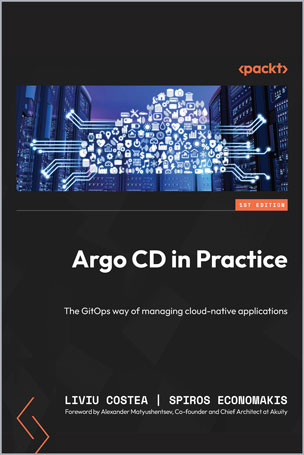
The GitOps way of managing cloud-native applications
Liviu Costea, Spiros Economakis
#GitOps
#Argo
#CD
#IaC
#Cloud-native
Build CD pipelines following GitOps principles like declarative and immutable changes stored in version control, all continuously reconciled by Argo CD, and minimize the failure of deployments.
GitOps follows the practices of infrastructure as code (IaC), allowing developers to use their day-to-day tools and practices such as source control and pull requests to manage apps. With this book, you'll understand how to apply GitOps bootstrap clusters in a repeatable manner, build CD pipelines for cloud-native apps running on Kubernetes, and minimize the failure of deployments.
You'll start by installing Argo CD in a cluster, setting up user access using single sign-on, performing declarative configuration changes, and enabling observability and disaster recovery. Once you have a production-ready setup of Argo CD, you'll explore how CD pipelines can be built using the pull method, how that increases security, and how the reconciliation process occurs when multi-cluster scenarios are involved. Next, you'll go through the common troubleshooting scenarios, from installation to day-to-day operations, and learn how performance can be improved. Later, you'll explore the tools that can be used to parse the YAML you write for deploying apps. You can then check if it is valid for new versions of Kubernetes, verify if it has any security or compliance misconfigurations, and that it follows the best practices for cloud-native apps running on Kubernetes.
By the end of this book, you'll be able to build a real-world CD pipeline using Argo CD.
If you're a software developer, DevOps engineer, or SRE who is responsible for building CD pipelines for projects running on Kubernetes and wants to advance in your career, this book is for you. Basic knowledge of Kubernetes, Helm, or Kustomize and CD pipelines will help you to get the most out of this book.
About the authors
Liviu Costea started as a developer in the early 2000s and his career path led him to different roles, from developer to coding architect, and from team lead to the Chief Technical Officer. In 2012, he transitioned to DevOps when, at a small company, someone had to start working on pipelines and automation because the traditional way wasn’t scalable anymore.
In 2018, he started with the platform team and then became the tech lead in the release team at Mambu, where they designed most of the Continuous Integration/Continuous Deployment (CI/CD) pipelines, adopting GitOps practices. They have been live with Argo CD since 2019. More recently, he joined Juni, a promising start-up, where they are planning GitOps adoption. For his contributions to OSS projects, including Argo CD, he was named a CNCF ambassador in August 2020.
Spiros Economakis started as a software engineer in 2010 and went through a series of jobs and roles, from software engineer and software architect to head of cloud. In 2013, he founded his own start-up, and that was his first encounter with DevOps culture. With a small team, he built a couple of CI/CD pipelines for a microservice architecture and mobile app releases. After this, with most of the companies he has been involved with, he has influenced DevOps culture and automation.
In 2019, he started as an SRE in Lenses (acquired by Celonis) and soon introduced the organization to Kubernetes, GitOps, and the cloud. He transitioned to a position as head of cloud, where he introduced GitOps across the whole company and used Argo CD to bootstrap K8s clusters and continuous delivery practices. Now, he works in an open source company called Mattermost as a senior engineering manager, where he transformed the old GitOps approach (fluxcd) to GitOps 2.0 with Argo CD and built a scalable architecture for multi-tenancy as the single GitOps platform in the company.