ثبت نام / ورود
0
ثبت نام / ورود
0
Max Kuhn, Kjell Johnson
#Applied_Predictive_Modeling
#R
#Data_mining
#Pattern_recognition
#Machine_learning
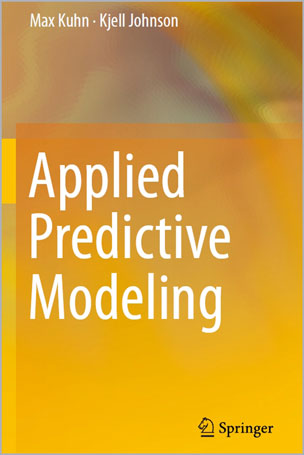
Applied Predictive Modeling covers the overall predictive modeling process, beginning with the crucial steps of data preprocessing, data splitting and foundations of model tuning. The text then provides intuitive explanations of numerous common and modern regression and classification techniques, always with an emphasis on illustrating and solving real data problems. The text illustrates all parts of the modeling process through many hands-on, real-life examples, and every chapter contains extensive R code for each step of the process.
This multi-purpose text can be used as an introduction to predictive models and the overall modeling process, a practitioner’s reference handbook, or as a text for advanced undergraduate or graduate level predictive modeling courses. To that end, each chapter contains problem sets to help solidify the covered concepts and uses data available in the book’s R package.
This text is intended for a broad audience as both an introduction to predictive models as well as a guide to applying them. Non-mathematical readers will appreciate the intuitive explanations of the techniques while an emphasis on problem-solving with real data across a wide variety of applications will aid practitioners who wish to extend their expertise. Readers should have knowledge of basic statistical ideas, such as correlation and linear regression analysis. While the text is biased against complex equations, a mathematical background is needed for advanced topics.
Table of Contents
I Introduction
Part I General Strategies
2 A Short Tour of the Predictive Modeling Process
3 Data Pre-processing
4 Over-Fitting and Model Tuning
Part II Regression Models
5 Measuring Performance in Regression Models
6 Linear Regression and Its Cousins
7 Nonlinear Regression Models
8 Regression Trees and Rule-Based Models
9 A Summary of Solubility Models
10 Case Study: Compressive Strength of ConcreteMixtures
Part Ill Classification Models
11 Measuring Performance in Classification Models
12 Discriminant Analysis and Other Linear Classification Models
13 Nonlinear Classification Models
14 Classification Trees and Rule-Based Models
15 A Summary of Grant Application Models
16 Remedies for Severe Class Imbalance
17 Case Study: Job Scheduling
Part IV Other Considerations
18 Measuring Predictor Importance
19 An Introduction to Feature Selection
20 Factors That Can Affect Model Performance
Appendix
A A Summary of Various Models
B An Introduction to R
C Interesting Web Sites
Max Kuhn is a Director of Non-Clinical Statistics at Pfizer Global R&D in Groton Connecticut. He has been applying predictive models in the pharmaceutical and diagnostic industries for over 15 years and is the author of a number of R packages.
Kjell Johnson has more than a decade of statistical consulting and predictive modeling experience in pharmaceutical research and development. He is a co-founder of Arbor Analytics, a firm specializing in predictive modeling and is a former Director of Statistics at Pfizer Global R&D. His scholarly work centers on the application and development of statistical methodology and learning algorithms.