ثبت نام / ورود
0
ثبت نام / ورود
0
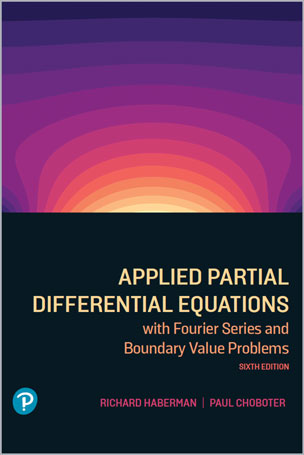
with Fourier Series and Boundary Value Problems
Richard Haberman, Paul Choboter
#Differential_Equations
#Heat_Equation
#Wave_Equations
#Nonlinearity
📐 معادلات دیفرانسیل جزئی کاربردی؛ پلی بین ریاضیات، فیزیک و مهندسی
📘 کتاب Applied Partial Differential Equations یک منبع کلاسیک و بسیار معتبر برای یادگیری PDEs هست؛ جایی که هم پایهی نظری قوی ساخته میشه و هم مهارت حل مسئله در مسائل واقعی فیزیک، مهندسی و ریاضیات کاربردی تقویت میشه.
🧠 رویکرد کتاب اینه که معادلات را صرفاً بهصورت فرمولهای انتزاعی ارائه نکنه، بلکه آنها را از مدلهای ساده فیزیکی مشتق کنه و سپس قدمبهقدم روشهای حل را توسعه بده.
⚙️ یکی از ویژگیهای مهم این کتاب اینه که نتایج ریاضی را در قالب interpretation فیزیکی توضیح میده؛ یعنی هر فرمول فقط ریاضی نیست، بلکه یک معنی واقعی در دنیای فیزیک یا مهندسی داره.
📊 موضوعاتی مثل سری فوریه، توابع متعامد، مسائل مقدار مرزی، توابع گرین و روشهای تبدیل، ستونهای اصلی این کتاب هستن.
🧩 در این کتاب چه چیزهایی یاد میگیری؟
🌡️ حل معادله حرارت (Heat Equation) و مدلسازی انتشار گرما
🎻 تحلیل معادله موج و ارتعاش سیمها و صفحات
📊 سری فوریه و توابع متعامد برای نمایش سیگنالها
🧠 مسائل مقدار ویژه و Sturm–Liouville Problems
⚙️ روشهای عددی مثل Finite Difference Methods
🌍 معادلات دیفرانسیل در ابعاد بالاتر
📡 توابع گرین برای مسائل وابسته به زمان و مکان
🔄 روش تبدیل فوریه و لاپلاس برای حل PDEها
🌊 موجهای پراکنده، پایداری و رفتار غیرخطی سیستمها
📚 فهرست مطالب
💡 ویژگیهای مهم نسخه ششم
📌 حدود ۵۷ تمرین جدید یا بهروزشده برای تقویت درک مفهومی
📌 بازنگری دقیق در روش Separation of Variables
📌 تمرینهای سطح پایه تا پیشرفته برای یادگیری مرحلهای
📌 افزودن ۱۸ برنامه MATLAB برای شبیهسازی و درک بهتر مفاهیم
🧪 این برنامههای MATLAB فقط برای محاسبه نیستن؛ بلکه برای visualization و درک شهودی طراحی شدن.
📉 مثلاً برخی از آنها تفاوت بین phase speed و group speed را در موجها بهصورت دینامیک نمایش میدن، که درک مفاهیم موج را خیلی عمیقتر میکنه.
👨🏫 درباره نویسنده
🧠 «ریچارد هابرمن» استاد ریاضیات در Southern Methodist University هست و سابقه تدریس در دانشگاههایی مثل Ohio State، Rutgers و UC San Diego را داره.
🎓 او مدرک دکتری خود را از MIT در ریاضیات کاربردی گرفته و در حوزههایی مثل موجهای غیرخطی، دینامیک غیرخطی، آشوب و مدلسازی ریاضی فعالیت کرده.
📊 تحقیقات او شامل موضوعاتی مثل solitons، shock waves، bifurcations و مدلهای فیزیکی در مکانیک سیالات و فیبر نوری است.
🧠 این ترکیب از ریاضیات پیشرفته و کاربردهای فیزیکی باعث شده کتاب او یکی از منابع استاندارد در آموزش PDE در سطح دانشگاهی باشد.
This well-known text helps you develop a foundation in essential theory along with problem-solving skills. Applied Partial Differential Equations discusses partial differential equations of applied mathematics, the physical sciences, and engineering. Equations are motivated and derived with simple models; solution techniques are developed patiently, and mathematical results are frequently given physical interpretations. Coverage includes Fourier series, orthogonal functions, boundary value problems, Green's functions, and transform methods. It is ideal for students in science, engineering, and applied mathematics.
The 6th Edition has been updated and clarified throughout while maintaining its hallmark style and tone. It offers approximately 57 new or updated exercises, substantially revises coverage on Method of Separation of Variables, and more.
This edition includes 57 new or edited exercises. Some of the exercises are introduced at a foundational level, intended to give the students a concrete example of the ideas discussed, and some are more advanced. For example, in Chapter 11 where Green’s functions for the wave equation are discussed, one particularly novel exercise (supported by a similar new in-text example) has students work through an application of Green’s functions to derive the classic change of observed frequency due to motion relative to the source, known as the Doppler effect.
Perhaps the most exciting new feature is the addition of 18 MATLAB programs, available for download. Some of these routines animate certain static figures found in the printed text. Some demonstrate numerical solution techniques of the partial differential equations. Most are designed for students (and teachers!) to dig in and play around with parameters to get a deeper intuition for how the solutions respond. For instance, one program dynamically illustrates the difference between the phase speed and the group speed of the superposition of several waves of similar wavelengths.
Table of Contents
1 Heat Equation
2 Method of Separation of Variables
3 Fourier Series
4 Wave Equation: Vibrating Strings and Membranes
5 Sturm- Liouville Eigenvalue Problems
6 Finite Difference Numerical Methods for Partial Differential Equations
7 Higher-Dimensional Partial Differential Equations
8 Nonhomogeneous Problems
9 Green's Functions for Time-Independent Problems
10 Infinite Domain Problems: Fourier Transform Solutions of Partial Differential Equations
11 Green's Functions for Wave and Heat Equations
12 The Method of Characteristics for Linear and Quasilinear Wave Equations
13 Laplace Transform Solution of Partial Differential Equations
14 Dispersive Waves: Slow Variations, Stability, Nonlinearity, and Perturbation Methods
Richard Haberman is Professor of Mathematics at Southern Methodist University, having previously taught at The Ohio State University, Rutgers University, and the University of California at San Diego. He received S.B. and Ph.D. degrees in applied mathematics from the Massachusetts Institute of Technology. He has supervised six Ph.D. students at SMU. His research has been funded by NSF and AFOSR. His research in applied mathematics has been published in prestigious international journals and include research on nonlinear wave motion (shocks, solitons, dispersive waves, caustics), nonlinear dynamical systems (bifurcations, homoclinic transitions, chaos), singular perturbation methods (partial differential equations, matched asymptotic expansions, boundary layers) and mathematical models (fluid dynamics, fiber optics). He is a member of the Society for Industrial and Applied Mathematics and the American Mathematical Society. He has taught a wide range of undergraduate and graduate mathematics. He has published undergraduate texts on Mathematical Models (Mechanical Vibrations, Population Dynamics, and Traffic Flow) and Ordinary Differential Equations.