ثبت نام / ورود
0
ثبت نام / ورود
0
#Ansible
#Up_and_Running
#DevOps
#CI/CD
#Windows
#Linux
#Network
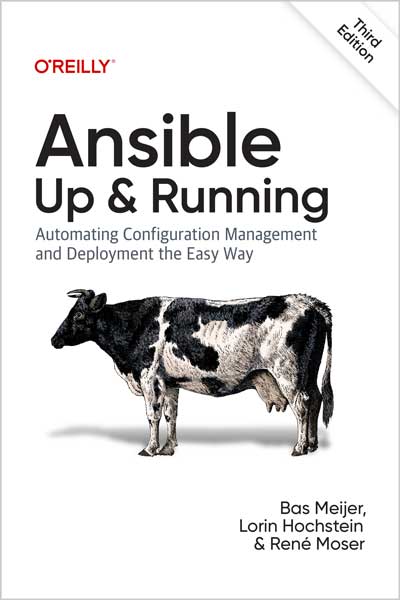
Among the many configuration management tools available, Ansible has some distinct advantages: It's minimal in nature. You don't need to install agents on your nodes. And there's an easy learning curve. With this updated third edition, you'll quickly learn how to be productive with Ansible whether you're a developer deploying code or a system administrator looking for a better automation solution.
Authors Bas Meijer, Lorin Hochstein, and Rene Moser show you how to write playbooks (Ansible's configuration management scripts), manage remote servers, and explore the tool's real power: built-in declarative modules. You'll learn how Ansible has all the functionality you need--and the simplicity you desire.
Since the second edition of this book was published in 2017, there have been tremendous changes in the world of Ansible and Python, including several major releases. Substantial changes happened outside the project as well: for example, Red Hat, the company that backs the Ansible project, was bought by IBM. That hasn’t slowed the Ansible project at all, of course: it’s still in active development and gaining users. The development of cloud infrastructure and containers has also changed the landscape immensely.
We’ve made multiple changes in this edition, most significantly adding six new chapters that cover containers, Molecule, Ansible collections, creating images, cloud infrastructure, and CI/CD. We’ve also added much more detail to other chapters, with a focus on using software engineering best practices and test frameworks to validate code and eradicate guesswork.
We’ve updated all the example code for compatibility with the latest Ansible, as well as everything that addresses Python dependencies. Our material was written to reflect the significant changes between 2017 and 2022. We could go on, but we hope you’ll dive into the text, try the code, and discover for yourself just how much Ansible continues to advance.
Review
I enjoyed reading the book. The hands-on examples with code, real-life applications, humorous comments and general writing flow have made it a pleasant read. The book has a high educational value which I experienced at first hand as someone that's been working with Ansible for only 7 months. The last chapters have been a great addition for the different applications that Ansible can be used for/with. Kudos to you, Bas!
-- Marek Vette
Software Engineer
Loved reading it, even learned some new things :-)
-- Ton Kersten
Ansible Trainer
"Bas Meijer has taken the work Lorin Hochstein and René Moser began and modernized the content for this third edition, adding to what was already a very good book. Whether you are a beginner, an intermediate, or an advanced Ansible user, this is a book you'll want to read."
-- Jan Piet Mens
About the Author
Bas Meijer is a freelance software engineer and devops coach. With a major from the University of Amsterdam, he has been pioneering open source since the early nineties. He worked in internet hosting, web development, high-frequency trading, banking, cloud security, aviation, high-tech, insurance, and government. Bas has been an Ansible Ambassador since 2014 and a HashiCorp Ambassador in 2021.
Lorin Hochstein is a senior software engineer on the Chaos Team at Netflix, where he works on ensuring that Netflix remains available. He is a coauthor of the OpenStack Operations Guide (O'Reilly), as well as numerous academic publications.
René Moser lives in Switzerland with his wife and three kids, likes simple things that work and scale, and has earned an Advanced Diploma of Higher Education in IT. He has been engaged in the open source community for the past 15 years, most recently working as an ASF CloudStack Committer and as the author of the Ansible CloudStack integration with over 30 CloudStack modules. He became an Ansible Community Core Member in April 2016 and is currently a senior system engineer at SwissTXT.