ثبت نام / ورود
0
ثبت نام / ورود
0
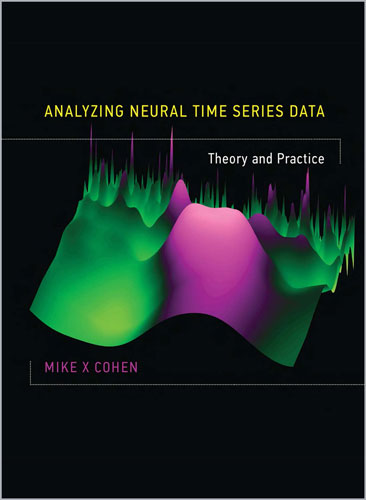
Theory and Practice
Mike X Cohen
#Neural
#Mathematics
#Neuroscientists
#Psychologists
A comprehensive guide to the conceptual, mathematical, and implementational aspects of analyzing electrical brain signals, including data from MEG, EEG, and LFP recordings.
This book offers a comprehensive guide to the theory and practice of analyzing electrical brain signals. It explains the conceptual, mathematical, and implementational (via Matlab programming) aspects of time-, time-frequency- and synchronization-based analyses of magnetoencephalography (MEG), electroencephalography (EEG), and local field potential (LFP) recordings from humans and nonhuman animals. It is the only book on the topic that covers both the theoretical background and the implementation in language that can be understood by readers without extensive formal training in mathematics, including cognitive scientists, neuroscientists, and psychologists.
Readers who go through the book chapter by chapter and implement the examples in Matlab will develop an understanding of why and how analyses are performed, how to interpret results, what the methodological issues are, and how to perform single-subject-level and group-level analyses. Researchers who are familiar with using automated programs to perform advanced analyses will learn what happens when they click the “analyze now” button.
The book provides sample data and downloadable Matlab code. Each of the 38 chapters covers one analysis topic, and these topics progress from simple to advanced. Most chapters conclude with exercises that further develop the material covered in the chapter. Many of the methods presented (including convolution, the Fourier transform, and Euler's formula) are fundamental and form the groundwork for other advanced data analysis methods. Readers who master the methods in the book will be well prepared to learn other approaches.
Part I: Introduction 1
1 The Purpose of This Book, Who Should Read It, and How to Use It
2 Advantages and Limitations of Time- and Time-Frequency-Domain Analyses
3 Interpreting and Asking Questions about Time-Frequency Results
4 Introduction to Matlab Programming
5 Introduction to the Physiological Bases of EEG
6 Practicalities of EEG Measurement and Experiment Design
Part II: Preprocessing and Time-Domain Analyses
7 Preprocessing Steps Necessary and Useful for Advanced Data Analysis
8 EEG Artifacts: Their Detection, Influence, and Removal
9 Overview of Time-Domain EEG Analyses
Part III: Frequency and Time-Frequency Domains Analyses
10 The Dot Product and Convolution
11 The Discrete Time Fourier Transform, the FFT, and the Convolution Theorem
12 Morlet Wavelets and Wavelet Convolution
13 Complex Morlet Wavelets and Extracting Power and Phase
14 Bandpass Filtering and the Hilbert Transform
15 Short-Time FFT
16 Multitapers
17 Less Commonly Used Time-Frequency Decomposition Methods
18 Time-Frequency Power and Baseline Normalizations
19 Intertrial Phase Clustering
20 Differences among Total, Phase-Locked, and Non-Phase-Locked Power and Intertrial Phase Consistency
21 Interpretations and Limitations of Time-Frequency Power and ITPC Analyses
Part IV: Spatial Filters
22 Surface Laplacian
23 Principal Components Analysis
24 Basics of Single-Dipole and Distributed-Source Imaging
Part V: Connectivity
25 Introduction to the Various Connectivity Analyses
26 Phase-Based Connectivity
27 Power-Based Connectivity
28 Granger Prediction
29 Mutual Information
30 Cross-Frequency Coupling
31 Graph Theory
Part VI: Statistical Analyses
32 Advantages and Limitations of Different Statistical Procedures
33 Nonparametric Permutation Testing
34 Within-Subject Statistical Analyses
35 Group-Level Analyses
36 Recommendations for Reporting Results in Figures, Tables, and Text
Part VII: Conclusions and Future Directions
37 Recurring Themes in This Book and Some Personal Advice
38 The Future of Cognitive Electrophysiology
Mike X Cohen is Assistant Professor in the Donders Institute for Brain, Cognition, and Behavior at the Radboud University and University Medical Center, Nijmegan, the Netherlands. He is the author of Analyzing Neural Time Series Data: Theory and Practice (MIT Press).