ثبت نام / ورود
0
ثبت نام / ورود
0
Loring W. Tu
#Manifolds
#topology
#algebra
#cohomology
#classical_mechanics
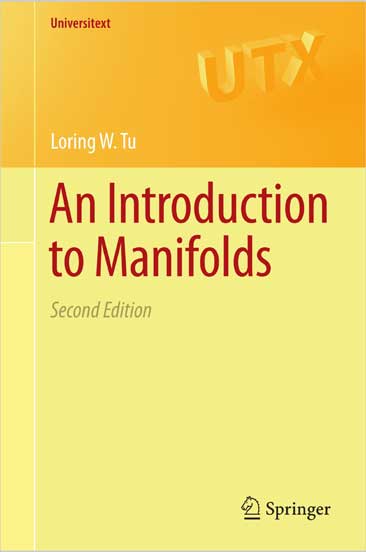
Manifolds, the higher-dimensional analogs of smooth curves and surfaces, are fundamental objects in modern mathematics. Combining aspects of algebra, topology, and analysis, manifolds have also been applied to classical mechanics, general relativity, and quantum field theory.
In this streamlined introduction to the subject, the theory of manifolds is presented with the aim of helping the reader achieve a rapid mastery of the essential topics. By the end of the book the reader should be able to compute, at least for simple spaces, one of the most basic topological invariants of a manifold, its de Rham cohomology. Along the way, the reader acquires the knowledge and skills necessary for further study of geometry and topology. The requisite point-set topology is included in an appendix of twenty pages; other appendices review facts from real analysis and linear algebra. Hints and solutions are provided to many of the exercises and problems.
This work may be used as the text for a one-semester graduate or advanced undergraduate course, as well as by students engaged in self-study. Requiring only minimal undergraduate prerequisites, 'Introduction to Manifolds' is also an excellent foundation for Springer's GTM 82, 'Differential Forms in Algebraic Topology'.
Contents
Chapter 1: Euclidean Spaces
Chapter 2: Manifolds
Chapter 3: The Tangent Space
Chapter 4: Lie Groups and Lie Algebras
Chapter 5: Differential Forms
Chapter 6: Integration
Chapter 7: De Rham Theory
From the reviews of the second edition:
“An excellent introduction to both point-set and algebraic topology at the early-graduate level, using manifolds as a primary source of examples and motivation. … The author has … fulfilled his objective of integrating a study of manifolds into an introductory course in general and algebraic topology. This text is well-organized and clearly written, with a good blend of motivational discussion and mathematical rigor. … Any student who has gone through this book should be well-prepared to pursue the study of differential geometry … .” (Mark Hunacek, The Mathematical Association of America, March, 2011)
“This book is designed for first year graduate students as an introduction to the topology of manifolds. … The book can be read with advantage by any graduate student with a good undergraduate background, and indeed by many upper class undergraduates. It can be used for self study or as a text book for a fine geometrically flavored introduction to manifolds. One which provides excellent motivation for studying the machinery needed for more advanced work.” (Jonathan Hodgson, Zentralblatt MATH, Vol. 1209, 2011)
John M. Lee is a professor of mathematics at the University of Washington. His previous Springer textbooks in the Graduate Texts in Mathematics series include the first edition of Introduction to Topological Manifolds, Introduction to Smooth Manifolds, and Riemannian Manifolds: An Introduction.