ثبت نام / ورود
0
ثبت نام / ورود
0
Martin J. Osborne
#Game_Theory
#Equilibrium
#Mathematics
#Prisoner’s_Dilemma
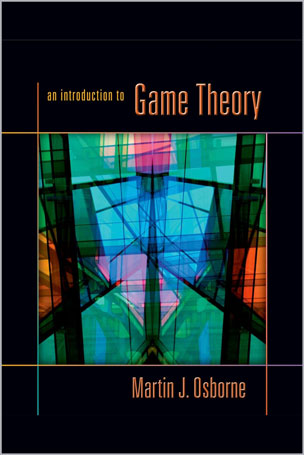
Game theoretic reasoning pervades economic theory and is used widely in other social and behavioral sciences. An Introduction to Game Theory, by Martin J. Osborne, presents the main principles of game theory and shows how they can be used to understand economic, social, political, and biological phenomena. The book introduces in an accessible manner the main ideas behind the theory rather than their mathematical expression. All concepts are defined precisely, and logical reasoning is used throughout. The book requires an understanding of basic mathematics but assumes no specific knowledge of economics, political science, or other social or behavioral sciences.
Coverage includes the fundamental concepts of strategic games, extensive games with perfect information, and coalitional games; the more advanced subjects of Bayesian games and extensive games with imperfect information; and the topics of repeated games, bargaining theory, evolutionary equilibrium, rationalizability, and maxminimization. The book offers a wide variety of illustrations from the social and behavioral sciences and more than 280 exercises. Each topic features examples that highlight theoretical points and illustrations that demonstrate how the theory may be used. Explaining the key concepts of game theory as simply as possible while maintaining complete precision, An Introduction to Game Theory is ideal for undergraduate and introductory graduate courses in game theory.
Table of Contents
1 Introduction
I Games with Perfect Information
2 Nash Equilibrium: Theory
3 Nash Equilibrium: Illustrations
4 Mixed Strategy Equilibrium
5 Extensive Games with Perfect Information: Theory
6 Extensive Games with Perfect Information: Illustrations
7 Extensive Games with Perfect Information: Extensions and Discussion
8 Coalitional Games and the Core
II Games with Imperfect Information
9 Bayesian Games
10 Extensive games with imperfect information
III Variants and Extensions
11 Strictly Competitive Games and Maxminimization
12 Rationalizability
13 Evolutionary Equilibrium
14 Repeated games: The Prisoner’s Dilemma
15 Repeated games: General Results
16 Bargaining
17 Appendix: Mathematics